



 Chat with AI
Exam 13: Observing Patterns in Inherited Traits

Exam 1: Invitation to Biology80 Questions
Exam 2: Lifes Chemical Basis53 Questions
Exam 3: Molecules of Life62 Questions
Exam 4: Cell Structure and Function80 Questions
Exam 5: Ground Rules of Metabolism58 Questions
Exam 6: Where It Startsphotosynthesis57 Questions
Exam 7: How Cells Release Chemical Energy60 Questions
Exam 8: Dna Structure and Function60 Questions
Exam 9: From Dna to Protein64 Questions
Exam 10: Gene Control64 Questions
Exam 11: How Cells Reproduce77 Questions
Exam 12: Meiosis and Sexual Reproduction58 Questions
Exam 13: Observing Patterns in Inherited Traits97 Questions
Exam 14: Chromosomes and Human Inheritance74 Questions
Exam 15: Studying and Manipulating Genomes57 Questions
Exam 16: Evidence of Evolution53 Questions
Exam 17: Processes of Evolution72 Questions
Exam 18: Organizing Information About Species46 Questions
Exam 19: Lifes Origin and Early Evolution60 Questions
Exam 20: Viruses and Prokaryotes56 Questions
Exam 21: Protiststhe Simplest Eukaryotes61 Questions
Exam 22: The Land Plants66 Questions
Exam 23: Fungi52 Questions
Exam 24: Animal Evolutionthe Invertebrates74 Questions
Exam 25: Animal Evolutionthe Chordates71 Questions
Exam 26: Animal Evolutionhuman Evolution51 Questions
Exam 27: Plant Tissues79 Questions
Exam 28: Plant Nutrition and Transport68 Questions
Exam 29: Life Cycles of Flowering Plants88 Questions
Exam 30: Communication Strategies in Plants72 Questions
Exam 31: Animal Tissues and Organ Systems77 Questions
Exam 32: Neural Control96 Questions
Exam 33: Sensory Perception71 Questions
Exam 34: Endocrine Control91 Questions
Exam 35: Structural Support and Movement72 Questions
Exam 36: Circulation58 Questions
Exam 37: Immunity73 Questions
Exam 38: Respiration78 Questions
Exam 39: Digestion and Nutrition98 Questions
Exam 40: Maintaining the Internal Environment73 Questions
Exam 41: Animal Reproductive Systems105 Questions
Exam 42: Animal Development69 Questions
Exam 43: Animal Behavior74 Questions
Exam 44: Population Ecology59 Questions
Exam 45: Community Ecology71 Questions
Exam 46: Ecosystems63 Questions
Exam 47: The Biosphere72 Questions
Exam 48: Human Impacts on the Biosphere62 Questions
Select questions type


In poultry, rose comb is controlled by a dominant allele, and its recessive allele controls single comb.
(a)
Give the genotype and phenotype produced from crossing a pure-breeding rose comb chicken with a pure-breeding single comb chicken.
(b)
Give the results of the backcross of the F1 hybrid with both pure-breeding parents.
(Essay)
4.7/5  (73)
(73) MATCHING
Classification.Answer the following questions using the group of answers below.
a.4
b.6
c.8
d.12
e.24
-In a dihybrid cross between a parent that is a double heterozygote (Aa Bb) and a parent that is homozygous recessive for one gene and heterozygous for the other (aa Bb), how many unique phenotypes potentially will be present in their offspring?
(Essay)
4.9/5 (91)
(91) In the garden pea, Mendel found that tall (D) green pods (G) and inflated pods (C) were dominant to their alleles, dwarf (d) yellow pods (g) and constricted pods (c).Given the following genotypes, determine the chances of producing the offspring shown.
(a)
DD Gg Cc * Dd Gg cc DD gg Cc
(b)
DD Gg Cc* Dd Gg Cc tall green pod, constricted pod
(c)
Dd Gg Cc * Dd GG cc tall green pod, inflated pod
(d)
Dd Gg Cc * Dd Gg Cc D__ G__ cc
(e)
Dd Gg Cc * Dd gg CC D__ G__ C__
(f)
Dd gg cc * DD Gg cc F tall green pod, inflated pod
(g)
Dd Gg Cc * Dd Gg Cc Dd Gg Cc
(h)
Dd Gg Cc *Dd Gg Cc dd gg cc
(Essay)
4.9/5 (75)
(75) In ____, a pair of nonidentical alleles affecting two phenotypes for a given trait are both expressed at the same time in heterozygotes.
(Multiple Choice)
4.9/5 (98)
(98) Which of the following does not stimulate the production of males in water fleas?
(Multiple Choice)
4.7/5 (74)
(74) In tomatoes, red (R) is dominant to yellow (r), tall (D) is dominant to dwarf (d), and smooth (H) is dominant to peach or hairy (h).
(a)
How many different genotypes are there in relationship to these three characteristics?
(b)
How many different phenotypes are there in relationship to these three characteristics?
(c)
How many different homozygous pure-breeding forms can be produced?
(Essay)
4.7/5 (85)
(85) In the classic argument of 'nature vs.nurture', nature would most correspond with:
(Multiple Choice)
4.9/5 (91)
(91) There are three alleles controlling the ABO blood types.IA and IB are codominant genes so that the combination IAIB produces the AB blood type.The third allele, IO, is recessive to the other two alleles.Indicate which of these parents could produce the given child:
Parents
Child
Yes or No
(a)
A * AB
B
(b)
A * O
A
(c)
A * B
O
(d)
A * AB
O
(e)
A * AB
B
(f)
B * B
O
(g)
AB * AB
A
(Essay)
5.0/5 (76)
(76) If 2 spot (S) is dominant to 4 spot (s), give the genotypes for the parents in the following crosses:
(a)
2 spot * 2 spot yields 2 spot and 4 spot
(b)
2 spot * 4 spot yields only 2 spot
(c)
2 spot * 4 spot yields 2 spot and 4 spot
(d)
2 spot * 2 spot yields only 2 spot
(e)
4 spot *4 spot yields only 4 spot
(Essay)
4.8/5 (70)
(70) In a certain plant, when individuals with blue flowers are crossed with individuals with blue flowers, only blue flowers are produced.Plants with red flowers crossed with plants with red flowers sometimes produce only red flowers, although other times they produce either red or blue flowers.When plants with red flowers are crossed with plants with blue flowers, sometimes only red flowers are produced; other times either red or blue flowers are produced.Which gene is dominant?
(Essay)
4.8/5 (82)
(82) In garden peas, one pair of alleles controls the height of the plant, and a second pair of alleles controls flower color.The allele for tall (D) is dominant to the allele for dwarf (d), and the allele for purple (P) is dominant to the allele for white (p).A tall plant with purple flowers crossed with a dwarf plant with white flowers produces 1/2 tall with purple flowers and 1/2 tall with white flowers.What is the genotype of the parents?
(Essay)
4.7/5 (69)
(69) MATCHING
Classification.Answer the following questions using the group of answers below.
a.4
b.6
c.8
d.12
e.24
-In a dihybrid cross between a parent that is a double heterozygote (Aa Bb) and a parent that is homozygous dominant for one gene and heterozygous for the other (AA Bb), how many unique genotypes potentially will be present in their offspring?
(Essay)
4.9/5 (84)
(84) The offspring of a cross between two individuals that breed true for different forms of a trait are __________.
(Essay)
4.8/5 (73)
(73) Congenital deafness in humans is due to the homozygous condition of either of the recessive genes d or e, or both of these genes.Both dominant D and E are necessary for normal hearing.Gene D/d affects the middle ear, while gene E/e affects the inner ear.It does not matter how good the normal inner ear (as indicated by E__) is; if there is something wrong in the middle ear, the individual is unable to hear.The same applies for the other gene.Give the phenotypic results of the following crosses:
(a)
Dd EE * Dd EE
(b)
Dd Ee *Dd Ee
(c)
dd EE * DD ee
(d)
Dd EE *Dd ee
(e)
Dd EE * DD Ee
(Essay)
4.8/5 (62)
(62) The role of environmental factors on gene expression is illustrated by
(Multiple Choice)
4.7/5 (96)
(96) In horses, there are four alleles at the A locus.Arranged in dominance sequence they are:
A (wild), ab (bay), ac (brown), ad (black)
If you bred several bay mares whose sires were brown to a brown stallion whose sire was black, what are the genotypes of the parents; what type of offspring would be produced; and in what proportion?
(Essay)
4.9/5 (75)
(75) 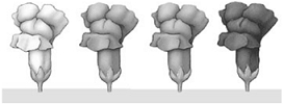 -The F2 phenotypic ratio of 9:3:4 is a result of a cross involving
 (Multiple Choice)
4.8/5 (82)
(82) 
Filters
- Essay(0)
- Multiple Choice(0)
- Short Answer(0)
- True False(0)
- Matching(0)