



 Chat with AI
Exam 46: Ecosystems

Exam 1: Invitation to Biology80 Questions
Exam 2: Lifes Chemical Basis53 Questions
Exam 3: Molecules of Life62 Questions
Exam 4: Cell Structure and Function80 Questions
Exam 5: Ground Rules of Metabolism58 Questions
Exam 6: Where It Startsphotosynthesis57 Questions
Exam 7: How Cells Release Chemical Energy60 Questions
Exam 8: Dna Structure and Function60 Questions
Exam 9: From Dna to Protein64 Questions
Exam 10: Gene Control64 Questions
Exam 11: How Cells Reproduce77 Questions
Exam 12: Meiosis and Sexual Reproduction58 Questions
Exam 13: Observing Patterns in Inherited Traits97 Questions
Exam 14: Chromosomes and Human Inheritance74 Questions
Exam 15: Studying and Manipulating Genomes57 Questions
Exam 16: Evidence of Evolution53 Questions
Exam 17: Processes of Evolution72 Questions
Exam 18: Organizing Information About Species46 Questions
Exam 19: Lifes Origin and Early Evolution60 Questions
Exam 20: Viruses and Prokaryotes56 Questions
Exam 21: Protiststhe Simplest Eukaryotes61 Questions
Exam 22: The Land Plants66 Questions
Exam 23: Fungi52 Questions
Exam 24: Animal Evolutionthe Invertebrates74 Questions
Exam 25: Animal Evolutionthe Chordates71 Questions
Exam 26: Animal Evolutionhuman Evolution51 Questions
Exam 27: Plant Tissues79 Questions
Exam 28: Plant Nutrition and Transport68 Questions
Exam 29: Life Cycles of Flowering Plants88 Questions
Exam 30: Communication Strategies in Plants72 Questions
Exam 31: Animal Tissues and Organ Systems77 Questions
Exam 32: Neural Control96 Questions
Exam 33: Sensory Perception71 Questions
Exam 34: Endocrine Control91 Questions
Exam 35: Structural Support and Movement72 Questions
Exam 36: Circulation58 Questions
Exam 37: Immunity73 Questions
Exam 38: Respiration78 Questions
Exam 39: Digestion and Nutrition98 Questions
Exam 40: Maintaining the Internal Environment73 Questions
Exam 41: Animal Reproductive Systems105 Questions
Exam 42: Animal Development69 Questions
Exam 43: Animal Behavior74 Questions
Exam 44: Population Ecology59 Questions
Exam 45: Community Ecology71 Questions
Exam 46: Ecosystems63 Questions
Exam 47: The Biosphere72 Questions
Exam 48: Human Impacts on the Biosphere62 Questions
Select questions type


Each tier of the biomass pyramid depicts the ____ of all the organisms in an ecosystem.

Free
(Multiple Choice)
4.7/5  (98)
(98) Correct Answer: Verified
C
Gross primary productivity refers to the total
Free
(Multiple Choice)
4.8/5 (83)
(83) Correct Answer:Verified
VerifiedC
Classification.Respond to the following statements with reference to the four steps of the nitrogen cycles listed below.
a.nitrogen fixation
b.nitrification
c.denitrification
d.ammonification
-__________ refers to nutrient enrichment of any ecosystem that is otherwise low in nutrients.
Free
(Essay)
5.0/5 (71)
(71) Correct Answer:Verified
VerifiedEutrophication
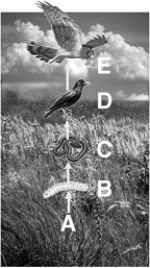 The following questions refer to the figure above illustrating a tallgrass prairie food chain.
-The most amount of energy is available to
The following questions refer to the figure above illustrating a tallgrass prairie food chain.
-The most amount of energy is available to (Multiple Choice)
4.7/5 (71)
(71) MATCHING
Matching.Choose the one most appropriate answer for each.
a.rate at which energy becomes stored in organic compounds through photosynthesis
b.total amount of solar energy stored in organic compounds during photosynthesis
c.a straight-line sequence of steps by which chemical bond energy moves to higher trophic levels
d.the potential chemical energy remaining (after aerobic respiration by autotrophs) that can be passed on to other trophic levels
e.DDT in the environment
f.a kind of plant that increases soil nitrogen content
g.particles of organic waste products, dead, or partly decomposed tissues
-food chain
(Essay)
4.8/5 (80)
(80) Classification.Respond to the following statements with reference to the four steps of the nitrogen cycles listed below.
a.nitrogen fixation
b.nitrification
c.denitrification
d.ammonification
-In a __________, water or some nutrient moves from an environmental reservoir, through organisms, then back to the environment.
(Essay)
4.9/5 (74)
(74) Which gas is increasing in the atmosphere and intensifying the greenhouse effect?
(Multiple Choice)
4.9/5 (81)
(81) Most of the carbon now present in the earth's atmosphere will eventually end up in what two reservoirs?
(Multiple Choice)
5.0/5 (85)
(85) Like ____, phosphorus can only be taken up by plants in ____.
(Multiple Choice)
4.8/5 (78)
(78) Classification.Respond to the following statements with reference to the four steps of the nitrogen cycles listed below.
a.nitrogen fixation
b.nitrification
c.denitrification
d.ammonification
-The conversion of gaseous nitrogen first to ammonia and then to other nitrogenous compounds involves this.
(Essay)
4.9/5 (76)
(76) Classification.Respond to the following statements with reference to the five trophic categories listed below.
a.producer
b.primary consumer
c.secondary consumer
d.tertiary consumer
e.decomposer
-Most fungi function as this.
(Essay)
4.8/5 (59)
(59) Classification.Respond to the following statements with reference to the four steps of the nitrogen cycles listed below.
a.nitrogen fixation
b.nitrification
c.denitrification
d.ammonification
-A __________ is an area where all precipitation drains into a specific waterway.
(Essay)
4.8/5 (85)
(85) Which of the following are in order from primary producer to 4th trophic level?
(Multiple Choice)
4.8/5 (82)
(82) A network of interactions that involves the cycling of materials and the flow of energy among organisms and their physical environment is
(Multiple Choice)
4.8/5 (78)
(78) MATCHING
Matching.Choose the one most appropriate answer for each.
a.rate at which energy becomes stored in organic compounds through photosynthesis
b.total amount of solar energy stored in organic compounds during photosynthesis
c.a straight-line sequence of steps by which chemical bond energy moves to higher trophic levels
d.the potential chemical energy remaining (after aerobic respiration by autotrophs) that can be passed on to other trophic levels
e.DDT in the environment
f.a kind of plant that increases soil nitrogen content
g.particles of organic waste products, dead, or partly decomposed tissues
-legumes
(Essay)
4.8/5 (84)
(84) The ultimate source of all energy in a terrestrial ecosystem is
(Multiple Choice)
4.8/5 (77)
(77) Classification.Respond to the following statements with reference to the four steps of the nitrogen cycles listed below.
a.nitrogen fixation
b.nitrification
c.denitrification
d.ammonification
-An __________ consists of an array of organisms along with nonliving components of their environment.
(Essay)
4.7/5 (81)
(81) The following questions refer to the figure above illustrating a tallgrass prairie food chain.
-A second level consumer is indicated by
The following questions refer to the figure above illustrating a tallgrass prairie food chain.
-A second level consumer is indicated by (Multiple Choice)
4.9/5 (85)
(85) 
Filters
- Essay(0)
- Multiple Choice(0)
- Short Answer(0)
- True False(0)
- Matching(0)