



 Chat with AI
Exam 13: Observing Patterns in Inherited Traits

Exam 1: Invitation to Biology80 Questions
Exam 2: Lifes Chemical Basis53 Questions
Exam 3: Molecules of Life62 Questions
Exam 4: Cell Structure and Function80 Questions
Exam 5: Ground Rules of Metabolism58 Questions
Exam 6: Where It Startsphotosynthesis57 Questions
Exam 7: How Cells Release Chemical Energy60 Questions
Exam 8: Dna Structure and Function60 Questions
Exam 9: From Dna to Protein64 Questions
Exam 10: Gene Control64 Questions
Exam 11: How Cells Reproduce77 Questions
Exam 12: Meiosis and Sexual Reproduction58 Questions
Exam 13: Observing Patterns in Inherited Traits97 Questions
Exam 14: Chromosomes and Human Inheritance74 Questions
Exam 15: Studying and Manipulating Genomes57 Questions
Exam 16: Evidence of Evolution53 Questions
Exam 17: Processes of Evolution72 Questions
Exam 18: Organizing Information About Species46 Questions
Exam 19: Lifes Origin and Early Evolution60 Questions
Exam 20: Viruses and Prokaryotes56 Questions
Exam 21: Protiststhe Simplest Eukaryotes61 Questions
Exam 22: The Land Plants66 Questions
Exam 23: Fungi52 Questions
Exam 24: Animal Evolutionthe Invertebrates74 Questions
Exam 25: Animal Evolutionthe Chordates71 Questions
Exam 26: Animal Evolutionhuman Evolution51 Questions
Exam 27: Plant Tissues79 Questions
Exam 28: Plant Nutrition and Transport68 Questions
Exam 29: Life Cycles of Flowering Plants88 Questions
Exam 30: Communication Strategies in Plants72 Questions
Exam 31: Animal Tissues and Organ Systems77 Questions
Exam 32: Neural Control96 Questions
Exam 33: Sensory Perception71 Questions
Exam 34: Endocrine Control91 Questions
Exam 35: Structural Support and Movement72 Questions
Exam 36: Circulation58 Questions
Exam 37: Immunity73 Questions
Exam 38: Respiration78 Questions
Exam 39: Digestion and Nutrition98 Questions
Exam 40: Maintaining the Internal Environment73 Questions
Exam 41: Animal Reproductive Systems105 Questions
Exam 42: Animal Development69 Questions
Exam 43: Animal Behavior74 Questions
Exam 44: Population Ecology59 Questions
Exam 45: Community Ecology71 Questions
Exam 46: Ecosystems63 Questions
Exam 47: The Biosphere72 Questions
Exam 48: Human Impacts on the Biosphere62 Questions
Select questions type


Crosses between a yellow rat with a yellow rat always produce yellow.Crosses between a white rat with a white rat always produce white.The alleles affect the same aspect of coat color.The crosses of a white with a yellow produce a cream.What happens if you cross two creams?

Free
(Essay)
4.9/5  (73)
(73) Correct Answer: Verified
1 yellow, 2 cream, 2 white
Which of the following can impact methylation patterns?
Free
(Multiple Choice)
4.9/5 (84)
(84) Correct Answer:Verified
VerifiedE
Height, weight, and eye color are examples of phenotypes that illustrate all BUT
Free
(Multiple Choice)
4.7/5 (81)
(81) Correct Answer:Verified
VerifiedC
MATCHING
Classification.Answer the following questions using the group of answers below.
a.4
b.6
c.8
d.12
e.24
-In a dihybrid cross between a parent that is a double heterozygote (Aa Bb) and a parent that is a double homozygous recessive (aa bb), how many unique phenotypes potentially will be present in their offspring?
(Essay)
4.8/5 (89)
(89) MATCHING
Classification.Answer the following questions using the group of answers below.
a.4
b.6
c.8
d.12
e.24
-Plant species X is diploid (2n = 24) and has a quantitative trait, the expression of which is controlled by gene loci on each of its chromosomes.What is the maximum number of alleles for this trait that any one individual of species X could have?
(Essay)
4.9/5 (80)
(80) Mendel's dihybrid crosses, but not his monohybrid crosses, show that
(Multiple Choice)
4.8/5 (92)
(92) Pure-breeding yellow guinea pigs crossed with pure-breeding white ones produce only cream-colored offspring.This pattern indicates incomplete dominance.Rough hair is found to be dominant to smooth hair.Give the F1 and F2 genotypic and phenotypic ratios of a cross of a smooth, white guinea pig with a homozygous, rough, yellow guinea pig.
(Essay)
4.9/5 (77)
(77) 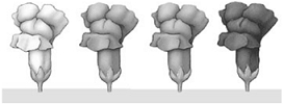 -A gene that produces multiple effects is called
A bell-shaped curve of phenotypic variation is indicative of
(Multiple Choice)
4.8/5 (77)
(77) 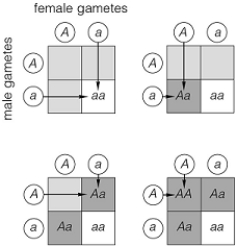 -Using the illustration above and the assumption that half of a plant's sperm and eggs are a and half are A, one can predict that the chance of sperm a meeting egg A at fertilization is
 (Multiple Choice)
4.9/5 (71)
(71) An individual that has two dominant alleles for a trait (AA) is __________.
(Essay)
4.7/5 (77)
(77) In humans, normal skin pigmentation is influenced by a dominant gene (C), which allows pigmentation to develop.All individuals who are homozygous for the recessive allele (c) are unable to produce an enzyme needed for melanin formation and are therefore referred to as albino.Two normal parents produce an albino child.What are the chances that the next child will be an albino?
(Essay)
4.8/5 (79)
(79) If wire hair (W) is dominant to smooth hair (w), and you find a wire-haired puppy, how would you determine its genotype by a genetic breeding experiment? Give both the genotype and phenotype involved with the cross with the unknown.
(Essay)
4.9/5 (95)
(95) Classically, nature and nurture have been considered as two very separate factors impacting phenotype.Considering what we have learned of methylation, is this always the case?
(Essay)
4.9/5 (73)
(73) Which eye color has the gene combination to deposit the most melanin in the iris?
(Multiple Choice)
4.8/5 (76)
(76) There are nine coat colors known in foxes.If a red fox were crossed with a double-black fox, all the hybrids would be red above and black below in a pattern known as blended cross.If two blended crosses were mated, the F2 ratio would be as follows: 1 red, 2 smoky red, 2 cross red, 4 blended cross, 1 standard silver, 2 substandard silver, 1 Alaskan silver, 2 sub-Alaskan silver, and 1 double black.
(a)
Using the letters A/a and B/b to serve as the genes for these animals, develop a genotype for each variety listed.
(b)
Two crosses will produce all blended-cross offspring.One is used above (red fox * double black); what is the other?
(c)
List the genotype and phenotype of all the pure-breeding foxes.
(d)
Give the genotypic and phenotypic ratio of a cross between two substandard silvers.
(e)
Give the genotype and phenotype of the offspring produced in a cross of a sub-Alaskan silver and a cross red.
(Essay)
4.9/5 (89)
(89) Provide evidence for and against the now disproven concept of blended inheritance?
(Essay)
4.8/5 (78)
(78) Tall (D) is dominant to dwarf (d).Give the F2 genotypic and phenotypic ratios of a cross between a pure-breeding tall plant and a pure-breeding dwarf plant.
(Essay)
4.9/5 (86)
(86) 
Filters
- Essay(0)
- Multiple Choice(0)
- Short Answer(0)
- True False(0)
- Matching(0)