



 Chat with AI
Exam 13: Observing Patterns in Inherited Traits

Exam 1: Invitation to Biology80 Questions
Exam 2: Lifes Chemical Basis53 Questions
Exam 3: Molecules of Life62 Questions
Exam 4: Cell Structure and Function80 Questions
Exam 5: Ground Rules of Metabolism58 Questions
Exam 6: Where It Startsphotosynthesis57 Questions
Exam 7: How Cells Release Chemical Energy60 Questions
Exam 8: Dna Structure and Function60 Questions
Exam 9: From Dna to Protein64 Questions
Exam 10: Gene Control64 Questions
Exam 11: How Cells Reproduce77 Questions
Exam 12: Meiosis and Sexual Reproduction58 Questions
Exam 13: Observing Patterns in Inherited Traits97 Questions
Exam 14: Chromosomes and Human Inheritance74 Questions
Exam 15: Studying and Manipulating Genomes57 Questions
Exam 16: Evidence of Evolution53 Questions
Exam 17: Processes of Evolution72 Questions
Exam 18: Organizing Information About Species46 Questions
Exam 19: Lifes Origin and Early Evolution60 Questions
Exam 20: Viruses and Prokaryotes56 Questions
Exam 21: Protiststhe Simplest Eukaryotes61 Questions
Exam 22: The Land Plants66 Questions
Exam 23: Fungi52 Questions
Exam 24: Animal Evolutionthe Invertebrates74 Questions
Exam 25: Animal Evolutionthe Chordates71 Questions
Exam 26: Animal Evolutionhuman Evolution51 Questions
Exam 27: Plant Tissues79 Questions
Exam 28: Plant Nutrition and Transport68 Questions
Exam 29: Life Cycles of Flowering Plants88 Questions
Exam 30: Communication Strategies in Plants72 Questions
Exam 31: Animal Tissues and Organ Systems77 Questions
Exam 32: Neural Control96 Questions
Exam 33: Sensory Perception71 Questions
Exam 34: Endocrine Control91 Questions
Exam 35: Structural Support and Movement72 Questions
Exam 36: Circulation58 Questions
Exam 37: Immunity73 Questions
Exam 38: Respiration78 Questions
Exam 39: Digestion and Nutrition98 Questions
Exam 40: Maintaining the Internal Environment73 Questions
Exam 41: Animal Reproductive Systems105 Questions
Exam 42: Animal Development69 Questions
Exam 43: Animal Behavior74 Questions
Exam 44: Population Ecology59 Questions
Exam 45: Community Ecology71 Questions
Exam 46: Ecosystems63 Questions
Exam 47: The Biosphere72 Questions
Exam 48: Human Impacts on the Biosphere62 Questions
Select questions type


MATCHING
Classification.Answer the following questions using the group of answers below.
a.4
b.6
c.8
d.12
e.24
-Animal species X is tetraploid (4n = 12).Following gene duplication and translocation, a given gene is found on each chromosome.How many alleles for this gene can be present in an individual of this species?
(Essay)
4.8/5  (67)
(67) In sweet peas, genes C and P are necessary for colored flowers.In the absence of either (__ pp or cc __) or both (cc pp), the flowers are white.What will be the color of the offspring of the crosses listed below and in what proportions?
(a)
Cc Pp * cc pp
(b)
Cc Pp *Cc Pp
(c)
Cc PP * Cc pp
(d)
Cc pp * cc Pp
(Essay)
4.8/5 (85)
(85) 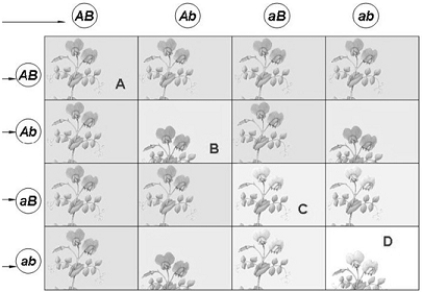 -Which offspring in the illustration above are homozygous recessive for both traits?
 (Multiple Choice)
5.0/5 (76)
(76) A cross of two Kerry horses always produces Kerry.A cross of a Kerry with a Dexter produces 1/2 and 1/2.Crosses of two Dexters produce two Dexters for every Kerry.Explain.
(Essay)
4.9/5 (70)
(70) If black fur color is controlled by a dominant allele (B) and brown by its recessive allele (b), give the genotypes of the parents and offspring of a cross of a black male with a brown female that produces 1/2 black offspring and 1/2 brown offspring.
(Essay)
4.9/5 (82)
(82) In a certain breed of chicken, an incomplete dominant gene controls color.The homozygous black, when crossed with the homozygous splashed-white, produces an intermediate gray color pattern referred to as blue.A second gene controls the shape of the comb.The dominant allele (R) produces rose, whereas the recessive allele (r) produces single.Give the F1 and F2 genotypic and phenotypic ratios of a cross between a pure-breeding black single and a pure-breeding splashed-white rose.
(Essay)
4.8/5 (100)
(100) In which of the following does environment not play a role?
(Multiple Choice)
5.0/5 (83)
(83) White fruit color in summer squash is influenced by a dominant allele W, whereas colored fruit must be ww.In the presence of ww, a dominant gene G results in yellow fruit, and if the individual had both recessive genes in the homozygous condition, it would be green.Give the F2 phenotypic ratios resulting from a cross of a pure-breeding white of genotype WW GG with a green.
(Essay)
4.9/5 (97)
(97) Which is easier to establish in a pure-breeding population, a dominant or a recessive gene?
(Essay)
4.9/5 (81)
(81) The most accurate description of an organism with genotype AaBb is
(Multiple Choice)
4.9/5 (84)
(84) In a certain variety of plants, a cross between a red-flowered plant and a white-flowered plant produced an all-red flower F1.In the F2 there were 140 red, 50 cream, and 65 white.
(a)
Offer an explanation for this F2 ratio.
(b)
What ratio would be produced in a testcross of the F1 hybrid?
(c)
What ratio would be produced if all the white F2 plants were crossed among themselves?
(Essay)
4.8/5 (78)
(78) In garden peas, one pair of alleles controls the height of the plant, and a second pair of alleles controls flower color.The allele for tall (D) is dominant to the allele for dwarf (d), and the allele for purple (P) is dominant to the allele for white (p).A tall purple crossed with a tall purple produces 3/4 tall purple and 1/4 tall white.What is the genotype of the parents?
(Essay)
4.8/5 (82)
(82) In garden peas, one pair of alleles controls the height of the plant, and a second pair of alleles controls flower color.The allele for tall (D) is dominant to the allele for dwarf (d), and the allele for purple (P) is dominant to the allele for white (p).A tall plant with white flowers crossed with a dwarf plant with purple flowers produces all tall offspring with purple flowers.What is the genotype of the parents?
(Essay)
4.8/5 (76)
(76) In radishes, two incompletely dominant genes control color and shape.Red and white radishes are homozygous, whereas the hybrid is purple.Long and round are homozygous and, if crossed, will produce an oval hybrid.Give the F2 genotypic and phenotypic ratio produced by crossing pure-breed red long radishes with white round varieties.
(Essay)
4.7/5 (85)
(85) In horses, black coat color is influenced by the dominant allele (B), and chestnut coat color is influenced by the recessive allele (b).Trotting gait is due to a dominant gene (T), pacing gait to the recessive allele (t).If a homozygous black trotter is crossed to a chestnut pacer,
(a)
what will be the appearance of the F1 and F2 generations?
(b)
which phenotype will be the most common?
(c)
which genotype will be the most common?
(d)
which of the potential offspring will be certain to breed true?
(Essay)
4.8/5 (70)
(70) 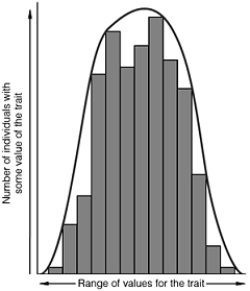 -A graph of phenotypic variation similar to the illustration above strongly suggests
 (Multiple Choice)
4.8/5 (72)
(72) 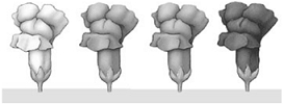 -The illustration above shows the F2 phenotypes from a monohybrid cross in snapdragons.What type of inheritance produces such an outcome?
 (Multiple Choice)
4.9/5 (84)
(84) 
Filters
- Essay(0)
- Multiple Choice(0)
- Short Answer(0)
- True False(0)
- Matching(0)