



 Chat with AI
Exam 25: Animal Evolutionthe Chordates

Exam 1: Invitation to Biology80 Questions
Exam 2: Lifes Chemical Basis53 Questions
Exam 3: Molecules of Life62 Questions
Exam 4: Cell Structure and Function80 Questions
Exam 5: Ground Rules of Metabolism58 Questions
Exam 6: Where It Startsphotosynthesis57 Questions
Exam 7: How Cells Release Chemical Energy60 Questions
Exam 8: Dna Structure and Function60 Questions
Exam 9: From Dna to Protein64 Questions
Exam 10: Gene Control64 Questions
Exam 11: How Cells Reproduce77 Questions
Exam 12: Meiosis and Sexual Reproduction58 Questions
Exam 13: Observing Patterns in Inherited Traits97 Questions
Exam 14: Chromosomes and Human Inheritance74 Questions
Exam 15: Studying and Manipulating Genomes57 Questions
Exam 16: Evidence of Evolution53 Questions
Exam 17: Processes of Evolution72 Questions
Exam 18: Organizing Information About Species46 Questions
Exam 19: Lifes Origin and Early Evolution60 Questions
Exam 20: Viruses and Prokaryotes56 Questions
Exam 21: Protiststhe Simplest Eukaryotes61 Questions
Exam 22: The Land Plants66 Questions
Exam 23: Fungi52 Questions
Exam 24: Animal Evolutionthe Invertebrates74 Questions
Exam 25: Animal Evolutionthe Chordates71 Questions
Exam 26: Animal Evolutionhuman Evolution51 Questions
Exam 27: Plant Tissues79 Questions
Exam 28: Plant Nutrition and Transport68 Questions
Exam 29: Life Cycles of Flowering Plants88 Questions
Exam 30: Communication Strategies in Plants72 Questions
Exam 31: Animal Tissues and Organ Systems77 Questions
Exam 32: Neural Control96 Questions
Exam 33: Sensory Perception71 Questions
Exam 34: Endocrine Control91 Questions
Exam 35: Structural Support and Movement72 Questions
Exam 36: Circulation58 Questions
Exam 37: Immunity73 Questions
Exam 38: Respiration78 Questions
Exam 39: Digestion and Nutrition98 Questions
Exam 40: Maintaining the Internal Environment73 Questions
Exam 41: Animal Reproductive Systems105 Questions
Exam 42: Animal Development69 Questions
Exam 43: Animal Behavior74 Questions
Exam 44: Population Ecology59 Questions
Exam 45: Community Ecology71 Questions
Exam 46: Ecosystems63 Questions
Exam 47: The Biosphere72 Questions
Exam 48: Human Impacts on the Biosphere62 Questions
Select questions type


Give the bird-like and reptile-like features of Archaeopteryx?

Free
(Essay)
5.0/5  (69)
(69) Correct Answer: Verified
Like a bird, Archaeopteryx had feathers and wings.Like a reptile it had a bony tail, clawed fingers and teeth.It is truly a classic example of a "transitional form.
MATCHING
Matching.Choose the one most appropriate letter for each.
a.cartilaginous skeleton; jaws
b.reptile with four-chambered heart
c.placental mammal
d.legless amphibian
e.invertebrate chordate; no metamorphosis
f.endotherm with feathers
g.limbless reptile
h.most primitive fishes with jaws; extinct
i.modern-day parasitic jawless vertebrate
j.
marsupial
k.adult is called "sea squirt"
l.
egg-laying mammal
m.
swim bladder for buoyancy
n.
may be sexually mature in larval form
-platypus
Free
(Essay)
4.9/5 (70)
(70) Correct Answer:Verified
VerifiedL
Which of the following is(are) NOT trend(s) of vertebrate evolution?
Free
(Multiple Choice)
4.9/5 (98)
(98) Correct Answer:Verified
VerifiedD
MATCHING
Matching.Choose the one most appropriate letter for each.
a.cartilaginous skeleton; jaws
b.reptile with four-chambered heart
c.placental mammal
d.legless amphibian
e.invertebrate chordate; no metamorphosis
f.endotherm with feathers
g.limbless reptile
h.most primitive fishes with jaws; extinct
i.modern-day parasitic jawless vertebrate
j.
marsupial
k.adult is called "sea squirt"
l.
egg-laying mammal
m.
swim bladder for buoyancy
n.
may be sexually mature in larval form
-humans
(Essay)
4.9/5 (71)
(71) Birds are evolved from reptiles, but also differ dramatically.List features of birds that differentiate them from most reptiles?
(Essay)
4.7/5 (84)
(84) 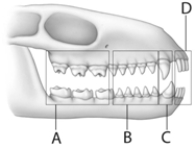 Use the figure above to answer the following questions.
-The letter "A" in the above figure represents which teeth?
Use the figure above to answer the following questions.
-The letter "A" in the above figure represents which teeth? (Multiple Choice)
4.8/5 (70)
(70) Which group of mammals exhibits the widest distribution and greatest diversity?
(Multiple Choice)
4.8/5 (83)
(83) Classification.Select the best choice for the following statements in reference to the five classes listed below.
a.Cartilaginous fishes
b.Bony fishes
c.Amphibians
d.Reptilians
-Members of this class have cartilaginous skeletons but also possess jaws.
(Essay)
4.9/5 (77)
(77) Mammals appeared 220 MYA but did not begin to greatly diversify until 65 MYA - why?
(Essay)
4.8/5 (81)
(81) Classification.Select the best choice for the following statements in reference to the five classes listed below.
a.Cartilaginous fishes
b.Bony fishes
c.Amphibians
d.Reptilians
-Members of one unusual group may have been ancestors of amphibians.
(Essay)
4.8/5 (83)
(83) A great adaptive radiation of mammals began about ____ million years ago.
(Multiple Choice)
4.7/5 (90)
(90) Four features help define __________: a notochord, a dorsal hollow nerve cord, a pharynx with gill slits, and a tail extending past the anus.
(Essay)
4.8/5 (83)
(83) Use the figure above to answer the following questions.
-The letter "D" in the above figure represents which teeth?
Use the figure above to answer the following questions.
-The letter "D" in the above figure represents which teeth? (Multiple Choice)
4.8/5 (93)
(93) Land vertebrates evolved which of the following to help maintain water balance?
(Multiple Choice)
5.0/5 (92)
(92) Pouches in the gut wall developed into ____ in fishes that are ancestral to land vertebrates.
(Multiple Choice)
4.9/5 (92)
(92) __________, or four-legged walkers, evolved from lobe-finned bony fishes.
(Essay)
4.8/5 (79)
(79) 
Filters
- Essay(0)
- Multiple Choice(0)
- Short Answer(0)
- True False(0)
- Matching(0)