



 Chat with AI
Exam 39: Digestion and Nutrition

Exam 1: Invitation to Biology80 Questions
Exam 2: Lifes Chemical Basis53 Questions
Exam 3: Molecules of Life62 Questions
Exam 4: Cell Structure and Function80 Questions
Exam 5: Ground Rules of Metabolism58 Questions
Exam 6: Where It Startsphotosynthesis57 Questions
Exam 7: How Cells Release Chemical Energy60 Questions
Exam 8: Dna Structure and Function60 Questions
Exam 9: From Dna to Protein64 Questions
Exam 10: Gene Control64 Questions
Exam 11: How Cells Reproduce77 Questions
Exam 12: Meiosis and Sexual Reproduction58 Questions
Exam 13: Observing Patterns in Inherited Traits97 Questions
Exam 14: Chromosomes and Human Inheritance74 Questions
Exam 15: Studying and Manipulating Genomes57 Questions
Exam 16: Evidence of Evolution53 Questions
Exam 17: Processes of Evolution72 Questions
Exam 18: Organizing Information About Species46 Questions
Exam 19: Lifes Origin and Early Evolution60 Questions
Exam 20: Viruses and Prokaryotes56 Questions
Exam 21: Protiststhe Simplest Eukaryotes61 Questions
Exam 22: The Land Plants66 Questions
Exam 23: Fungi52 Questions
Exam 24: Animal Evolutionthe Invertebrates74 Questions
Exam 25: Animal Evolutionthe Chordates71 Questions
Exam 26: Animal Evolutionhuman Evolution51 Questions
Exam 27: Plant Tissues79 Questions
Exam 28: Plant Nutrition and Transport68 Questions
Exam 29: Life Cycles of Flowering Plants88 Questions
Exam 30: Communication Strategies in Plants72 Questions
Exam 31: Animal Tissues and Organ Systems77 Questions
Exam 32: Neural Control96 Questions
Exam 33: Sensory Perception71 Questions
Exam 34: Endocrine Control91 Questions
Exam 35: Structural Support and Movement72 Questions
Exam 36: Circulation58 Questions
Exam 37: Immunity73 Questions
Exam 38: Respiration78 Questions
Exam 39: Digestion and Nutrition98 Questions
Exam 40: Maintaining the Internal Environment73 Questions
Exam 41: Animal Reproductive Systems105 Questions
Exam 42: Animal Development69 Questions
Exam 43: Animal Behavior74 Questions
Exam 44: Population Ecology59 Questions
Exam 45: Community Ecology71 Questions
Exam 46: Ecosystems63 Questions
Exam 47: The Biosphere72 Questions
Exam 48: Human Impacts on the Biosphere62 Questions
Select questions type


The liver is associated with all EXCEPT which of the following functions?

Free
(Multiple Choice)
4.8/5  (68)
(68) Correct Answer: Verified
D
 Use the figure above to answer the following questions.
-Sphincters
Use the figure above to answer the following questions.
-SphinctersFree
(Multiple Choice)
4.8/5 (89)
(89) Correct Answer:Verified
VerifiedE
MATCHING
Matching.Choose the one most appropriate statement for each.
a.a process that mixes the contents of the lumen and forces it against the absorptive surface of the gut
b.stimulates pancreatic bicarbonate secretion
c.thin, outermost layer of stomach
d.a softened ball of food particles
e.emulsify fat globules
f.have multiple stomach chambers, some of which store populations of microorganisms
g.innermost layer of the gut; contains diverse secretory cells
h.gastric inhibitory peptide
i.stimulates gallbladder and stomach emptying as well as pancreatic enzyme secretions
j.
a mixture of food particles in the stomach
-secretin
Free
(Essay)
5.0/5 (90)
(90) Correct Answer:Verified
VerifiedB
 -Large gut populations of Bifidobacterium are associated with:
 (Multiple Choice)
4.8/5 (83)
(83) MATCHING
Matching.Choose the one most appropriate statement for each.
a.a process that mixes the contents of the lumen and forces it against the absorptive surface of the gut
b.stimulates pancreatic bicarbonate secretion
c.thin, outermost layer of stomach
d.a softened ball of food particles
e.emulsify fat globules
f.have multiple stomach chambers, some of which store populations of microorganisms
g.innermost layer of the gut; contains diverse secretory cells
h.gastric inhibitory peptide
i.stimulates gallbladder and stomach emptying as well as pancreatic enzyme secretions
j.
a mixture of food particles in the stomach
-bile salts
(Essay)
4.8/5 (67)
(67) Matching.Choose the one most appropriate statement for each.
a.made in the small intestine and pancreas; act on peptide fragments
b.glucose, fructose, and galactose are examples
c.made in the pancreas; acts on fats
d.made by the pancreas and salivary glands; acts on starch
e.made by the small intestine; acts on double sugars
f.made by the pancreas; acts on proteins and polypeptides
g.contains cholesterol; helps emulsify fats
h.made in the stomach; acts on proteins
i.stimulates hydrochloric acid secretion
j.
circular muscle acts like valve
-sphincter
(Essay)
4.9/5 (91)
(91)
-Which of the following statements about digestion in ruminants is false?
-Which of the following statements about digestion in ruminants is false? (Multiple Choice)
4.9/5 (84)
(84) Classification.Respond to the following statements with reference to the four glands or structures of the mammalian gastrointestinal tract listed below.
a.salivary glands
b.stomach mucosa
c.intestinal mucosa
d.pancreas
-The fat-digesting enzyme, lipase, is formed there.
(Essay)
4.9/5 (96)
(96) MATCHING
Matching.Choose the one most appropriate statement for each.
a.a process that mixes the contents of the lumen and forces it against the absorptive surface of the gut
b.stimulates pancreatic bicarbonate secretion
c.thin, outermost layer of stomach
d.a softened ball of food particles
e.emulsify fat globules
f.have multiple stomach chambers, some of which store populations of microorganisms
g.innermost layer of the gut; contains diverse secretory cells
h.gastric inhibitory peptide
i.stimulates gallbladder and stomach emptying as well as pancreatic enzyme secretions
j.
a mixture of food particles in the stomach
-chyme
(Essay)
4.8/5 (70)
(70)  The following questions refer to the figure above.
-The structures illustrated in the figure are found in the
The following questions refer to the figure above.
-The structures illustrated in the figure are found in the (Multiple Choice)
4.8/5 (96)
(96) Matching.Choose the one most appropriate statement for each.
a.made in the small intestine and pancreas; act on peptide fragments
b.glucose, fructose, and galactose are examples
c.made in the pancreas; acts on fats
d.made by the pancreas and salivary glands; acts on starch
e.made by the small intestine; acts on double sugars
f.made by the pancreas; acts on proteins and polypeptides
g.contains cholesterol; helps emulsify fats
h.made in the stomach; acts on proteins
i.stimulates hydrochloric acid secretion
j.
circular muscle acts like valve
-amino- and carboxypeptidase
(Essay)
4.8/5 (80)
(80) MATCHING
Matching.Choose the one most appropriate statement for each.
a.a process that mixes the contents of the lumen and forces it against the absorptive surface of the gut
b.stimulates pancreatic bicarbonate secretion
c.thin, outermost layer of stomach
d.a softened ball of food particles
e.emulsify fat globules
f.have multiple stomach chambers, some of which store populations of microorganisms
g.innermost layer of the gut; contains diverse secretory cells
h.gastric inhibitory peptide
i.stimulates gallbladder and stomach emptying as well as pancreatic enzyme secretions
j.
a mixture of food particles in the stomach
-bolus
(Essay)
4.9/5 (85)
(85) 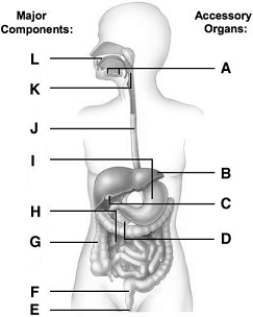 -__________ moves food down the esophagus and through a __________ (a ring of muscle that can close off an opening) into the stomach.
 (Short Answer)
4.9/5 (71)
(71) Classification.Respond to the following statements with reference to the five vitamins listed below.
a.Vitamin B1
b.Vitamin B2
c.Niacin
d.Vitamin B6
e.Vitamin B12
-A deficiency of this vitamin causes pernicious anemia and neurological disorders and is a coenzyme important in synthesizing DNA.
(Essay)
4.9/5 (91)
(91) 
Filters
- Essay(0)
- Multiple Choice(0)
- Short Answer(0)
- True False(0)
- Matching(0)