



 Chat with AI
Exam 39: Digestion and Nutrition

Exam 1: Invitation to Biology80 Questions
Exam 2: Lifes Chemical Basis53 Questions
Exam 3: Molecules of Life62 Questions
Exam 4: Cell Structure and Function80 Questions
Exam 5: Ground Rules of Metabolism58 Questions
Exam 6: Where It Startsphotosynthesis57 Questions
Exam 7: How Cells Release Chemical Energy60 Questions
Exam 8: Dna Structure and Function60 Questions
Exam 9: From Dna to Protein64 Questions
Exam 10: Gene Control64 Questions
Exam 11: How Cells Reproduce77 Questions
Exam 12: Meiosis and Sexual Reproduction58 Questions
Exam 13: Observing Patterns in Inherited Traits97 Questions
Exam 14: Chromosomes and Human Inheritance74 Questions
Exam 15: Studying and Manipulating Genomes57 Questions
Exam 16: Evidence of Evolution53 Questions
Exam 17: Processes of Evolution72 Questions
Exam 18: Organizing Information About Species46 Questions
Exam 19: Lifes Origin and Early Evolution60 Questions
Exam 20: Viruses and Prokaryotes56 Questions
Exam 21: Protiststhe Simplest Eukaryotes61 Questions
Exam 22: The Land Plants66 Questions
Exam 23: Fungi52 Questions
Exam 24: Animal Evolutionthe Invertebrates74 Questions
Exam 25: Animal Evolutionthe Chordates71 Questions
Exam 26: Animal Evolutionhuman Evolution51 Questions
Exam 27: Plant Tissues79 Questions
Exam 28: Plant Nutrition and Transport68 Questions
Exam 29: Life Cycles of Flowering Plants88 Questions
Exam 30: Communication Strategies in Plants72 Questions
Exam 31: Animal Tissues and Organ Systems77 Questions
Exam 32: Neural Control96 Questions
Exam 33: Sensory Perception71 Questions
Exam 34: Endocrine Control91 Questions
Exam 35: Structural Support and Movement72 Questions
Exam 36: Circulation58 Questions
Exam 37: Immunity73 Questions
Exam 38: Respiration78 Questions
Exam 39: Digestion and Nutrition98 Questions
Exam 40: Maintaining the Internal Environment73 Questions
Exam 41: Animal Reproductive Systems105 Questions
Exam 42: Animal Development69 Questions
Exam 43: Animal Behavior74 Questions
Exam 44: Population Ecology59 Questions
Exam 45: Community Ecology71 Questions
Exam 46: Ecosystems63 Questions
Exam 47: The Biosphere72 Questions
Exam 48: Human Impacts on the Biosphere62 Questions
Select questions type


Classification.Respond to the following statements with reference to the five vitamins listed below.
a.Vitamin B1
b.Vitamin B2
c.Niacin
d.Vitamin B6
e.Vitamin B12
-This vitamin functions in connective tissue formation.
(Essay)
4.9/5  (92)
(92)  -The liver is commonly damaged if drugs or other toxins are over consumed.Why?
 (Essay)
4.9/5 (86)
(86) Classification.Respond to the following statements with reference to the five vitamins listed below.
a.Vitamin B1
b.Vitamin B2
c.Niacin
d.Vitamin B6
e.Vitamin B12
-This vitamin functions in coenzyme NAD+ action.
(Essay)
4.8/5 (78)
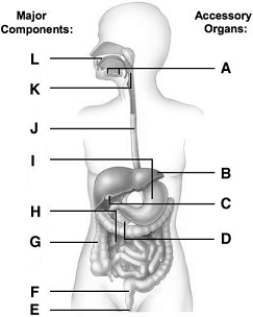
(78)  Use the figure above to answer the following questions.
-The structure designated by the letter "A" in the above figure is called
Use the figure above to answer the following questions.
-The structure designated by the letter "A" in the above figure is called (Multiple Choice)
5.0/5 (81)
(81) MATCHING
Matching.Choose the one most appropriate statement for each.
a.a process that mixes the contents of the lumen and forces it against the absorptive surface of the gut
b.stimulates pancreatic bicarbonate secretion
c.thin, outermost layer of stomach
d.a softened ball of food particles
e.emulsify fat globules
f.have multiple stomach chambers, some of which store populations of microorganisms
g.innermost layer of the gut; contains diverse secretory cells
h.gastric inhibitory peptide
i.stimulates gallbladder and stomach emptying as well as pancreatic enzyme secretions
j.
a mixture of food particles in the stomach
-ruminants
(Essay)
4.7/5 (81)
(81) Classification.Respond to the following statements with reference to the four glands or structures of the mammalian gastrointestinal tract listed below.
a.salivary glands
b.stomach mucosa
c.intestinal mucosa
d.pancreas
-The peptide-digesting enzyme, aminopeptidase, is produced there.
(Essay)
4.9/5 (76)
(76) Classification.Respond to the following statements with reference to the five components of the gastrointestinal tract listed below.
a.stomach
b.gallbladder
c.small intestine
d.appendix
e.large intestine
-The digestion of cellulose occurs in this part of the digestive system of the pronghorn antelope.
(Essay)
4.9/5 (90)
(90) Glucose is absorbed through the membranes of the small intestine primarily by
(Multiple Choice)
4.9/5 (84)
(84)  Use the figure above to answer the following questions.
-The second structure encountered in a biopsy of the stomach is the
Use the figure above to answer the following questions.
-The second structure encountered in a biopsy of the stomach is the (Multiple Choice)
4.8/5 (81)
(81)
-__________, which assists in fat digestion, is made in the liver and stored in the __________.
-__________, which assists in fat digestion, is made in the liver and stored in the __________. (Short Answer)
5.0/5 (82)
(82)  Use the figure above to answer the following questions.
-The grinding organ indicated by the letter "E" is called the
Use the figure above to answer the following questions.
-The grinding organ indicated by the letter "E" is called the (Multiple Choice)
4.8/5 (72)
(72) Lipids can serve in all EXCEPT which of the following capacities?
(Multiple Choice)
4.9/5 (89)
(89) Use the figure above to answer the following questions.
-The teeth designated by the letter "B" in the above figure are called
Use the figure above to answer the following questions.
-The teeth designated by the letter "B" in the above figure are called (Multiple Choice)
4.9/5 (88)
(88) Use the figure above to answer the following questions.
-High stomach acidity
Use the figure above to answer the following questions.
-High stomach acidity (Multiple Choice)
4.9/5 (85)
(85) Which of the following substances is found in the least amount in the small intestine?
(Multiple Choice)
4.7/5 (86)
(86) 
Filters
- Essay(0)
- Multiple Choice(0)
- Short Answer(0)
- True False(0)
- Matching(0)