



 Chat with AI
Exam 13: Observing Patterns in Inherited Traits

Exam 1: Invitation to Biology80 Questions
Exam 2: Lifes Chemical Basis53 Questions
Exam 3: Molecules of Life62 Questions
Exam 4: Cell Structure and Function80 Questions
Exam 5: Ground Rules of Metabolism58 Questions
Exam 6: Where It Startsphotosynthesis57 Questions
Exam 7: How Cells Release Chemical Energy60 Questions
Exam 8: Dna Structure and Function60 Questions
Exam 9: From Dna to Protein64 Questions
Exam 10: Gene Control64 Questions
Exam 11: How Cells Reproduce77 Questions
Exam 12: Meiosis and Sexual Reproduction58 Questions
Exam 13: Observing Patterns in Inherited Traits97 Questions
Exam 14: Chromosomes and Human Inheritance74 Questions
Exam 15: Studying and Manipulating Genomes57 Questions
Exam 16: Evidence of Evolution53 Questions
Exam 17: Processes of Evolution72 Questions
Exam 18: Organizing Information About Species46 Questions
Exam 19: Lifes Origin and Early Evolution60 Questions
Exam 20: Viruses and Prokaryotes56 Questions
Exam 21: Protiststhe Simplest Eukaryotes61 Questions
Exam 22: The Land Plants66 Questions
Exam 23: Fungi52 Questions
Exam 24: Animal Evolutionthe Invertebrates74 Questions
Exam 25: Animal Evolutionthe Chordates71 Questions
Exam 26: Animal Evolutionhuman Evolution51 Questions
Exam 27: Plant Tissues79 Questions
Exam 28: Plant Nutrition and Transport68 Questions
Exam 29: Life Cycles of Flowering Plants88 Questions
Exam 30: Communication Strategies in Plants72 Questions
Exam 31: Animal Tissues and Organ Systems77 Questions
Exam 32: Neural Control96 Questions
Exam 33: Sensory Perception71 Questions
Exam 34: Endocrine Control91 Questions
Exam 35: Structural Support and Movement72 Questions
Exam 36: Circulation58 Questions
Exam 37: Immunity73 Questions
Exam 38: Respiration78 Questions
Exam 39: Digestion and Nutrition98 Questions
Exam 40: Maintaining the Internal Environment73 Questions
Exam 41: Animal Reproductive Systems105 Questions
Exam 42: Animal Development69 Questions
Exam 43: Animal Behavior74 Questions
Exam 44: Population Ecology59 Questions
Exam 45: Community Ecology71 Questions
Exam 46: Ecosystems63 Questions
Exam 47: The Biosphere72 Questions
Exam 48: Human Impacts on the Biosphere62 Questions
Select questions type


In garden peas, one pair of alleles controls the height of the plant, and a second pair of alleles controls flower color.The allele for tall (D) is dominant to the allele for dwarf (d), and the allele for purple (P) is dominant to the allele for white (p).A tall plant with purple flowers crossed with a dwarf plant with white flowers produces 1/4 tall purple, 1/4 tall white, 1/4 dwarf purple, and 1/4 dwarf white.What is the genotype of the parents?
(Essay)
4.9/5  (71)
(71) A homozygous recessive where "A" represents the trait has two recessive alleles symbolized by __________.
(Essay)
4.7/5 (81)
(81) If long or round are homozygous forms of an incompletely dominant gene, and oval is the phenotype of the heterozygote, give the F2 ratio of the cross between long and round (both genotype and phenotype).
(Essay)
4.9/5 (72)
(72) In mice the allele for colored fur (C) is dominant to the allele for albinism (c).The allele for normal behavior (W) is dominant to that for waltzing movement (w).Give the probable genotypes of the parents if they produced the offspring listed after the following crosses:
(a)
colored normal * white waltzer produced 10 colored normal, 8 colored waltzers, 2 white waltzers, 11 white normal
(b)
colored normal * white normal produced 35 colored normal, 13 colored waltzers
(c)
colored normal * colored normal produced 37 colored normal, 14 colored waltzers, 9 white normal, and 5 white waltzers
(Essay)
4.8/5 (78)
(78) In poultry, the genes for rose comb (R) and pea comb (P) produce walnut whenever they occur together (R__ P__); single-combed individuals have the homozygous condition for both genes (rr pp).
(a)
Give the F1 and F2 phenotypic results of a cross of a pure-breeding rose comb (RR pp) with a pure-breeding pea comb (rr PP).
(b)
Give the phenotypic results of a cross of Rr Pp * rr Pp.
(c)
Give the phenotypic results of a cross of RR Pp * rr Pp.
(d)
Give the phenotypic results of a cross of Rr pp * rr Pp.
(e)
Give the phenotypic results of a cross of Rr Pp * rr pp.
(Essay)
4.8/5 (81)
(81) Which of the following is NOT a known effect in the expression of Marfan syndrome?
(Multiple Choice)
4.8/5 (92)
(92) According to Mendel, what kinds of genes "disappear" in F1 pea plants?
(Multiple Choice)
4.7/5 (75)
(75) The allele for albinism (c) is recessive to the allele for normal pigmentation (C).A normally pigmented woman whose father is an albino marries an albino man whose parents are normal.They have three children, two normal and one albino.Give the genotypes for each person listed.
(Essay)
4.8/5 (78)
(78) Explain what genetic 'trick' could have confounded Mendel is his recognition of segregation?
(Essay)
5.0/5 (95)
(95) In sweet peas, genes C and P are necessary for colored flowers.In the absence of either (__ pp or cc __) or both (cc pp), the flowers are white.Give the probable genotype of a plant with colored flowers and a plant with white flowers that produced 38 plants with colored flowers and 42 plants with white flowers.
(Essay)
4.8/5 (78)
(78) In cultivated stocks, the cross of a variety of white flower plants produced all red flowers in the F1 generation, but the F2 generation produced 87 red, 31 cream, and 39 white.Explain these results by giving the genotypes possible for each phenotype.
(Essay)
4.9/5 (73)
(73) If you were following the inheritance patterns of two different sets of multiple alleles located on different chromosomes, how many different possible gametes could be produced if locus 1 had five possible alleles and locus 2 had six alleles?
(Essay)
4.8/5 (73)
(73) Consider the work Mendel did with his pea plants.Why is the study of human genetics much more difficult?
(Essay)
4.8/5 (93)
(93) In summer squash, spherical-shaped fruit has been shown to be dominant to elongated fruit.On one occasion two different spherical varieties were crossed and produced all disk-shaped fruits.When these hybrid disk-shaped fruits were crossed, they produced 75 disk-shaped fruits, 48 spherical fruits, and 9 elongated fruits.Explain these results.
(Essay)
4.9/5 (67)
(67) 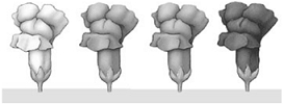 -Genes at one locus that affect the expression of genes at a different locus are said to be
 (Multiple Choice)
4.8/5 (82)
(82) In rabbits, there are four alleles at the c locus.Arranged in dominance sequence they are:
C (agouti), cch(chinchilla), ch(Himalayan), and c (albino)
(a)
Is it possible to cross two agouti rabbits and produce both chinchilla and Himalayan offspring?
(b)
Is it possible to cross two chinchillas and produce 1/2 chinchilla and 1/2 Himalayan?
(Essay)
5.0/5 (81)
(81) 
Filters
- Essay(0)
- Multiple Choice(0)
- Short Answer(0)
- True False(0)
- Matching(0)