



 Chat with AI
Exam 46: Ecosystems

Exam 1: Invitation to Biology80 Questions
Exam 2: Lifes Chemical Basis53 Questions
Exam 3: Molecules of Life62 Questions
Exam 4: Cell Structure and Function80 Questions
Exam 5: Ground Rules of Metabolism58 Questions
Exam 6: Where It Startsphotosynthesis57 Questions
Exam 7: How Cells Release Chemical Energy60 Questions
Exam 8: Dna Structure and Function60 Questions
Exam 9: From Dna to Protein64 Questions
Exam 10: Gene Control64 Questions
Exam 11: How Cells Reproduce77 Questions
Exam 12: Meiosis and Sexual Reproduction58 Questions
Exam 13: Observing Patterns in Inherited Traits97 Questions
Exam 14: Chromosomes and Human Inheritance74 Questions
Exam 15: Studying and Manipulating Genomes57 Questions
Exam 16: Evidence of Evolution53 Questions
Exam 17: Processes of Evolution72 Questions
Exam 18: Organizing Information About Species46 Questions
Exam 19: Lifes Origin and Early Evolution60 Questions
Exam 20: Viruses and Prokaryotes56 Questions
Exam 21: Protiststhe Simplest Eukaryotes61 Questions
Exam 22: The Land Plants66 Questions
Exam 23: Fungi52 Questions
Exam 24: Animal Evolutionthe Invertebrates74 Questions
Exam 25: Animal Evolutionthe Chordates71 Questions
Exam 26: Animal Evolutionhuman Evolution51 Questions
Exam 27: Plant Tissues79 Questions
Exam 28: Plant Nutrition and Transport68 Questions
Exam 29: Life Cycles of Flowering Plants88 Questions
Exam 30: Communication Strategies in Plants72 Questions
Exam 31: Animal Tissues and Organ Systems77 Questions
Exam 32: Neural Control96 Questions
Exam 33: Sensory Perception71 Questions
Exam 34: Endocrine Control91 Questions
Exam 35: Structural Support and Movement72 Questions
Exam 36: Circulation58 Questions
Exam 37: Immunity73 Questions
Exam 38: Respiration78 Questions
Exam 39: Digestion and Nutrition98 Questions
Exam 40: Maintaining the Internal Environment73 Questions
Exam 41: Animal Reproductive Systems105 Questions
Exam 42: Animal Development69 Questions
Exam 43: Animal Behavior74 Questions
Exam 44: Population Ecology59 Questions
Exam 45: Community Ecology71 Questions
Exam 46: Ecosystems63 Questions
Exam 47: The Biosphere72 Questions
Exam 48: Human Impacts on the Biosphere62 Questions
Select questions type


Classification.Respond to the following statements with reference to the five trophic categories listed below.
a.producer
b.primary consumer
c.secondary consumer
d.tertiary consumer
e.decomposer
-A bear eating blueberries is functioning as this.
(Essay)
4.9/5  (84)
(84) Approximately what percent of the energy that enters a trophic level becomes available to the next trophic level?
(Multiple Choice)
4.9/5 (85)
(85) The concept of an ecosystem differs from that of a community in that, unlike the community, the ecosystem includes the
(Multiple Choice)
4.8/5 (81)
(81) Classification.Respond to the following statements with reference to the four steps of the nitrogen cycles listed below.
a.nitrogen fixation
b.nitrification
c.denitrification
d.ammonification
-The action of bacteria on ammonia, ultimately converting it to nitrate, involves this process.
(Essay)
5.0/5 (87)
(87) Classification.Respond to the following statements with reference to the four steps of the nitrogen cycles listed below.
a.nitrogen fixation
b.nitrification
c.denitrification
d.ammonification
-A __________ shows one path of energy and nutrient flow among organisms.
(Essay)
4.9/5 (87)
(87) 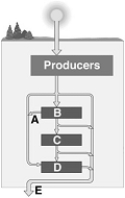 The following questions refer to the figure above.
-The figure illustrates
The following questions refer to the figure above.
-The figure illustrates (Multiple Choice)
4.9/5 (81)
(81) Classification.Respond to the following statements with reference to the five trophic categories listed below.
a.producer
b.primary consumer
c.secondary consumer
d.tertiary consumer
e.decomposer
-A bear feeding on a salmon is functioning as this.
(Essay)
4.8/5 (79)
(79) MATCHING
Matching.Choose the one most appropriate answer for each.
a.rate at which energy becomes stored in organic compounds through photosynthesis
b.total amount of solar energy stored in organic compounds during photosynthesis
c.a straight-line sequence of steps by which chemical bond energy moves to higher trophic levels
d.the potential chemical energy remaining (after aerobic respiration by autotrophs) that can be passed on to other trophic levels
e.DDT in the environment
f.a kind of plant that increases soil nitrogen content
g.particles of organic waste products, dead, or partly decomposed tissues
-detritus
(Essay)
4.9/5 (76)
(76) Carbon is introduced into the atmosphere by all EXCEPT which of the following means?
(Multiple Choice)
5.0/5 (77)
(77) Classification.Respond to the following statements with reference to the four steps of the nitrogen cycles listed below.
a.nitrogen fixation
b.nitrification
c.denitrification
d.ammonification
-There is a __________ flow of energy into and out of an ecosystem, and a cycling of materials among resident species.
(Essay)
4.7/5 (87)
(87) Classification.Respond to the following statements with reference to the four steps of the nitrogen cycles listed below.
a.nitrogen fixation
b.nitrification
c.denitrification
d.ammonification
-__________ is an energy-intensive method of obtaining fresh water from __________.
(Essay)
4.8/5 (82)
(82) MATCHING
Matching.Choose the one most appropriate answer for each.
a.rate at which energy becomes stored in organic compounds through photosynthesis
b.total amount of solar energy stored in organic compounds during photosynthesis
c.a straight-line sequence of steps by which chemical bond energy moves to higher trophic levels
d.the potential chemical energy remaining (after aerobic respiration by autotrophs) that can be passed on to other trophic levels
e.DDT in the environment
f.a kind of plant that increases soil nitrogen content
g.particles of organic waste products, dead, or partly decomposed tissues
-primary productivity
(Essay)
4.8/5 (85)
(85) MATCHING
Matching.Choose the one most appropriate answer for each.
a.rate at which energy becomes stored in organic compounds through photosynthesis
b.total amount of solar energy stored in organic compounds during photosynthesis
c.a straight-line sequence of steps by which chemical bond energy moves to higher trophic levels
d.the potential chemical energy remaining (after aerobic respiration by autotrophs) that can be passed on to other trophic levels
e.DDT in the environment
f.a kind of plant that increases soil nitrogen content
g.particles of organic waste products, dead, or partly decomposed tissues
-net primary production
(Essay)
4.9/5 (76)
(76) Most of the water vapor in the earth's atmosphere comes from evaporation from
(Multiple Choice)
4.8/5 (87)
(87) Which of the following is NOT dependent on the others as a source of food?
(Multiple Choice)
4.9/5 (80)
(80) Which of the following indicators of global warming has (have) occurred?
(Multiple Choice)
4.9/5 (83)
(83) 
Filters
- Essay(0)
- Multiple Choice(0)
- Short Answer(0)
- True False(0)
- Matching(0)