



 Chat with AI
Exam 10: The Muscular System: Axial Musculature

Exam 1: Foundations: An Introduction to Anatomy124 Questions
Exam 2: Foundations: The Cell117 Questions
Exam 3: Foundations: Tissues and Early Embryology127 Questions
Exam 4: The Integumentary System127 Questions
Exam 5: The Skeletal System: Osseous Tissue and Skeletal Structure142 Questions
Exam 6: The Skeletal System: Axial Division150 Questions
Exam 7: The Skeletal System: Appendicular Division131 Questions
Exam 8: The Skeletal System: Articulations131 Questions
Exam 9: The Muscular System: Skeletal Muscle Tissue and Muscle Organization145 Questions
Exam 10: The Muscular System: Axial Musculature142 Questions
Exam 11: The Muscular System: Appendicular Musculature135 Questions
Exam 12: Surface Anatomy and Cross-Sectional Anatomy129 Questions
Exam 13: The Nervous System: Neural Tissue127 Questions
Exam 14: The Nervous System: The Spinal Cord and Spinal Nerves131 Questions
Exam 15: The Nervous System: Sensory and Motor Tracts of the Spinal Cord81 Questions
Exam 16: The Nervous System: The Brain and Cranial Nerves132 Questions
Exam 17: The Nervous System: Autonomic Nervous System115 Questions
Exam 18: The Nervous System: General and Special Senses127 Questions
Exam 19: The Endocrine System102 Questions
Exam 20: The Cardiovascular System: Blood71 Questions
Exam 21: The Cardiovascular System: The Heart150 Questions
Exam 22: The Cardiovascular System: Vessels and Circulation129 Questions
Exam 23: The Lymphatic System105 Questions
Exam 24: The Respiratory System128 Questions
Exam 25: The Digestive System132 Questions
Exam 26: The Urinary System135 Questions
Exam 27: The Reproductive System134 Questions
Exam 28: Embryology and Human Development140 Questions
Select questions type


Figure 10.2
 Using the above-referenced diagrammatic posterior view of the major superficial axial and appendicular muscles, identify the specified labeled item(s)in each of the following questions.
-Identify the structure(s) indicated by Label CC.
Using the above-referenced diagrammatic posterior view of the major superficial axial and appendicular muscles, identify the specified labeled item(s)in each of the following questions.
-Identify the structure(s) indicated by Label CC. (Multiple Choice)
4.8/5  (70)
(70) The oblique muscle and/or rectus muscle do which of the following?
(Multiple Choice)
4.8/5 (81)
(81) Figure 10.3
 Using the above-referenced diagrammatic view of extra-ocular muscles on the lateral surface of the right eye, identify the specified labeled item(s)in each of the following questions.
-Identify the structure(s) indicated by Label A.
Using the above-referenced diagrammatic view of extra-ocular muscles on the lateral surface of the right eye, identify the specified labeled item(s)in each of the following questions.
-Identify the structure(s) indicated by Label A. (Multiple Choice)
4.8/5 (85)
(85) Figure 10.2
Using the above-referenced diagrammatic posterior view of the major superficial axial and appendicular muscles, identify the specified labeled item(s)in each of the following questions.
-Identify the structure(s) indicated by Label M.
Using the above-referenced diagrammatic posterior view of the major superficial axial and appendicular muscles, identify the specified labeled item(s)in each of the following questions.
-Identify the structure(s) indicated by Label M. (Multiple Choice)
4.8/5 (65)
(65) Figure 10.2
Using the above-referenced diagrammatic posterior view of the major superficial axial and appendicular muscles, identify the specified labeled item(s)in each of the following questions.
-Identify the structure(s) indicated by Label B.
Using the above-referenced diagrammatic posterior view of the major superficial axial and appendicular muscles, identify the specified labeled item(s)in each of the following questions.
-Identify the structure(s) indicated by Label B. (Multiple Choice)
4.8/5 (66)
(66) The internal intercostal muscles aid in respiration by depressing the ribs.
(True/False)
4.9/5 (92)
(92) Figure 10.2
Using the above-referenced diagrammatic posterior view of the major superficial axial and appendicular muscles, identify the specified labeled item(s)in each of the following questions.
-Identify the structure(s) indicated by Label BB.
Using the above-referenced diagrammatic posterior view of the major superficial axial and appendicular muscles, identify the specified labeled item(s)in each of the following questions.
-Identify the structure(s) indicated by Label BB. (Multiple Choice)
4.8/5 (85)
(85) Figure 10.1
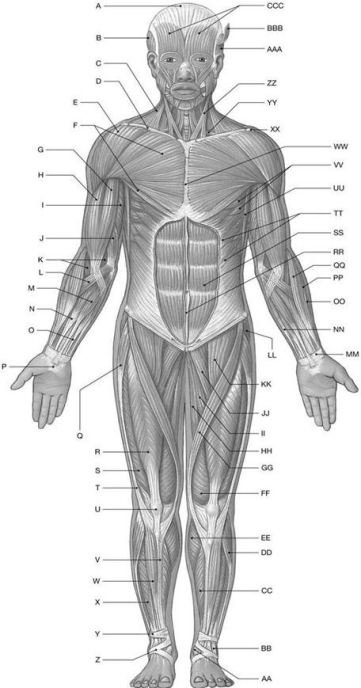 Using the above-referenced diagrammatic anterior view of the major superficial axial and appendicular muscles, identify the specified labeled item(s)in each of the following questions.
-Identify the structure(s) indicated by Label E.
Using the above-referenced diagrammatic anterior view of the major superficial axial and appendicular muscles, identify the specified labeled item(s)in each of the following questions.
-Identify the structure(s) indicated by Label E. (Multiple Choice)
4.7/5 (82)
(82) Figure 10.3
Using the above-referenced diagrammatic view of extra-ocular muscles on the lateral surface of the right eye, identify the specified labeled item(s)in each of the following questions.
-Identify the structure(s) indicated by Label G.
Using the above-referenced diagrammatic view of extra-ocular muscles on the lateral surface of the right eye, identify the specified labeled item(s)in each of the following questions.
-Identify the structure(s) indicated by Label G. (Multiple Choice)
4.9/5 (73)
(73) Which of the following muscles originates at the mandible bone?
(Multiple Choice)
4.8/5 (83)
(83) These posterior neck muscles extend, rotate, and laterally flex the cervical vertebrae.
(Multiple Choice)
4.7/5 (92)
(92) The external anal sphincter muscle and the pubococcygeus muscle are located within this perineal region.
(Multiple Choice)
4.9/5 (80)
(80) Axial muscles fall into logical groups based upon ________.
(Multiple Choice)
4.9/5 (83)
(83) Figure 10.2
Using the above-referenced diagrammatic posterior view of the major superficial axial and appendicular muscles, identify the specified labeled item(s)in each of the following questions.
-Identify the structure(s) indicated by Label AA.
Using the above-referenced diagrammatic posterior view of the major superficial axial and appendicular muscles, identify the specified labeled item(s)in each of the following questions.
-Identify the structure(s) indicated by Label AA. (Multiple Choice)
4.8/5 (91)
(91) Orbicularis oris, orbicularis oculi, and platysma are part of the group of muscles known as the muscles of ________.
(Multiple Choice)
4.8/5 (81)
(81) Which of the following is/are the major action(s)of the anterior neck musculature?
(Multiple Choice)
4.9/5 (90)
(90) Figure 10.2
Using the above-referenced diagrammatic posterior view of the major superficial axial and appendicular muscles, identify the specified labeled item(s)in each of the following questions.
-Identify the structure(s) indicated by Label FF.
Using the above-referenced diagrammatic posterior view of the major superficial axial and appendicular muscles, identify the specified labeled item(s)in each of the following questions.
-Identify the structure(s) indicated by Label FF. (Multiple Choice)
4.9/5 (88)
(88) When the ________ muscle contracts, the eye rolls and looks up and laterally.
(Multiple Choice)
4.8/5 (98)
(98) Figure 10.2
Using the above-referenced diagrammatic posterior view of the major superficial axial and appendicular muscles, identify the specified labeled item(s)in each of the following questions.
-Identify the structure(s) indicated by Label N.
Using the above-referenced diagrammatic posterior view of the major superficial axial and appendicular muscles, identify the specified labeled item(s)in each of the following questions.
-Identify the structure(s) indicated by Label N. (Multiple Choice)
4.8/5 (71)
(71) 
Filters
- Essay(0)
- Multiple Choice(0)
- Short Answer(0)
- True False(0)
- Matching(0)