



 Chat with AI
Exam 21: The Cardiovascular System: The Heart

Exam 1: Foundations: An Introduction to Anatomy124 Questions
Exam 2: Foundations: The Cell117 Questions
Exam 3: Foundations: Tissues and Early Embryology127 Questions
Exam 4: The Integumentary System127 Questions
Exam 5: The Skeletal System: Osseous Tissue and Skeletal Structure142 Questions
Exam 6: The Skeletal System: Axial Division150 Questions
Exam 7: The Skeletal System: Appendicular Division131 Questions
Exam 8: The Skeletal System: Articulations131 Questions
Exam 9: The Muscular System: Skeletal Muscle Tissue and Muscle Organization145 Questions
Exam 10: The Muscular System: Axial Musculature142 Questions
Exam 11: The Muscular System: Appendicular Musculature135 Questions
Exam 12: Surface Anatomy and Cross-Sectional Anatomy129 Questions
Exam 13: The Nervous System: Neural Tissue127 Questions
Exam 14: The Nervous System: The Spinal Cord and Spinal Nerves131 Questions
Exam 15: The Nervous System: Sensory and Motor Tracts of the Spinal Cord81 Questions
Exam 16: The Nervous System: The Brain and Cranial Nerves132 Questions
Exam 17: The Nervous System: Autonomic Nervous System115 Questions
Exam 18: The Nervous System: General and Special Senses127 Questions
Exam 19: The Endocrine System102 Questions
Exam 20: The Cardiovascular System: Blood71 Questions
Exam 21: The Cardiovascular System: The Heart150 Questions
Exam 22: The Cardiovascular System: Vessels and Circulation129 Questions
Exam 23: The Lymphatic System105 Questions
Exam 24: The Respiratory System128 Questions
Exam 25: The Digestive System132 Questions
Exam 26: The Urinary System135 Questions
Exam 27: The Reproductive System134 Questions
Exam 28: Embryology and Human Development140 Questions
Select questions type


Figure 21.3
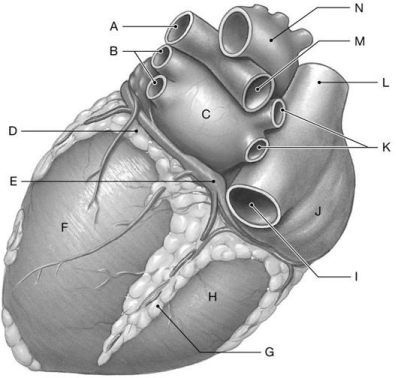 Using the above figure, identify the labeled structure(s) in each of the following questions.
-Identify the structure(s) indicated by Label F.
Using the above figure, identify the labeled structure(s) in each of the following questions.
-Identify the structure(s) indicated by Label F.
Free
(Multiple Choice)
4.9/5  (80)
(80) Correct Answer: Verified
E
Norepinephrine release produces an increase in both the heart rate and force of contraction through the stimulation of beta receptors on nodal cells and contractile cells.
Free
(True/False)
4.8/5 (78)
(78) Correct Answer:Verified
VerifiedTrue
Which of the following is a function of the cardiac skeleton of the heart?
Free
(Multiple Choice)
4.9/5 (83)
(83) Correct Answer:Verified
VerifiedA
Figure 21.5
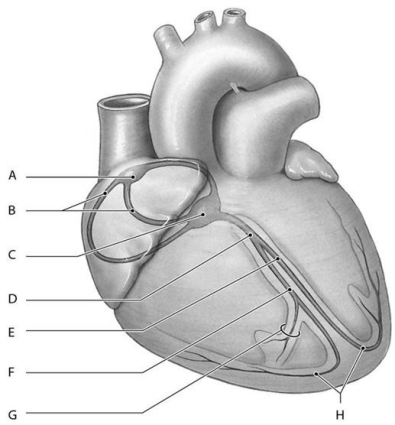 Using the above figure, identify the labeled structure(s) in each of the following questions.
-Identify the structure(s) indicated by Label A.
Using the above figure, identify the labeled structure(s) in each of the following questions.
-Identify the structure(s) indicated by Label A. (Multiple Choice)
4.7/5 (82)
(82) ________ is the term used to indicate a heart rate that is slower than normal.
(Multiple Choice)
4.7/5 (87)
(87) Figure 21.1
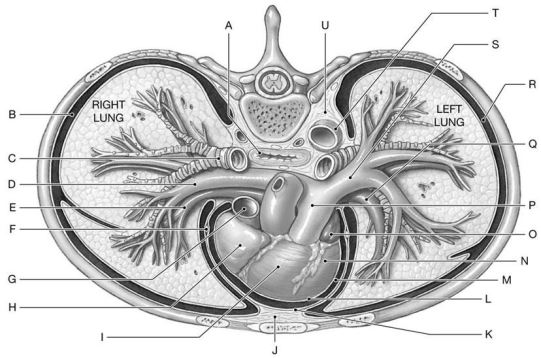 Using the above figure, identify the labeled structure(s) in each of the following questions.
-Identify the structure(s) indicated by Label N.
Using the above figure, identify the labeled structure(s) in each of the following questions.
-Identify the structure(s) indicated by Label N. (Multiple Choice)
4.9/5 (81)
(81) Which branch(es)of the right coronary artery extends toward the apex along the anterior surface of the right ventricle of the heart?
(Multiple Choice)
4.9/5 (72)
(72) ________ release produces a decrease in both the heart rate and force of contraction through the stimulation of muscarinic receptors on nodal cells and contractile cells.
(Multiple Choice)
4.8/5 (84)
(84) Figure 21.2
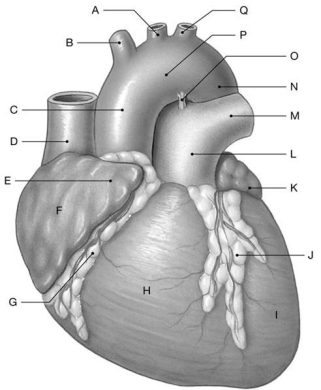 Using the above figure, identify the labeled structure(s) in each of the following questions.
-Identify the structure(s) indicated by Label B.
Using the above figure, identify the labeled structure(s) in each of the following questions.
-Identify the structure(s) indicated by Label B. (Multiple Choice)
4.9/5 (84)
(84) Figure 21.1
Using the above figure, identify the labeled structure(s) in each of the following questions.
-Identify the structure(s) indicated by Label K.
Using the above figure, identify the labeled structure(s) in each of the following questions.
-Identify the structure(s) indicated by Label K. (Multiple Choice)
4.7/5 (84)
(84) Because cardiac muscles are mechanically, chemically, and electrically connected to one another, cardiac muscle tissue functions like a single enormous muscle cell. For this reason, it is called a functional ________.
(Multiple Choice)
4.9/5 (80)
(80) The ________ are a series of irregular muscular folds formed on the internal surface of the ventricles.
(Multiple Choice)
4.9/5 (87)
(87) Figure 21.1
Using the above figure, identify the labeled structure(s) in each of the following questions.
-Identify the structure(s) indicated by Label A.
Using the above figure, identify the labeled structure(s) in each of the following questions.
-Identify the structure(s) indicated by Label A. (Multiple Choice)
4.8/5 (80)
(80) Which vessel delivers venous blood from the tissues and organs of the abdominal and pelvic cavities, and from the lower limbs?
(Multiple Choice)
4.8/5 (76)
(76) Cardiac muscle cells obtain energy almost exclusively through ________.
(Multiple Choice)
4.8/5 (86)
(86) Figure 21.2
Using the above figure, identify the labeled structure(s) in each of the following questions.
-Identify the structure(s) indicated by Label L.
Using the above figure, identify the labeled structure(s) in each of the following questions.
-Identify the structure(s) indicated by Label L. (Multiple Choice)
4.9/5 (77)
(77) Figure 21.5
Using the above figure, identify the labeled structure(s) in each of the following questions.
-Identify the structure(s) indicated by Label F.
Using the above figure, identify the labeled structure(s) in each of the following questions.
-Identify the structure(s) indicated by Label F. (Multiple Choice)
4.8/5 (83)
(83) The rapidly depolarizing cells, called pacemaker cells, are found in the ________, which is embedded in the posterior wall of the right atrium.
(Multiple Choice)
4.8/5 (84)
(84) Figure 21.4
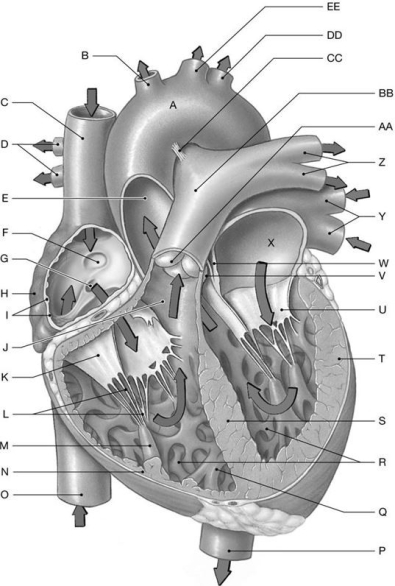 Using the above figure, identify the labeled structure(s) in each of the following questions.
-Identify the structure(s) indicated by Label I.
Using the above figure, identify the labeled structure(s) in each of the following questions.
-Identify the structure(s) indicated by Label I. (Multiple Choice)
4.8/5 (76)
(76) Figure 21.2
Using the above figure, identify the labeled structure(s) in each of the following questions.
-Identify the structure(s) indicated by Label F.
Using the above figure, identify the labeled structure(s) in each of the following questions.
-Identify the structure(s) indicated by Label F. (Multiple Choice)
4.7/5 (77)
(77) 
Filters
- Essay(0)
- Multiple Choice(0)
- Short Answer(0)
- True False(0)
- Matching(0)