



 Chat with AI
Exam 8: The Skeletal System: Articulations

Exam 1: Foundations: An Introduction to Anatomy124 Questions
Exam 2: Foundations: The Cell117 Questions
Exam 3: Foundations: Tissues and Early Embryology127 Questions
Exam 4: The Integumentary System127 Questions
Exam 5: The Skeletal System: Osseous Tissue and Skeletal Structure142 Questions
Exam 6: The Skeletal System: Axial Division150 Questions
Exam 7: The Skeletal System: Appendicular Division131 Questions
Exam 8: The Skeletal System: Articulations131 Questions
Exam 9: The Muscular System: Skeletal Muscle Tissue and Muscle Organization145 Questions
Exam 10: The Muscular System: Axial Musculature142 Questions
Exam 11: The Muscular System: Appendicular Musculature135 Questions
Exam 12: Surface Anatomy and Cross-Sectional Anatomy129 Questions
Exam 13: The Nervous System: Neural Tissue127 Questions
Exam 14: The Nervous System: The Spinal Cord and Spinal Nerves131 Questions
Exam 15: The Nervous System: Sensory and Motor Tracts of the Spinal Cord81 Questions
Exam 16: The Nervous System: The Brain and Cranial Nerves132 Questions
Exam 17: The Nervous System: Autonomic Nervous System115 Questions
Exam 18: The Nervous System: General and Special Senses127 Questions
Exam 19: The Endocrine System102 Questions
Exam 20: The Cardiovascular System: Blood71 Questions
Exam 21: The Cardiovascular System: The Heart150 Questions
Exam 22: The Cardiovascular System: Vessels and Circulation129 Questions
Exam 23: The Lymphatic System105 Questions
Exam 24: The Respiratory System128 Questions
Exam 25: The Digestive System132 Questions
Exam 26: The Urinary System135 Questions
Exam 27: The Reproductive System134 Questions
Exam 28: Embryology and Human Development140 Questions
Select questions type


The radial collateral ligament extends from the styloid process of the radius to the medial surface of the scaphoid.

Free
(True/False)
4.9/5  (79)
(79) Correct Answer: Verified
False
Figure 8.5
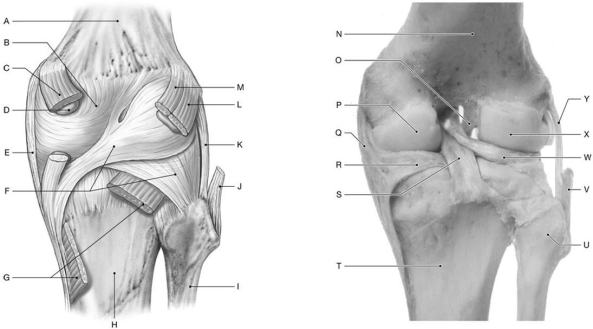 Using the above-referenced posterior views of the extended right knee (joint capsule removed in right side cadaveric image), identify the specified labeled items in each of the following questions.
-Identify the structure(s) indicated by Label S.
Using the above-referenced posterior views of the extended right knee (joint capsule removed in right side cadaveric image), identify the specified labeled items in each of the following questions.
-Identify the structure(s) indicated by Label S.Free
(Multiple Choice)
4.8/5 (92)
(92) Correct Answer:Verified
VerifiedE
Figure 8.1
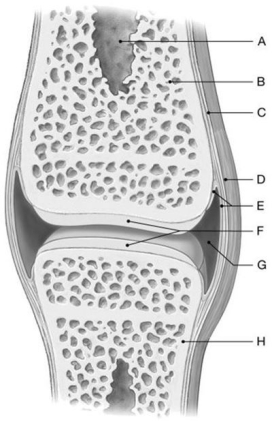 Using the above-referenced diagrammatic view of a simple articulation, identify the specified labeled items in each of the following questions.
-Identify the structure(s) indicated by Label F.
Using the above-referenced diagrammatic view of a simple articulation, identify the specified labeled items in each of the following questions.
-Identify the structure(s) indicated by Label F.Free
(Multiple Choice)
5.0/5 (80)
(80) Correct Answer:Verified
VerifiedB
Figure 8.6
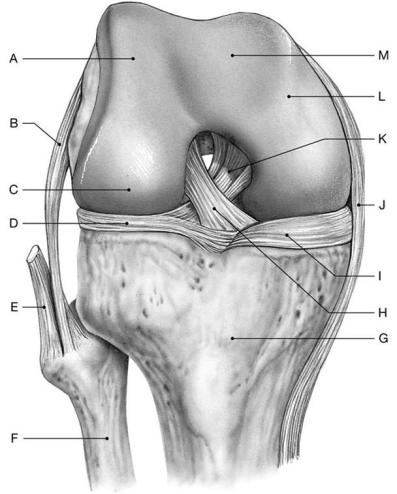 Using the above-referenced anterior view of the right knee at full flexion (joint capsule, patella, and associated ligaments removed), identify the specified labeled items in each of the following questions.
-Identify the structure(s) indicated by Label H.
Using the above-referenced anterior view of the right knee at full flexion (joint capsule, patella, and associated ligaments removed), identify the specified labeled items in each of the following questions.
-Identify the structure(s) indicated by Label H. (Multiple Choice)
4.8/5 (76)
(76) Figure 8.2
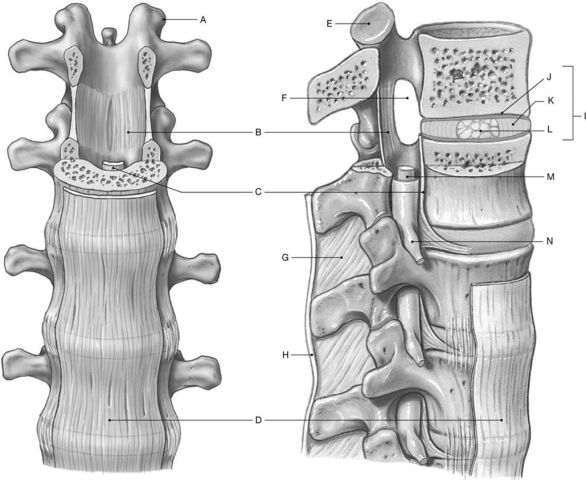 Using the above-referenced anterior view and lateral and sectional views of the intervertebral articulations, identify the specified labeled items in each of the following questions.
-Identify the structure(s) indicated by Label B.
Using the above-referenced anterior view and lateral and sectional views of the intervertebral articulations, identify the specified labeled items in each of the following questions.
-Identify the structure(s) indicated by Label B. (Multiple Choice)
4.9/5 (75)
(75) Figure 8.4
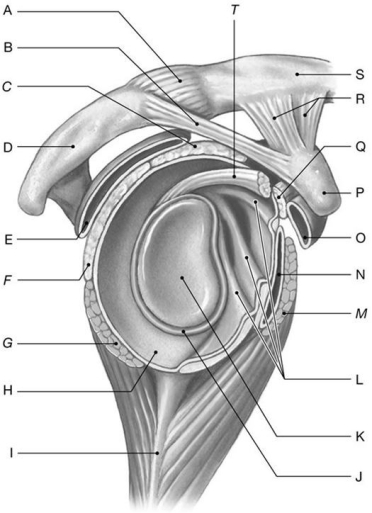 Using the above-referenced lateral view of the right shoulder joint (humerus removed), identify the specified labeled items in each of the following questions.
-Identify the structure(s) indicated by Label P.
Using the above-referenced lateral view of the right shoulder joint (humerus removed), identify the specified labeled items in each of the following questions.
-Identify the structure(s) indicated by Label P. (Multiple Choice)
4.8/5 (76)
(76) An accessory structure of a joint that may subdivide a synovial cavity, channel the flow of synovial fluid, or allow for variations in the shapes of the articular surfaces is a ________.
(Multiple Choice)
4.8/5 (84)
(84) Small, synovial fluid-filled pockets in connective tissue are called ________.
(Multiple Choice)
4.8/5 (87)
(87) A specialized form of fibrous synarthrosis that binds each tooth to the surrounding bony socket is a ________.
(Multiple Choice)
4.8/5 (83)
(83) Movement in the anterior-posterior plane that decreases the angle between the articulating elements is ________.
(Multiple Choice)
4.8/5 (82)
(82) A ligament that originates at the base of the coracoid process and inserts on the head of the humerus is the acromioclavicular ligament.
(True/False)
4.7/5 (77)
(77) How does the construction of the shoulder capsule contribute to the extensive range of motion of the shoulder joint?
(Essay)
5.0/5 (63)
(63) Figure 8.5
Using the above-referenced posterior views of the extended right knee (joint capsule removed in right side cadaveric image), identify the specified labeled items in each of the following questions.
-Identify the structure(s) indicated by Label C.
Using the above-referenced posterior views of the extended right knee (joint capsule removed in right side cadaveric image), identify the specified labeled items in each of the following questions.
-Identify the structure(s) indicated by Label C. (Multiple Choice)
4.7/5 (81)
(81) Figure 8.2
Using the above-referenced anterior view and lateral and sectional views of the intervertebral articulations, identify the specified labeled items in each of the following questions.
-Identify the structure(s) indicated by Label H.
Using the above-referenced anterior view and lateral and sectional views of the intervertebral articulations, identify the specified labeled items in each of the following questions.
-Identify the structure(s) indicated by Label H. (Multiple Choice)
4.8/5 (84)
(84) Figure 8.5
Using the above-referenced posterior views of the extended right knee (joint capsule removed in right side cadaveric image), identify the specified labeled items in each of the following questions.
-Identify the structure(s) indicated by Label G.
Using the above-referenced posterior views of the extended right knee (joint capsule removed in right side cadaveric image), identify the specified labeled items in each of the following questions.
-Identify the structure(s) indicated by Label G. (Multiple Choice)
4.8/5 (87)
(87) Figure 8.2
Using the above-referenced anterior view and lateral and sectional views of the intervertebral articulations, identify the specified labeled items in each of the following questions.
-Identify the structure(s) indicated by Label D.
Using the above-referenced anterior view and lateral and sectional views of the intervertebral articulations, identify the specified labeled items in each of the following questions.
-Identify the structure(s) indicated by Label D. (Multiple Choice)
4.9/5 (91)
(91) Joints between the superior and inferior articulating facets of adjacent vertebrae are called ________.
(Multiple Choice)
4.9/5 (70)
(70) The atlanto-axial joint is an example of a(n)________ joint.
(Multiple Choice)
4.9/5 (82)
(82) 
Filters
- Essay(0)
- Multiple Choice(0)
- Short Answer(0)
- True False(0)
- Matching(0)