



 Chat with AI
Exam 21: The Cardiovascular System: The Heart

Exam 1: Foundations: An Introduction to Anatomy124 Questions
Exam 2: Foundations: The Cell117 Questions
Exam 3: Foundations: Tissues and Early Embryology127 Questions
Exam 4: The Integumentary System127 Questions
Exam 5: The Skeletal System: Osseous Tissue and Skeletal Structure142 Questions
Exam 6: The Skeletal System: Axial Division150 Questions
Exam 7: The Skeletal System: Appendicular Division131 Questions
Exam 8: The Skeletal System: Articulations131 Questions
Exam 9: The Muscular System: Skeletal Muscle Tissue and Muscle Organization145 Questions
Exam 10: The Muscular System: Axial Musculature142 Questions
Exam 11: The Muscular System: Appendicular Musculature135 Questions
Exam 12: Surface Anatomy and Cross-Sectional Anatomy129 Questions
Exam 13: The Nervous System: Neural Tissue127 Questions
Exam 14: The Nervous System: The Spinal Cord and Spinal Nerves131 Questions
Exam 15: The Nervous System: Sensory and Motor Tracts of the Spinal Cord81 Questions
Exam 16: The Nervous System: The Brain and Cranial Nerves132 Questions
Exam 17: The Nervous System: Autonomic Nervous System115 Questions
Exam 18: The Nervous System: General and Special Senses127 Questions
Exam 19: The Endocrine System102 Questions
Exam 20: The Cardiovascular System: Blood71 Questions
Exam 21: The Cardiovascular System: The Heart150 Questions
Exam 22: The Cardiovascular System: Vessels and Circulation129 Questions
Exam 23: The Lymphatic System105 Questions
Exam 24: The Respiratory System128 Questions
Exam 25: The Digestive System132 Questions
Exam 26: The Urinary System135 Questions
Exam 27: The Reproductive System134 Questions
Exam 28: Embryology and Human Development140 Questions
Select questions type


Which of the following conditions would cause an increase in the heart rate?
(Multiple Choice)
4.9/5  (75)
(75) Externally, the posterior and inferior portions of the left and right ventricles form the ________.
(Multiple Choice)
4.8/5 (82)
(82) Which of the following is a unique feature of the right ventricle?
(Multiple Choice)
4.8/5 (81)
(81) The inherent ability of cardiac muscle tissue to contract in the absence of neural or hormonal stimulation is called ________.
(Multiple Choice)
4.8/5 (69)
(69) There are many interconnections between the arterial branches of the coronary circulation, which function to maintain a constant blood supply to the muscle of the heart. These connections are called ________.
(Multiple Choice)
4.8/5 (89)
(89) Which of the following is true regarding contractions of the heart?
(Multiple Choice)
4.8/5 (89)
(89) Which heart structure receives blood from the systemic circuit?
(Multiple Choice)
4.9/5 (73)
(73) If the cusps of an atrioventricular valve are damaged or functionally impaired so that they do not close completely during the normal point in the cardiac cycle, blood may flow backwards. This is called ________.
(Multiple Choice)
4.8/5 (82)
(82) Figure 21.2
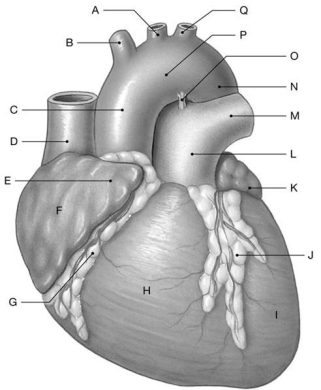 Using the above figure, identify the labeled structure(s) in each of the following questions.
-Identify the structure(s) indicated by Label C.
Using the above figure, identify the labeled structure(s) in each of the following questions.
-Identify the structure(s) indicated by Label C. (Multiple Choice)
4.9/5 (95)
(95) The exchange of oxygen and carbon dioxide in the cardiovascular system occurs in which vessels?
(Multiple Choice)
4.8/5 (88)
(88) Oxygen-poor blood travels from the right atrium into the right ventricle through the ________ valve.
(Multiple Choice)
4.7/5 (83)
(83) Figure 21.4
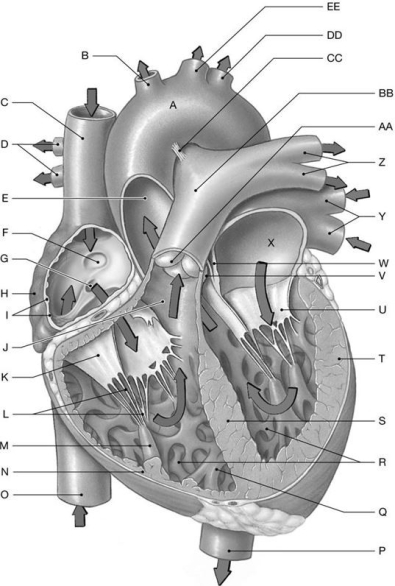 Using the above figure, identify the labeled structure(s) in each of the following questions.
-Identify the structure(s) indicated by Label Y.
Using the above figure, identify the labeled structure(s) in each of the following questions.
-Identify the structure(s) indicated by Label Y. (Multiple Choice)
4.8/5 (72)
(72) Figure 21.5
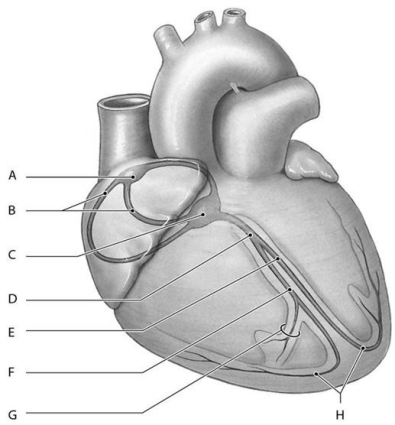 Using the above figure, identify the labeled structure(s) in each of the following questions.
-Identify the structure(s) indicated by Label B.
Using the above figure, identify the labeled structure(s) in each of the following questions.
-Identify the structure(s) indicated by Label B. (Multiple Choice)
4.9/5 (73)
(73) Which of the following vessels drains the anterior surface of the right ventricle and empties directly into the right atrium?
(Multiple Choice)
4.7/5 (90)
(90) Which event occurs during the first phase of ventricular systole?
(Multiple Choice)
4.8/5 (84)
(84) When not filled with blood the anterior portion of each atrium deflates and becomes a rather lumpy and wrinkled flap called the________.
(Multiple Choice)
5.0/5 (86)
(86) The outermost layer of the serous pericardium is termed the ________.
(Multiple Choice)
4.8/5 (69)
(69) Figure 21.2
Using the above figure, identify the labeled structure(s) in each of the following questions.
-Identify the structure(s) indicated by Label H.
Using the above figure, identify the labeled structure(s) in each of the following questions.
-Identify the structure(s) indicated by Label H. (Multiple Choice)
4.9/5 (71)
(71) 
Filters
- Essay(0)
- Multiple Choice(0)
- Short Answer(0)
- True False(0)
- Matching(0)