



 Chat with AI
Exam 10: The Muscular System: Axial Musculature

Exam 1: Foundations: An Introduction to Anatomy124 Questions
Exam 2: Foundations: The Cell117 Questions
Exam 3: Foundations: Tissues and Early Embryology127 Questions
Exam 4: The Integumentary System127 Questions
Exam 5: The Skeletal System: Osseous Tissue and Skeletal Structure142 Questions
Exam 6: The Skeletal System: Axial Division150 Questions
Exam 7: The Skeletal System: Appendicular Division131 Questions
Exam 8: The Skeletal System: Articulations131 Questions
Exam 9: The Muscular System: Skeletal Muscle Tissue and Muscle Organization145 Questions
Exam 10: The Muscular System: Axial Musculature142 Questions
Exam 11: The Muscular System: Appendicular Musculature135 Questions
Exam 12: Surface Anatomy and Cross-Sectional Anatomy129 Questions
Exam 13: The Nervous System: Neural Tissue127 Questions
Exam 14: The Nervous System: The Spinal Cord and Spinal Nerves131 Questions
Exam 15: The Nervous System: Sensory and Motor Tracts of the Spinal Cord81 Questions
Exam 16: The Nervous System: The Brain and Cranial Nerves132 Questions
Exam 17: The Nervous System: Autonomic Nervous System115 Questions
Exam 18: The Nervous System: General and Special Senses127 Questions
Exam 19: The Endocrine System102 Questions
Exam 20: The Cardiovascular System: Blood71 Questions
Exam 21: The Cardiovascular System: The Heart150 Questions
Exam 22: The Cardiovascular System: Vessels and Circulation129 Questions
Exam 23: The Lymphatic System105 Questions
Exam 24: The Respiratory System128 Questions
Exam 25: The Digestive System132 Questions
Exam 26: The Urinary System135 Questions
Exam 27: The Reproductive System134 Questions
Exam 28: Embryology and Human Development140 Questions
Select questions type


The muscle that originates on the lateral nasal cartilages and the aponeuroses covering the inferior portions of the nasal bones, and draws the medial angle of eyebrows inferiorly is called the ________.
(Multiple Choice)
4.8/5  (79)
(79) Temporalis is a muscle of facial expression, which moves the auricle of the ear.
(True/False)
4.8/5 (78)
(78) Figure 10.4
 Using the above-referenced anterior view of the trunk, showing superficial and deep members of the oblique and rectus groups, and the horizontal section through the abdominal region, identify the specified labeled item(s)in each of the following questions.
-Identify the structure(s) indicated by Label H.
Using the above-referenced anterior view of the trunk, showing superficial and deep members of the oblique and rectus groups, and the horizontal section through the abdominal region, identify the specified labeled item(s)in each of the following questions.
-Identify the structure(s) indicated by Label H. (Multiple Choice)
4.8/5 (85)
(85) Figure 10.1
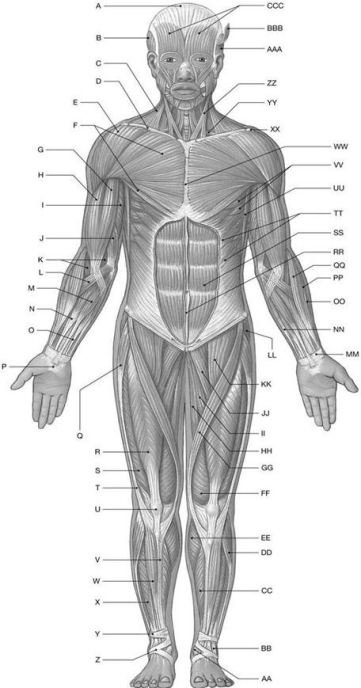 Using the above-referenced diagrammatic anterior view of the major superficial axial and appendicular muscles, identify the specified labeled item(s)in each of the following questions.
-Identify the structure(s) indicated by Label A.
Using the above-referenced diagrammatic anterior view of the major superficial axial and appendicular muscles, identify the specified labeled item(s)in each of the following questions.
-Identify the structure(s) indicated by Label A. (Multiple Choice)
4.8/5 (86)
(86) Figure 10.1
Using the above-referenced diagrammatic anterior view of the major superficial axial and appendicular muscles, identify the specified labeled item(s)in each of the following questions.
-Identify the structure(s) indicated by Label G.
Using the above-referenced diagrammatic anterior view of the major superficial axial and appendicular muscles, identify the specified labeled item(s)in each of the following questions.
-Identify the structure(s) indicated by Label G. (Multiple Choice)
4.7/5 (81)
(81) Figure 10.1
Using the above-referenced diagrammatic anterior view of the major superficial axial and appendicular muscles, identify the specified labeled item(s)in each of the following questions.
-Identify the structure(s) indicated by Label RR.
Using the above-referenced diagrammatic anterior view of the major superficial axial and appendicular muscles, identify the specified labeled item(s)in each of the following questions.
-Identify the structure(s) indicated by Label RR. (Multiple Choice)
4.8/5 (79)
(79) Figure 10.2
 Using the above-referenced diagrammatic posterior view of the major superficial axial and appendicular muscles, identify the specified labeled item(s)in each of the following questions.
-Identify the structure(s) indicated by Label Y.
Using the above-referenced diagrammatic posterior view of the major superficial axial and appendicular muscles, identify the specified labeled item(s)in each of the following questions.
-Identify the structure(s) indicated by Label Y. (Multiple Choice)
4.9/5 (65)
(65) A muscle that elevates the corner of the mouth and draws it laterally is the ________ muscle.
(Multiple Choice)
4.9/5 (87)
(87) The deep transverse perineal muscle flexes coccygeal joints, and it elevates and supports the pelvic floor.
(True/False)
4.9/5 (84)
(84) Figure 10.2
Using the above-referenced diagrammatic posterior view of the major superficial axial and appendicular muscles, identify the specified labeled item(s)in each of the following questions.
-Identify the structure(s) indicated by Label G.
Using the above-referenced diagrammatic posterior view of the major superficial axial and appendicular muscles, identify the specified labeled item(s)in each of the following questions.
-Identify the structure(s) indicated by Label G. (Multiple Choice)
4.8/5 (78)
(78) Figure 10.4
Using the above-referenced anterior view of the trunk, showing superficial and deep members of the oblique and rectus groups, and the horizontal section through the abdominal region, identify the specified labeled item(s)in each of the following questions.
-Identify the structure(s) indicated by Label I.
Using the above-referenced anterior view of the trunk, showing superficial and deep members of the oblique and rectus groups, and the horizontal section through the abdominal region, identify the specified labeled item(s)in each of the following questions.
-Identify the structure(s) indicated by Label I. (Multiple Choice)
4.8/5 (94)
(94) The muscle that originates on the sacrum and transverse process of each vertebra and inserts on the spinous process of the third or fourth more superior vertebra is the ________ muscle.
(Multiple Choice)
4.8/5 (71)
(71) Figure 10.4
Using the above-referenced anterior view of the trunk, showing superficial and deep members of the oblique and rectus groups, and the horizontal section through the abdominal region, identify the specified labeled item(s)in each of the following questions.
-Identify the structure(s) indicated by Label O.
Using the above-referenced anterior view of the trunk, showing superficial and deep members of the oblique and rectus groups, and the horizontal section through the abdominal region, identify the specified labeled item(s)in each of the following questions.
-Identify the structure(s) indicated by Label O. (Multiple Choice)
4.9/5 (83)
(83) Figure 10.4
Using the above-referenced anterior view of the trunk, showing superficial and deep members of the oblique and rectus groups, and the horizontal section through the abdominal region, identify the specified labeled item(s)in each of the following questions.
-Identify the structure(s) indicated by Label A.
Using the above-referenced anterior view of the trunk, showing superficial and deep members of the oblique and rectus groups, and the horizontal section through the abdominal region, identify the specified labeled item(s)in each of the following questions.
-Identify the structure(s) indicated by Label A. (Multiple Choice)
4.9/5 (84)
(84) The ________ muscle is divided longitudinally by a median collagenous partition called the linea alba.
(Multiple Choice)
4.8/5 (89)
(89) A muscle that constricts the opening of the mouth is orbicularis oculi.
(True/False)
4.7/5 (89)
(89) The muscular partition that separates the abdominopelvic and thoracic cavities is the ________.
(Multiple Choice)
4.8/5 (84)
(84) Figure 10.2
Using the above-referenced diagrammatic posterior view of the major superficial axial and appendicular muscles, identify the specified labeled item(s)in each of the following questions.
-Identify the structure(s) indicated by Label A.
Using the above-referenced diagrammatic posterior view of the major superficial axial and appendicular muscles, identify the specified labeled item(s)in each of the following questions.
-Identify the structure(s) indicated by Label A. (Multiple Choice)
4.8/5 (84)
(84) 
Filters
- Essay(0)
- Multiple Choice(0)
- Short Answer(0)
- True False(0)
- Matching(0)