



 Chat with AI
Exam 10: The Muscular System: Axial Musculature

Exam 1: Foundations: An Introduction to Anatomy124 Questions
Exam 2: Foundations: The Cell117 Questions
Exam 3: Foundations: Tissues and Early Embryology127 Questions
Exam 4: The Integumentary System127 Questions
Exam 5: The Skeletal System: Osseous Tissue and Skeletal Structure142 Questions
Exam 6: The Skeletal System: Axial Division150 Questions
Exam 7: The Skeletal System: Appendicular Division131 Questions
Exam 8: The Skeletal System: Articulations131 Questions
Exam 9: The Muscular System: Skeletal Muscle Tissue and Muscle Organization145 Questions
Exam 10: The Muscular System: Axial Musculature142 Questions
Exam 11: The Muscular System: Appendicular Musculature135 Questions
Exam 12: Surface Anatomy and Cross-Sectional Anatomy129 Questions
Exam 13: The Nervous System: Neural Tissue127 Questions
Exam 14: The Nervous System: The Spinal Cord and Spinal Nerves131 Questions
Exam 15: The Nervous System: Sensory and Motor Tracts of the Spinal Cord81 Questions
Exam 16: The Nervous System: The Brain and Cranial Nerves132 Questions
Exam 17: The Nervous System: Autonomic Nervous System115 Questions
Exam 18: The Nervous System: General and Special Senses127 Questions
Exam 19: The Endocrine System102 Questions
Exam 20: The Cardiovascular System: Blood71 Questions
Exam 21: The Cardiovascular System: The Heart150 Questions
Exam 22: The Cardiovascular System: Vessels and Circulation129 Questions
Exam 23: The Lymphatic System105 Questions
Exam 24: The Respiratory System128 Questions
Exam 25: The Digestive System132 Questions
Exam 26: The Urinary System135 Questions
Exam 27: The Reproductive System134 Questions
Exam 28: Embryology and Human Development140 Questions
Select questions type


Figure 10.2
 Using the above-referenced diagrammatic posterior view of the major superficial axial and appendicular muscles, identify the specified labeled item(s)in each of the following questions.
-Identify the structure(s) indicated by Label Q.
Using the above-referenced diagrammatic posterior view of the major superficial axial and appendicular muscles, identify the specified labeled item(s)in each of the following questions.
-Identify the structure(s) indicated by Label Q. (Multiple Choice)
4.8/5  (88)
(88) Figure 10.1
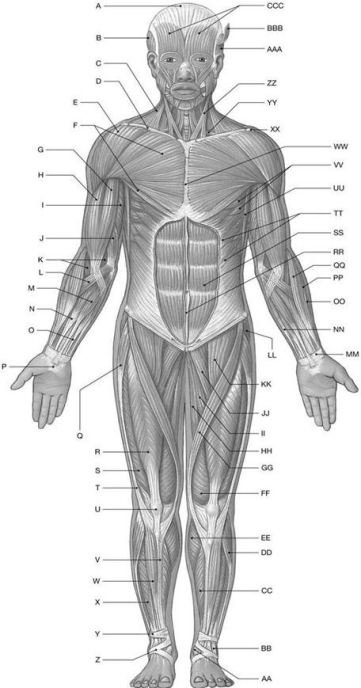 Using the above-referenced diagrammatic anterior view of the major superficial axial and appendicular muscles, identify the specified labeled item(s)in each of the following questions.
-Identify the structure(s) indicated by Label ZZ.
Using the above-referenced diagrammatic anterior view of the major superficial axial and appendicular muscles, identify the specified labeled item(s)in each of the following questions.
-Identify the structure(s) indicated by Label ZZ. (Multiple Choice)
4.8/5 (84)
(84) The muscle that elevates, everts, and protrudes the lower lip is the mentalis.
(True/False)
4.9/5 (77)
(77) What would be the consequences of a lacerated trigeminal nerve in terms of muscular control?
(Essay)
4.9/5 (68)
(68) A muscle of the scalp, with two bellies separated by a collagenous sheet, is called occipitofrontalis.
(True/False)
4.8/5 (71)
(71) Figure 10.3
 Using the above-referenced diagrammatic view of extra-ocular muscles on the lateral surface of the right eye, identify the specified labeled item(s)in each of the following questions.
-Identify the structure(s) indicated by Label J.
Using the above-referenced diagrammatic view of extra-ocular muscles on the lateral surface of the right eye, identify the specified labeled item(s)in each of the following questions.
-Identify the structure(s) indicated by Label J. (Multiple Choice)
4.8/5 (76)
(76) Figure 10.1
Using the above-referenced diagrammatic anterior view of the major superficial axial and appendicular muscles, identify the specified labeled item(s)in each of the following questions.
-Identify the structure(s) indicated by Label CCC.
Using the above-referenced diagrammatic anterior view of the major superficial axial and appendicular muscles, identify the specified labeled item(s)in each of the following questions.
-Identify the structure(s) indicated by Label CCC. (Multiple Choice)
4.8/5 (76)
(76) Figure 10.4
 Using the above-referenced anterior view of the trunk, showing superficial and deep members of the oblique and rectus groups, and the horizontal section through the abdominal region, identify the specified labeled item(s)in each of the following questions.
-Identify the structure(s) indicated by Label D.
Using the above-referenced anterior view of the trunk, showing superficial and deep members of the oblique and rectus groups, and the horizontal section through the abdominal region, identify the specified labeled item(s)in each of the following questions.
-Identify the structure(s) indicated by Label D. (Multiple Choice)
4.9/5 (62)
(62) Figure 10.4
Using the above-referenced anterior view of the trunk, showing superficial and deep members of the oblique and rectus groups, and the horizontal section through the abdominal region, identify the specified labeled item(s)in each of the following questions.
-Identify the structure(s) indicated by Label G.
Using the above-referenced anterior view of the trunk, showing superficial and deep members of the oblique and rectus groups, and the horizontal section through the abdominal region, identify the specified labeled item(s)in each of the following questions.
-Identify the structure(s) indicated by Label G. (Multiple Choice)
4.8/5 (85)
(85) The digastric muscle depresses the mandible and/or elevates the larynx.
(True/False)
4.7/5 (82)
(82) Figure 10.4
Using the above-referenced anterior view of the trunk, showing superficial and deep members of the oblique and rectus groups, and the horizontal section through the abdominal region, identify the specified labeled item(s)in each of the following questions.
-Identify the structure(s) indicated by Label B.
Using the above-referenced anterior view of the trunk, showing superficial and deep members of the oblique and rectus groups, and the horizontal section through the abdominal region, identify the specified labeled item(s)in each of the following questions.
-Identify the structure(s) indicated by Label B. (Multiple Choice)
4.9/5 (87)
(87) Figure 10.1
Using the above-referenced diagrammatic anterior view of the major superficial axial and appendicular muscles, identify the specified labeled item(s)in each of the following questions.
-Identify the structure(s) indicated by Label R.
Using the above-referenced diagrammatic anterior view of the major superficial axial and appendicular muscles, identify the specified labeled item(s)in each of the following questions.
-Identify the structure(s) indicated by Label R. (Multiple Choice)
4.9/5 (83)
(83) Figure 10.2
Using the above-referenced diagrammatic posterior view of the major superficial axial and appendicular muscles, identify the specified labeled item(s)in each of the following questions.
-Identify the structure(s) indicated by Label I.
Using the above-referenced diagrammatic posterior view of the major superficial axial and appendicular muscles, identify the specified labeled item(s)in each of the following questions.
-Identify the structure(s) indicated by Label I. (Multiple Choice)
4.8/5 (87)
(87) Which of the following belongs to the second group of the axial muscles that include flexors and extensors of the axial skeleton?
(Multiple Choice)
4.7/5 (82)
(82) How do the extra-ocular eye muscles differ in action from the intrinsic eye muscles?
(Multiple Choice)
4.8/5 (85)
(85) Why are there so few spinal flexors associated with the anterior surface of the vertebral column, whereas there are a large number of different extensor groups?
(Essay)
5.0/5 (78)
(78) The erector spinae muscle group that is located most medial to the vertebral column is the ________.
(Multiple Choice)
4.8/5 (85)
(85) Muscles of mastication most often insert into the ________.
(Multiple Choice)
4.9/5 (76)
(76) 
Filters
- Essay(0)
- Multiple Choice(0)
- Short Answer(0)
- True False(0)
- Matching(0)