



 Chat with AI
Exam 2: Foundations: The Cell

Exam 1: Foundations: An Introduction to Anatomy124 Questions
Exam 2: Foundations: The Cell117 Questions
Exam 3: Foundations: Tissues and Early Embryology127 Questions
Exam 4: The Integumentary System127 Questions
Exam 5: The Skeletal System: Osseous Tissue and Skeletal Structure142 Questions
Exam 6: The Skeletal System: Axial Division150 Questions
Exam 7: The Skeletal System: Appendicular Division131 Questions
Exam 8: The Skeletal System: Articulations131 Questions
Exam 9: The Muscular System: Skeletal Muscle Tissue and Muscle Organization145 Questions
Exam 10: The Muscular System: Axial Musculature142 Questions
Exam 11: The Muscular System: Appendicular Musculature135 Questions
Exam 12: Surface Anatomy and Cross-Sectional Anatomy129 Questions
Exam 13: The Nervous System: Neural Tissue127 Questions
Exam 14: The Nervous System: The Spinal Cord and Spinal Nerves131 Questions
Exam 15: The Nervous System: Sensory and Motor Tracts of the Spinal Cord81 Questions
Exam 16: The Nervous System: The Brain and Cranial Nerves132 Questions
Exam 17: The Nervous System: Autonomic Nervous System115 Questions
Exam 18: The Nervous System: General and Special Senses127 Questions
Exam 19: The Endocrine System102 Questions
Exam 20: The Cardiovascular System: Blood71 Questions
Exam 21: The Cardiovascular System: The Heart150 Questions
Exam 22: The Cardiovascular System: Vessels and Circulation129 Questions
Exam 23: The Lymphatic System105 Questions
Exam 24: The Respiratory System128 Questions
Exam 25: The Digestive System132 Questions
Exam 26: The Urinary System135 Questions
Exam 27: The Reproductive System134 Questions
Exam 28: Embryology and Human Development140 Questions
Select questions type


Which type of cell junction attach an epithelial cell to extracellular structures.
(Multiple Choice)
4.9/5  (75)
(75) A transport process that produces cytoplasmic vesicles filled with extracellular fluid is called ________.
(Multiple Choice)
4.8/5 (71)
(71) Endocytosis is an energy-requiring process where vesicles are packaged with extracellular material for importation into the cell.
(True/False)
4.8/5 (88)
(88) Chemical communication between the nucleus and the cytosol occurs through (the)________.
(Multiple Choice)
4.9/5 (70)
(70) In correct order from beginning to end, cells undergoing mitosis pass through ________.
(Multiple Choice)
4.7/5 (82)
(82) ________ help stabilize the plasma membrane structure and maintain its fluidity.
(Multiple Choice)
4.8/5 (80)
(80) Microtubules, thick filaments, intermediate filaments, and microfilaments are all part of the cell's ________.
(Multiple Choice)
4.9/5 (72)
(72) ________ are organelles that contain an unusual double-layered membrane, and functions in producing most of the ATP in the body.
(Multiple Choice)
4.7/5 (85)
(85) How do peripheral proteins contribute to the structure of the plasma membrane?
(Multiple Choice)
4.7/5 (78)
(78) ________ provide strength, stabilize organelles, and transport materials within the cytoplasm; they are defined by their size rather than composition, which varies from cell to cell.
(Multiple Choice)
4.9/5 (86)
(86) Distinguish between primary and secondary lysosomes; how do they function?
(Essay)
4.9/5 (85)
(85) Figure 2.1
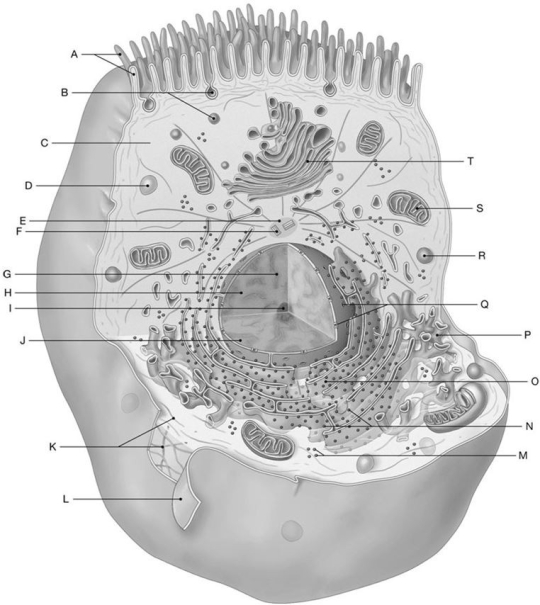 Using the figure above, answer the following questions.
-What is the anatomical term for Label L?
Using the figure above, answer the following questions.
-What is the anatomical term for Label L? (Multiple Choice)
4.9/5 (72)
(72) Why are microtubules considered among the non-membranous organelles?
(Multiple Choice)
4.8/5 (86)
(86) Figure 2.1
Using the figure above, answer the following questions.
-What is the anatomical term for Label A?
Using the figure above, answer the following questions.
-What is the anatomical term for Label A? (Multiple Choice)
4.9/5 (67)
(67) Figure 2.2
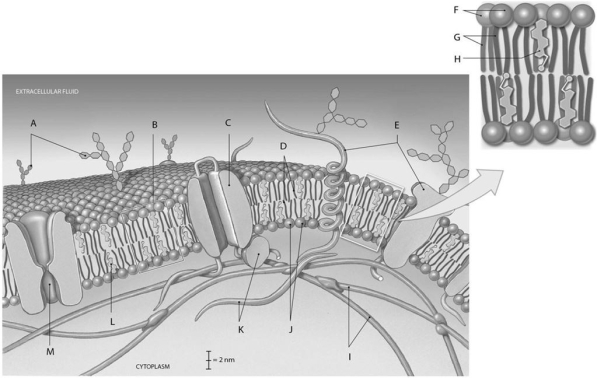 Using the figure above, identify the labeled parts.
-What is the anatomical term for Label B?
Using the figure above, identify the labeled parts.
-What is the anatomical term for Label B? (Multiple Choice)
4.8/5 (76)
(76) Which organelle determines the structural and functional characteristics of the cell by controlling protein synthesis, determining what proteins are synthesized, and in what amounts?
(Multiple Choice)
4.9/5 (81)
(81) 
Filters
- Essay(0)
- Multiple Choice(0)
- Short Answer(0)
- True False(0)
- Matching(0)