



 Chat with AI
Exam 2: Foundations: The Cell

Exam 1: Foundations: An Introduction to Anatomy124 Questions
Exam 2: Foundations: The Cell117 Questions
Exam 3: Foundations: Tissues and Early Embryology127 Questions
Exam 4: The Integumentary System127 Questions
Exam 5: The Skeletal System: Osseous Tissue and Skeletal Structure142 Questions
Exam 6: The Skeletal System: Axial Division150 Questions
Exam 7: The Skeletal System: Appendicular Division131 Questions
Exam 8: The Skeletal System: Articulations131 Questions
Exam 9: The Muscular System: Skeletal Muscle Tissue and Muscle Organization145 Questions
Exam 10: The Muscular System: Axial Musculature142 Questions
Exam 11: The Muscular System: Appendicular Musculature135 Questions
Exam 12: Surface Anatomy and Cross-Sectional Anatomy129 Questions
Exam 13: The Nervous System: Neural Tissue127 Questions
Exam 14: The Nervous System: The Spinal Cord and Spinal Nerves131 Questions
Exam 15: The Nervous System: Sensory and Motor Tracts of the Spinal Cord81 Questions
Exam 16: The Nervous System: The Brain and Cranial Nerves132 Questions
Exam 17: The Nervous System: Autonomic Nervous System115 Questions
Exam 18: The Nervous System: General and Special Senses127 Questions
Exam 19: The Endocrine System102 Questions
Exam 20: The Cardiovascular System: Blood71 Questions
Exam 21: The Cardiovascular System: The Heart150 Questions
Exam 22: The Cardiovascular System: Vessels and Circulation129 Questions
Exam 23: The Lymphatic System105 Questions
Exam 24: The Respiratory System128 Questions
Exam 25: The Digestive System132 Questions
Exam 26: The Urinary System135 Questions
Exam 27: The Reproductive System134 Questions
Exam 28: Embryology and Human Development140 Questions
Select questions type


During ________, the centromere of each chromatid pair separates and the daughter chromosomes are pulled toward opposite ends of the cell, along the chromosomal microtubules.
(Multiple Choice)
4.8/5  (69)
(69) Figure 2.1
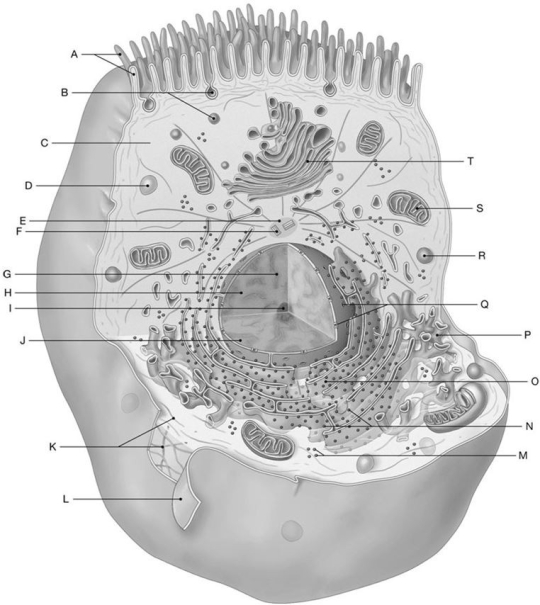 Using the figure above, answer the following questions.
-What is the anatomical term for Label O?
Using the figure above, answer the following questions.
-What is the anatomical term for Label O? (Multiple Choice)
4.8/5 (78)
(78) At intervals, the DNA wind around special proteins, forming a complex called ________; this complex may also coil around other special proteins.
(Multiple Choice)
4.9/5 (87)
(87) The mitochondrion is enclosed by a double membrane with numerous folds, or cristae, in the inner membrane; the fluid matrix of these organelles contains important metabolic enzymes.
(True/False)
4.9/5 (76)
(76) The cytosol contains a high concentration of ________ ions, while the extracellular fluid usually contains a high concentration of ________ ions.
(Multiple Choice)
4.8/5 (82)
(82) Which of the following describes phospholipids in the plasma membrane?
(Multiple Choice)
4.8/5 (76)
(76) Predict the consequences of non-functional cilia in the respiratory airways.
(Essay)
4.9/5 (95)
(95) Which of the following is a passive process for material movement across a plasma membrane?
(Multiple Choice)
4.9/5 (94)
(94) Active transport is an energy-requiring process whereby ions and possibly other materials are moved across a membrane by carrier proteins, which work despite an opposing concentration gradient.
(True/False)
4.8/5 (77)
(77) A passive process that involves the movement of water (solvent)molecules toward solute concentrations across a membrane is called facilitated diffusion.
(True/False)
4.8/5 (90)
(90) Which of the following is a cylindrical structure composed of short microtubules?
(Multiple Choice)
4.9/5 (73)
(73) Figure 2.1
Using the figure above, answer the following questions.
-What is the anatomical term for Label Q?
Using the figure above, answer the following questions.
-What is the anatomical term for Label Q? (Multiple Choice)
4.8/5 (77)
(77) An active process for transporting extracellular fluid, such as water and small molecules, across a plasm membrane is ________.
(Multiple Choice)
4.8/5 (91)
(91) At structures called ________, two cells are held together by membrane proteins that function as a narrow passageway, allowing ions, small metabolites, and regulatory molecules to pass from cell to cell.
(Multiple Choice)
4.9/5 (82)
(82) 
Filters
- Essay(0)
- Multiple Choice(0)
- Short Answer(0)
- True False(0)
- Matching(0)