



 Chat with AI
Exam 2: Foundations: The Cell

Exam 1: Foundations: An Introduction to Anatomy124 Questions
Exam 2: Foundations: The Cell117 Questions
Exam 3: Foundations: Tissues and Early Embryology127 Questions
Exam 4: The Integumentary System127 Questions
Exam 5: The Skeletal System: Osseous Tissue and Skeletal Structure142 Questions
Exam 6: The Skeletal System: Axial Division150 Questions
Exam 7: The Skeletal System: Appendicular Division131 Questions
Exam 8: The Skeletal System: Articulations131 Questions
Exam 9: The Muscular System: Skeletal Muscle Tissue and Muscle Organization145 Questions
Exam 10: The Muscular System: Axial Musculature142 Questions
Exam 11: The Muscular System: Appendicular Musculature135 Questions
Exam 12: Surface Anatomy and Cross-Sectional Anatomy129 Questions
Exam 13: The Nervous System: Neural Tissue127 Questions
Exam 14: The Nervous System: The Spinal Cord and Spinal Nerves131 Questions
Exam 15: The Nervous System: Sensory and Motor Tracts of the Spinal Cord81 Questions
Exam 16: The Nervous System: The Brain and Cranial Nerves132 Questions
Exam 17: The Nervous System: Autonomic Nervous System115 Questions
Exam 18: The Nervous System: General and Special Senses127 Questions
Exam 19: The Endocrine System102 Questions
Exam 20: The Cardiovascular System: Blood71 Questions
Exam 21: The Cardiovascular System: The Heart150 Questions
Exam 22: The Cardiovascular System: Vessels and Circulation129 Questions
Exam 23: The Lymphatic System105 Questions
Exam 24: The Respiratory System128 Questions
Exam 25: The Digestive System132 Questions
Exam 26: The Urinary System135 Questions
Exam 27: The Reproductive System134 Questions
Exam 28: Embryology and Human Development140 Questions
Select questions type


In cells preparing for division, the phase of the life cycle that is most variable in length is the ________ of interphase.
(Multiple Choice)
4.9/5  (77)
(77) Figure 2.1
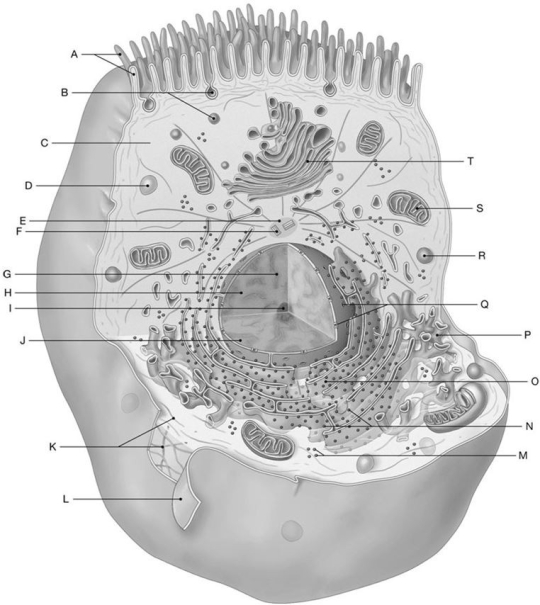 Using the figure above, answer the following questions.
-What is the anatomical term for Label D?
Using the figure above, answer the following questions.
-What is the anatomical term for Label D? (Multiple Choice)
4.7/5 (92)
(92) The extracellular fluid contains high concentration of ________.
(Multiple Choice)
4.8/5 (83)
(83) A passive process that involves movement of substances from an area of higher concentration to an area of lower concentration is called ________.
(Multiple Choice)
5.0/5 (72)
(72) The membrane of a cell is composed of a(n)________ bilayer.
(Multiple Choice)
4.8/5 (80)
(80) Figure 2.2
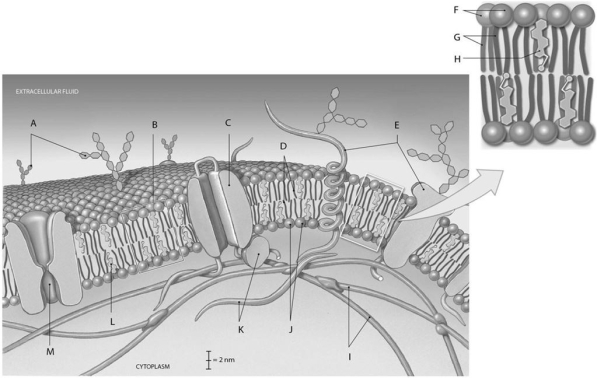 Using the figure above, identify the labeled parts.
-What is the anatomical term for Label K?
Using the figure above, identify the labeled parts.
-What is the anatomical term for Label K? (Multiple Choice)
4.9/5 (82)
(82) In osmosis, the substance(s)moved across a selectively permeable membrane is/are ________.
(Multiple Choice)
4.9/5 (74)
(74) Which statement describes how the plasma membrane is used in communication and sensitivity?
(Multiple Choice)
4.9/5 (95)
(95) Why is it potentially harmful to give a patient intravenous fluid that is pure water?
(Essay)
4.8/5 (86)
(86) Which of the following synthesizes the components of ribosomes?
(Multiple Choice)
4.9/5 (79)
(79) ________ are slender strands, usually composed of the protein actin.
(Multiple Choice)
4.7/5 (93)
(93) Figure 2.1
Using the figure above, answer the following questions.
-What is the anatomical term for Label G?
Using the figure above, answer the following questions.
-What is the anatomical term for Label G? (Multiple Choice)
5.0/5 (84)
(84) ________ is/are the substance(s)involved in facilitated diffusion.
(Multiple Choice)
4.8/5 (85)
(85) How does the plasma membrane change either over time or in response to modifications in the extracellular fluid?
(Essay)
4.9/5 (77)
(77) A ________ moves a cell through the surrounding fluid, rather than moving the fluid past a stationary cell.
(Multiple Choice)
4.8/5 (71)
(71) Peripheral proteins are attached to the surface of the plasma membrane, while ________ are embedded within the membrane.
(Multiple Choice)
4.7/5 (87)
(87) 
Filters
- Essay(0)
- Multiple Choice(0)
- Short Answer(0)
- True False(0)
- Matching(0)