



 Chat with AI
Exam 2: Foundations: The Cell

Exam 1: Foundations: An Introduction to Anatomy124 Questions
Exam 2: Foundations: The Cell117 Questions
Exam 3: Foundations: Tissues and Early Embryology127 Questions
Exam 4: The Integumentary System127 Questions
Exam 5: The Skeletal System: Osseous Tissue and Skeletal Structure142 Questions
Exam 6: The Skeletal System: Axial Division150 Questions
Exam 7: The Skeletal System: Appendicular Division131 Questions
Exam 8: The Skeletal System: Articulations131 Questions
Exam 9: The Muscular System: Skeletal Muscle Tissue and Muscle Organization145 Questions
Exam 10: The Muscular System: Axial Musculature142 Questions
Exam 11: The Muscular System: Appendicular Musculature135 Questions
Exam 12: Surface Anatomy and Cross-Sectional Anatomy129 Questions
Exam 13: The Nervous System: Neural Tissue127 Questions
Exam 14: The Nervous System: The Spinal Cord and Spinal Nerves131 Questions
Exam 15: The Nervous System: Sensory and Motor Tracts of the Spinal Cord81 Questions
Exam 16: The Nervous System: The Brain and Cranial Nerves132 Questions
Exam 17: The Nervous System: Autonomic Nervous System115 Questions
Exam 18: The Nervous System: General and Special Senses127 Questions
Exam 19: The Endocrine System102 Questions
Exam 20: The Cardiovascular System: Blood71 Questions
Exam 21: The Cardiovascular System: The Heart150 Questions
Exam 22: The Cardiovascular System: Vessels and Circulation129 Questions
Exam 23: The Lymphatic System105 Questions
Exam 24: The Respiratory System128 Questions
Exam 25: The Digestive System132 Questions
Exam 26: The Urinary System135 Questions
Exam 27: The Reproductive System134 Questions
Exam 28: Embryology and Human Development140 Questions
Select questions type


The continual movement and exchange of vesicles to and from the plasma membrane is called ________.
(Multiple Choice)
5.0/5  (73)
(73) A passive process wherein carrier molecules transport materials down concentration gradients across a membrane is called osmosis.
(True/False)
4.8/5 (73)
(73) As the Golgi apparatus loses membrane through generation of vesicles at the cis face, it gains membrane by the fusion of transport vesicles at the trans face.
(True/False)
4.8/5 (76)
(76) Figure 2.2
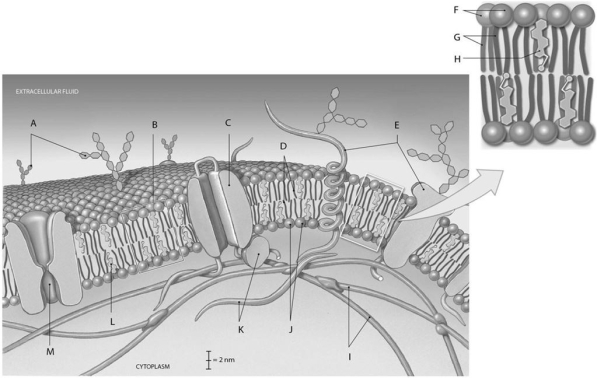 Using the figure above, identify the labeled parts.
-What is the anatomical term for Label C?
Using the figure above, identify the labeled parts.
-What is the anatomical term for Label C? (Multiple Choice)
4.8/5 (70)
(70) What is the term for the movement of water across a selectively permeable membrane from a low solute concentration to a high solute concentration?
(Multiple Choice)
4.8/5 (73)
(73) Factors affecting the rate of phagocytosis include the presence and abundance of ________.
(Multiple Choice)
4.9/5 (93)
(93) ________ are common inclusions in the cytosol of fat cells.
(Multiple Choice)
4.7/5 (83)
(83) Carbon dioxide moves through the plasma membrane through the process of ________.
(Multiple Choice)
4.7/5 (76)
(76) Compared with extracellular fluid, a sample of cytosol has ________.
(Multiple Choice)
4.8/5 (88)
(88) Figure 2.1
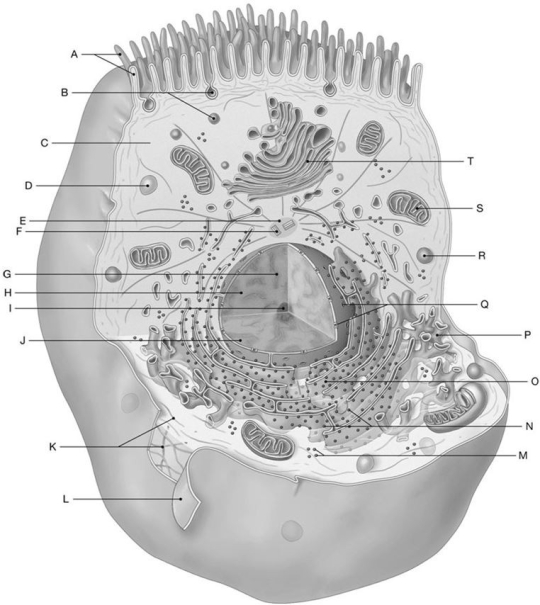 Using the figure above, answer the following questions.
-What is the anatomical term for Label K?
Using the figure above, answer the following questions.
-What is the anatomical term for Label K? (Multiple Choice)
4.8/5 (76)
(76) Somatic cells spend the majority of their functional lives in ________.
(Multiple Choice)
4.9/5 (75)
(75) ________ increase surface area to facilitate absorption of extracellular materials.
(Multiple Choice)
4.9/5 (87)
(87) Channels in the plasma membrane that can open or close to regulate the passage of water, small ions, and water-soluble molecules are called ________ channels.
(Multiple Choice)
4.9/5 (71)
(71) Figure 2.1
Using the figure above, answer the following questions.
-What is the anatomical term for Label I?
Using the figure above, answer the following questions.
-What is the anatomical term for Label I? (Multiple Choice)
4.9/5 (65)
(65) A passive process that allows passage of small inorganic ions and molecules, gases, and lipid-soluble materials in all cell types is called diffusion.
(True/False)
4.8/5 (87)
(87) "Little organs" inside a cell that have specialized functions are called ________.
(Multiple Choice)
4.9/5 (86)
(86) 
Filters
- Essay(0)
- Multiple Choice(0)
- Short Answer(0)
- True False(0)
- Matching(0)