



 Chat with AI
Exam 2: Foundations: The Cell

Exam 1: Foundations: An Introduction to Anatomy124 Questions
Exam 2: Foundations: The Cell117 Questions
Exam 3: Foundations: Tissues and Early Embryology127 Questions
Exam 4: The Integumentary System127 Questions
Exam 5: The Skeletal System: Osseous Tissue and Skeletal Structure142 Questions
Exam 6: The Skeletal System: Axial Division150 Questions
Exam 7: The Skeletal System: Appendicular Division131 Questions
Exam 8: The Skeletal System: Articulations131 Questions
Exam 9: The Muscular System: Skeletal Muscle Tissue and Muscle Organization145 Questions
Exam 10: The Muscular System: Axial Musculature142 Questions
Exam 11: The Muscular System: Appendicular Musculature135 Questions
Exam 12: Surface Anatomy and Cross-Sectional Anatomy129 Questions
Exam 13: The Nervous System: Neural Tissue127 Questions
Exam 14: The Nervous System: The Spinal Cord and Spinal Nerves131 Questions
Exam 15: The Nervous System: Sensory and Motor Tracts of the Spinal Cord81 Questions
Exam 16: The Nervous System: The Brain and Cranial Nerves132 Questions
Exam 17: The Nervous System: Autonomic Nervous System115 Questions
Exam 18: The Nervous System: General and Special Senses127 Questions
Exam 19: The Endocrine System102 Questions
Exam 20: The Cardiovascular System: Blood71 Questions
Exam 21: The Cardiovascular System: The Heart150 Questions
Exam 22: The Cardiovascular System: Vessels and Circulation129 Questions
Exam 23: The Lymphatic System105 Questions
Exam 24: The Respiratory System128 Questions
Exam 25: The Digestive System132 Questions
Exam 26: The Urinary System135 Questions
Exam 27: The Reproductive System134 Questions
Exam 28: Embryology and Human Development140 Questions
Select questions type


Figure 2.1
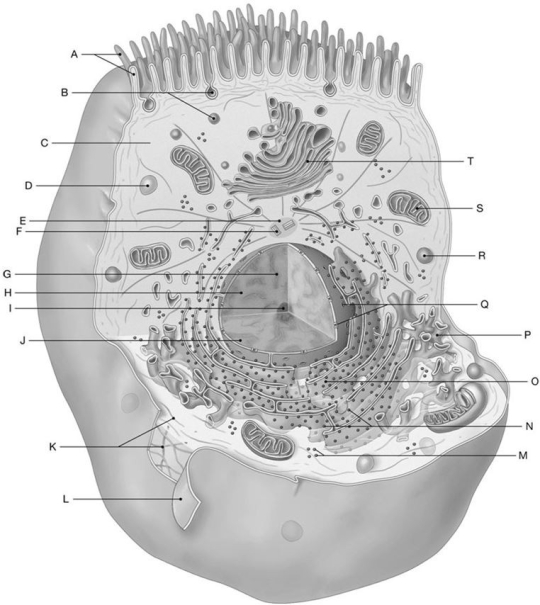 Using the figure above, answer the following questions.
-What is the anatomical term for Label M?
Using the figure above, answer the following questions.
-What is the anatomical term for Label M? (Multiple Choice)
4.9/5  (92)
(92) Figure 2.1
Using the figure above, answer the following questions.
-What is the anatomical term for Label C?
Using the figure above, answer the following questions.
-What is the anatomical term for Label C? (Multiple Choice)
4.8/5 (79)
(79) Figure 2.2
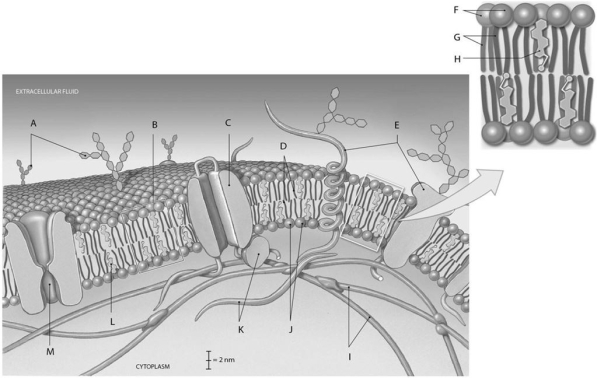 Using the figure above, identify the labeled parts.
-What is the anatomical term for Label M?
Using the figure above, identify the labeled parts.
-What is the anatomical term for Label M? (Multiple Choice)
4.9/5 (82)
(82) The endoplasmic reticulum is the organelle responsible for the synthesis of secretory products and provides for intracellular storage and transport.
(True/False)
4.8/5 (83)
(83) Because the plasma membrane restricts some substances and permits others through, it is referred to as being ________.
(Multiple Choice)
4.9/5 (85)
(85) Vesicles that contain oxidases and catalase are called peroxisomes.
(True/False)
5.0/5 (82)
(82) ________ are organelles filled with digestive enzymes, which function in the intracellular removal of pathogens and damaged organelles.
(Multiple Choice)
4.8/5 (79)
(79) The ________ is the organelle that synthesizes the components of ribosomes.
(Multiple Choice)
4.9/5 (65)
(65) Figure 2.1
Using the figure above, answer the following questions.
-What is the anatomical term for Label T?
Using the figure above, answer the following questions.
-What is the anatomical term for Label T? (Multiple Choice)
4.7/5 (86)
(86) Which of the following statements accurately describes cytosol?
(Multiple Choice)
4.8/5 (77)
(77) In the nucleus, what is the special protein to which DNA strands are bound?
(Multiple Choice)
4.9/5 (78)
(78) Which sequence correctly traces the steps of DNA replication during the S phase?
(1)Weak bonds between nitrogenous bases of the DNA are broken.
(2)DNA strands unwind.
(3)DNA polymerase binds to exposed nitrogenous bases.
(4)Ligases link together short complementary chains of nucleotides.
(5)Nitrogenous bases of the DNA strand attach to complementary nucleotides.
(Multiple Choice)
4.9/5 (73)
(73) Figure 2.2
Using the figure above, identify the labeled parts.
-What is the anatomical term for Label A?
Using the figure above, identify the labeled parts.
-What is the anatomical term for Label A? (Multiple Choice)
4.9/5 (70)
(70) Processes involved in the movement of substances across a membrane at the expense of ATP, via exchange pumps, are classified as ________.
(Multiple Choice)
4.9/5 (81)
(81) If a cell lacked centrioles, it would be unable to ________.
(Multiple Choice)
4.7/5 (78)
(78) Figure 2.2
Using the figure above, identify the labeled parts.
-What is the anatomical term for Label E?
Using the figure above, identify the labeled parts.
-What is the anatomical term for Label E? (Multiple Choice)
4.8/5 (83)
(83) Manufactured proteins from the rough endoplasmic reticulum are delivered to the Golgi apparatus by ________.
(Multiple Choice)
4.7/5 (74)
(74) How does the structure of a tight junction differ from that of an anchoring junction?
(Essay)
4.7/5 (74)
(74) Renewal or modification of the plasma membrane is the major function of which organelle?
(Multiple Choice)
4.7/5 (74)
(74) 
Filters
- Essay(0)
- Multiple Choice(0)
- Short Answer(0)
- True False(0)
- Matching(0)