



 Chat with AI
Exam 35: International Trade and Comparative Advantage

Exam 1: What Is Economics?227 Questions
Exam 2: The Economy: Myth and Reality150 Questions
Exam 3: The Fundamental Economic Problem: Scarcity and Choice250 Questions
Exam 4: Supply and Demand: An Initial Look308 Questions
Exam 5: Consumer Choice: Individual and Market Demand202 Questions
Exam 6: Demand and Elasticity209 Questions
Exam 7: Production, Inputs, and Cost: Building Blocks for Supply Analysis216 Questions
Exam 8: Output, Price, and Profit: The Importance of Marginal Analysis189 Questions
Exam 9: Securities: Business Finance, and the Economy: The Tail that Wags the Dog?198 Questions
Exam 10: The Firm and the Industry under Perfect Competition208 Questions
Exam 11: Monopoly203 Questions
Exam 12: Between Competition and Monopoly225 Questions
Exam 13: Limiting Market Power: Regulation and Antitrust152 Questions
Exam 14: The Case for Free Markets I: The Price System220 Questions
Exam 15: The Shortcomings of Free Markets212 Questions
Exam 16: The Market's Prime Achievement: Innovation and Growth110 Questions
Exam 17: Externalities, the Environment, and Natural Resources217 Questions
Exam 18: Taxation and Resource Allocation219 Questions
Exam 19: Pricing the Factors of Production228 Questions
Exam 20: Labor and Entrepreneurship: The Human Inputs223 Questions
Exam 21: Poverty, Inequality, and Discrimination167 Questions
Exam 22: An Introduction to Macroeconomics211 Questions
Exam 23: The Goals of Macroeconomic Policy207 Questions
Exam 24: Economic Growth: Theory and Policy223 Questions
Exam 25: Aggregate Demand and the Powerful Consumer214 Questions
Exam 26: Demand-Side Equilibrium: Unemployment or Inflation?210 Questions
Exam 27: Bringing in the Supply Side: Unemployment and Inflation?223 Questions
Exam 28: Managing Aggregate Demand: Fiscal Policy205 Questions
Exam 29: Money and the Banking System219 Questions
Exam 30: Monetary Policy: Conventional and Unconventional205 Questions
Exam 31: The Financial Crisis and the Great Recession61 Questions
Exam 32: The Debate over Monetary and Fiscal Policy214 Questions
Exam 33: Budget Deficits in the Short and Long Run210 Questions
Exam 34: The Trade-Off between Inflation and Unemployment214 Questions
Exam 35: International Trade and Comparative Advantage226 Questions
Exam 36: The International Monetary System: Order or Disorder?213 Questions
Exam 37: Exchange Rates and the Macroeconomy214 Questions
Select questions type


An essential point, among many, in the refutation of the "cheap foreign labor" argument is that
(Multiple Choice)
4.8/5  (83)
(83) If Brazil voluntarily ships coffee to the United States in return for airplanes,
(Multiple Choice)
5.0/5 (70)
(70) If all countries produce the goods for which they have comparative advantages, all countries benefit with the increased production of goods with no additional resources being used.
(True/False)
4.9/5 (68)
(68) If Argentina has a large amount of farmland and Great Britain has many factories,
(Multiple Choice)
4.9/5 (94)
(94) American producers often complain about dumping.What is dumping, and should it be prohibited?
(Essay)
4.9/5 (89)
(89) Table 18-1
Alternate Outputs from One Day's Labor Input Wheat Textiles United States (One person's/day's labor) 12 bushels or 3 yards Great Britain (One person's/day's labor) 3 bushels or 12 yards
-From Table 18-1, the United States
(Multiple Choice)
4.7/5 (77)
(77) Colombia produces coffee with less labor and land than any other country; it therefore surely has
(Multiple Choice)
4.9/5 (81)
(81) A program of protection that results in preserving jobs in certain industries
(Multiple Choice)
4.8/5 (72)
(72)  -In Figure 18-9, at price OC
Figure 18-2
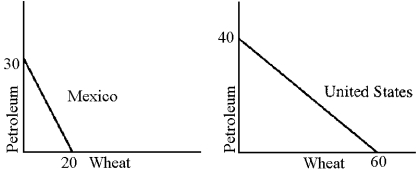 -In Figure 18-2, if the United States and Mexico are negotiating to trade wheat for petroleum,
 (Multiple Choice)
4.8/5 (76)
(76) Using graphs to illustrate the concepts, absolute advantage
(Multiple Choice)
4.7/5 (71)
(71) "Free trade benefits one country at another country's expense." Evaluate this statement using economic analysis.
(Essay)
4.8/5 (71)
(71) A country can gain by importing a good that it can make itself if
(Multiple Choice)
4.7/5 (88)
(88) Even though international trade is more complicated, supply and demand are still at the center of the price determination mechanism.
(True/False)
5.0/5 (84)
(84) Comparative advantage is illustrated by the slopes of production possibilities frontiers.
(True/False)
4.8/5 (72)
(72) Suppose the South had won the Civil War, and trade no longer took place between Northern and Southern states.Explain whether the sum of the North and South GDPs would have been higher or lower than with the current United States.
(Essay)
5.0/5 (80)
(80) 
Filters
- Essay(0)
- Multiple Choice(0)
- Short Answer(0)
- True False(0)
- Matching(0)