



 Chat with AI
Exam 35: International Trade and Comparative Advantage

Exam 1: What Is Economics?227 Questions
Exam 2: The Economy: Myth and Reality150 Questions
Exam 3: The Fundamental Economic Problem: Scarcity and Choice250 Questions
Exam 4: Supply and Demand: An Initial Look308 Questions
Exam 5: Consumer Choice: Individual and Market Demand202 Questions
Exam 6: Demand and Elasticity209 Questions
Exam 7: Production, Inputs, and Cost: Building Blocks for Supply Analysis216 Questions
Exam 8: Output, Price, and Profit: The Importance of Marginal Analysis189 Questions
Exam 9: Securities: Business Finance, and the Economy: The Tail that Wags the Dog?198 Questions
Exam 10: The Firm and the Industry under Perfect Competition208 Questions
Exam 11: Monopoly203 Questions
Exam 12: Between Competition and Monopoly225 Questions
Exam 13: Limiting Market Power: Regulation and Antitrust152 Questions
Exam 14: The Case for Free Markets I: The Price System220 Questions
Exam 15: The Shortcomings of Free Markets212 Questions
Exam 16: The Market's Prime Achievement: Innovation and Growth110 Questions
Exam 17: Externalities, the Environment, and Natural Resources217 Questions
Exam 18: Taxation and Resource Allocation219 Questions
Exam 19: Pricing the Factors of Production228 Questions
Exam 20: Labor and Entrepreneurship: The Human Inputs223 Questions
Exam 21: Poverty, Inequality, and Discrimination167 Questions
Exam 22: An Introduction to Macroeconomics211 Questions
Exam 23: The Goals of Macroeconomic Policy207 Questions
Exam 24: Economic Growth: Theory and Policy223 Questions
Exam 25: Aggregate Demand and the Powerful Consumer214 Questions
Exam 26: Demand-Side Equilibrium: Unemployment or Inflation?210 Questions
Exam 27: Bringing in the Supply Side: Unemployment and Inflation?223 Questions
Exam 28: Managing Aggregate Demand: Fiscal Policy205 Questions
Exam 29: Money and the Banking System219 Questions
Exam 30: Monetary Policy: Conventional and Unconventional205 Questions
Exam 31: The Financial Crisis and the Great Recession61 Questions
Exam 32: The Debate over Monetary and Fiscal Policy214 Questions
Exam 33: Budget Deficits in the Short and Long Run210 Questions
Exam 34: The Trade-Off between Inflation and Unemployment214 Questions
Exam 35: International Trade and Comparative Advantage226 Questions
Exam 36: The International Monetary System: Order or Disorder?213 Questions
Exam 37: Exchange Rates and the Macroeconomy214 Questions
Select questions type


A country that must inhibit imports should give preference to
(Multiple Choice)
4.9/5  (74)
(74) A restriction of imports that is accomplished by a quota normally
(Multiple Choice)
4.8/5 (83)
(83) Figure 18-9
 -In Figure 18-9, at price OC total quantity demanded exceeds quantity supplied and price will rise to
 (Multiple Choice)
4.7/5 (79)
(79) If one country has an absolute advantage in every commodity, there is no reason for it to trade.
(True/False)
4.9/5 (87)
(87) An export subsidy is a payment by the government to exporters to permit them to charge lower prices.
(True/False)
4.9/5 (88)
(88) If the United States imposed a 25 percent tariff on imports of minivans, the effect would be to
(Multiple Choice)
4.9/5 (95)
(95) "Dumping" means destroying goods to prevent driving down the price.
(True/False)
4.8/5 (72)
(72) Is the call for protection on the basis of national defense valid?
(Multiple Choice)
4.8/5 (84)
(84) If a nation can produce greater quantities of a good than another nation, it has a(n)
(Multiple Choice)
4.8/5 (60)
(60) The essential logic behind international trade is not different from that underlying trade among different states.Why, then, do we study international trade as a special subject?
(Essay)
4.9/5 (74)
(74) Compare and contrast the effects of a quota and a tariff on imports.Be sure to include both short-run and long-run effects in your answer.
(Essay)
5.0/5 (89)
(89) At least two demand curves are present in an international equilibrium model.
(True/False)
4.8/5 (74)
(74) Figure 18-8
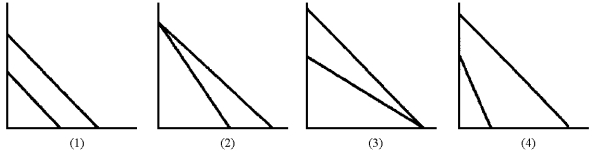 -Figure 18-8 has four sets of production possibility curves for two hypothetical countries.In which case will there be no advantage to trade between the two countries?
 (Multiple Choice)
4.7/5 (79)
(79) Table 18-4
Quantity Quantity Quantity Quantity Price per Demanded Supplied Demanded Supplied TV in United States in United States Japan Japan 100 100 10 100 25 200 85 20 85 50 300 70 30 70 70 400 60 40 60 80 500 50 50 50 90 600 40 60 40 100 700 30 70 30 110 800 30 80 20 120
-Table 18-4 presents the demand and supply schedules for television sets in Japan and the United States.If Japan and the United States trade with each other, which country will export television sets and how many?
(Multiple Choice)
4.9/5 (79)
(79) Suppose that the citizens of South Dakota decided to limit imports of citrus fruit from Florida and California on the grounds that climatic differences give those two states an unfair advantage in the production of those products.How would the analysis used to explain international trade apply?
(Essay)
4.8/5 (75)
(75) Equilibrium price in international trade is the common price between exporting and importing countries.
(True/False)
4.8/5 (74)
(74) 
Filters
- Essay(0)
- Multiple Choice(0)
- Short Answer(0)
- True False(0)
- Matching(0)