



 Chat with AI
Exam 35: International Trade and Comparative Advantage

Exam 1: What Is Economics?227 Questions
Exam 2: The Economy: Myth and Reality150 Questions
Exam 3: The Fundamental Economic Problem: Scarcity and Choice250 Questions
Exam 4: Supply and Demand: An Initial Look308 Questions
Exam 5: Consumer Choice: Individual and Market Demand202 Questions
Exam 6: Demand and Elasticity209 Questions
Exam 7: Production, Inputs, and Cost: Building Blocks for Supply Analysis216 Questions
Exam 8: Output, Price, and Profit: The Importance of Marginal Analysis189 Questions
Exam 9: Securities: Business Finance, and the Economy: The Tail that Wags the Dog?198 Questions
Exam 10: The Firm and the Industry under Perfect Competition208 Questions
Exam 11: Monopoly203 Questions
Exam 12: Between Competition and Monopoly225 Questions
Exam 13: Limiting Market Power: Regulation and Antitrust152 Questions
Exam 14: The Case for Free Markets I: The Price System220 Questions
Exam 15: The Shortcomings of Free Markets212 Questions
Exam 16: The Market's Prime Achievement: Innovation and Growth110 Questions
Exam 17: Externalities, the Environment, and Natural Resources217 Questions
Exam 18: Taxation and Resource Allocation219 Questions
Exam 19: Pricing the Factors of Production228 Questions
Exam 20: Labor and Entrepreneurship: The Human Inputs223 Questions
Exam 21: Poverty, Inequality, and Discrimination167 Questions
Exam 22: An Introduction to Macroeconomics211 Questions
Exam 23: The Goals of Macroeconomic Policy207 Questions
Exam 24: Economic Growth: Theory and Policy223 Questions
Exam 25: Aggregate Demand and the Powerful Consumer214 Questions
Exam 26: Demand-Side Equilibrium: Unemployment or Inflation?210 Questions
Exam 27: Bringing in the Supply Side: Unemployment and Inflation?223 Questions
Exam 28: Managing Aggregate Demand: Fiscal Policy205 Questions
Exam 29: Money and the Banking System219 Questions
Exam 30: Monetary Policy: Conventional and Unconventional205 Questions
Exam 31: The Financial Crisis and the Great Recession61 Questions
Exam 32: The Debate over Monetary and Fiscal Policy214 Questions
Exam 33: Budget Deficits in the Short and Long Run210 Questions
Exam 34: The Trade-Off between Inflation and Unemployment214 Questions
Exam 35: International Trade and Comparative Advantage226 Questions
Exam 36: The International Monetary System: Order or Disorder?213 Questions
Exam 37: Exchange Rates and the Macroeconomy214 Questions
Select questions type


Economists say that voluntary exchange makes both parties better off.What is the explanation that they offer to back up this conclusion?
(Essay)
4.9/5  (87)
(87) The United States is known worldwide as being a low tariff nation.
(True/False)
4.7/5 (71)
(71) Foreign competition will always put a domestic industry at a disadvantage.This leads to massive trade adjustment assistance on the part of each country.
(True/False)
4.9/5 (85)
(85) Figure 18-7
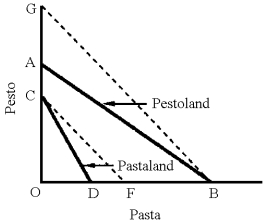 -In Figure 18-7, it is probably true that wages are
 (Multiple Choice)
4.8/5 (87)
(87) If nations begin to specialize in production for the purpose of trade,
(Multiple Choice)
4.8/5 (89)
(89) Why does equilibrium in the market for a traded good not occur where that country's quantity demanded equals quantity supplied?
(Multiple Choice)
4.9/5 (84)
(84) The "infant industry argument" recommends protectionism for industries that produce children's clothing.
(True/False)
4.8/5 (82)
(82) A country has a comparative advantage over another in the production of gadgets if it can produce
(Multiple Choice)
4.8/5 (71)
(71) When other nations Orient "dump" products on the U.S.market, they
(Multiple Choice)
4.8/5 (87)
(87) What matters most in determining efficient distribution of production over the world is
(Multiple Choice)
4.8/5 (86)
(86) Japan and China produce guns and rice.The country with the lowest opportunity cost of guns (in terms of rice) will
(Multiple Choice)
4.9/5 (88)
(88) International trade usually benefits one trading partner while making the other trading partner worse off.
(True/False)
4.9/5 (69)
(69) Comparing international trade with trade among the different states of the United States shows that
(Multiple Choice)
4.9/5 (91)
(91) The way in which a country benefits from trade is that it can
(Multiple Choice)
4.9/5 (72)
(72) Suppose that a quota is imposed on imports of minivans.Show graphically what the effect is in terms of price and quantity of imports.Be sure that your graph is completely and correctly labeled.What determines how much of the quota is paid by the buyers of the minivans?
(Essay)
4.9/5 (91)
(91) The basic concept behind strategic trade policy is that free trade is the best policy to pursue, but some countries don't play by those rules.Therefore,
(Multiple Choice)
4.8/5 (73)
(73) If two countries each are currently producing two goods, and each begins to specialize in the good in which it has a comparative advantage, what will happen to total (world) output?
(Multiple Choice)
4.9/5 (76)
(76) 
Filters
- Essay(0)
- Multiple Choice(0)
- Short Answer(0)
- True False(0)
- Matching(0)