



 Chat with AI
Exam 35: International Trade and Comparative Advantage

Exam 1: What Is Economics?227 Questions
Exam 2: The Economy: Myth and Reality150 Questions
Exam 3: The Fundamental Economic Problem: Scarcity and Choice250 Questions
Exam 4: Supply and Demand: An Initial Look308 Questions
Exam 5: Consumer Choice: Individual and Market Demand202 Questions
Exam 6: Demand and Elasticity209 Questions
Exam 7: Production, Inputs, and Cost: Building Blocks for Supply Analysis216 Questions
Exam 8: Output, Price, and Profit: The Importance of Marginal Analysis189 Questions
Exam 9: Securities: Business Finance, and the Economy: The Tail that Wags the Dog?198 Questions
Exam 10: The Firm and the Industry under Perfect Competition208 Questions
Exam 11: Monopoly203 Questions
Exam 12: Between Competition and Monopoly225 Questions
Exam 13: Limiting Market Power: Regulation and Antitrust152 Questions
Exam 14: The Case for Free Markets I: The Price System220 Questions
Exam 15: The Shortcomings of Free Markets212 Questions
Exam 16: The Market's Prime Achievement: Innovation and Growth110 Questions
Exam 17: Externalities, the Environment, and Natural Resources217 Questions
Exam 18: Taxation and Resource Allocation219 Questions
Exam 19: Pricing the Factors of Production228 Questions
Exam 20: Labor and Entrepreneurship: The Human Inputs223 Questions
Exam 21: Poverty, Inequality, and Discrimination167 Questions
Exam 22: An Introduction to Macroeconomics211 Questions
Exam 23: The Goals of Macroeconomic Policy207 Questions
Exam 24: Economic Growth: Theory and Policy223 Questions
Exam 25: Aggregate Demand and the Powerful Consumer214 Questions
Exam 26: Demand-Side Equilibrium: Unemployment or Inflation?210 Questions
Exam 27: Bringing in the Supply Side: Unemployment and Inflation?223 Questions
Exam 28: Managing Aggregate Demand: Fiscal Policy205 Questions
Exam 29: Money and the Banking System219 Questions
Exam 30: Monetary Policy: Conventional and Unconventional205 Questions
Exam 31: The Financial Crisis and the Great Recession61 Questions
Exam 32: The Debate over Monetary and Fiscal Policy214 Questions
Exam 33: Budget Deficits in the Short and Long Run210 Questions
Exam 34: The Trade-Off between Inflation and Unemployment214 Questions
Exam 35: International Trade and Comparative Advantage226 Questions
Exam 36: The International Monetary System: Order or Disorder?213 Questions
Exam 37: Exchange Rates and the Macroeconomy214 Questions
Select questions type


A quota reduces quantity sold by operating through the demand side of the market.
(True/False)
5.0/5  (77)
(77) Which of the following observations is true of the principle of comparative advantage?
(Multiple Choice)
4.7/5 (90)
(90) The estimated cost of automobile jobs saved due to limitations on foreign autos is $105,000 per job.Why is there a cost to saving jobs through protectionism?
(Essay)
4.9/5 (76)
(76) William Safire argues that a unilateral free trade policy is a disaster if
(Multiple Choice)
4.9/5 (89)
(89) Table 18-1
Alternate Outputs from One Day's Labor Input Wheat Textiles United States (One person's/day's labor) 12 bushels or 3 yards Great Britain (One person's/day's labor) 3 bushels or 12 yards
-From Table 18-1, the opportunity cost of one bushel of wheat in Great Britain is
(Multiple Choice)
4.9/5 (82)
(82) If a nation does not have an absolute advantage in producing anything, it
(Multiple Choice)
4.9/5 (61)
(61) Is it possible for a country to have an absolute disadvantage and a comparative advantage in the production of a good?
(Multiple Choice)
4.8/5 (90)
(90) Strategic trade policy relies on threats of protectionism to protect free trade.
(True/False)
4.7/5 (75)
(75) 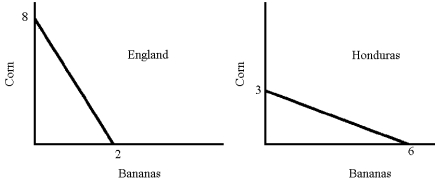 -From Figure 18-6, one can infer that
A quota sets the maximum amount of a good that is permitted into a country.
(True/False)
4.8/5 (85)
(85) Which of the following statements regarding the cheap foreign labor argument is correct?
(Multiple Choice)
4.7/5 (80)
(80) Quotas increase the profits of importers but decrease the profits of exporters.
(True/False)
4.9/5 (79)
(79) Quebec is capable of producing 10 pallets of wood shingles or 8 barrels of maple syrup with a unit of labor.Vermont is capable of producing 12 pallets of wood shingles or 12 barrels of maple syrup with a unit of labor.Assume that this is typical of the labor force as a whole.Which location has the absolute advantage and which has the comparative advantage, in the production of each good? Can these locations reap gains from trade?
(Essay)
4.8/5 (70)
(70) Table 18-3
Output Per Unit Labor Input Egypt 20 24 United States 2 12
-The data in Table 18-3 indicate that the United States has
(Multiple Choice)
5.0/5 (68)
(68) Quebec is capable of producing 10,000 pallets of wood shingles or 8,000 barrels of maple syrup.Vermont is capable of producing 12,000 pallets of wood shingles or 12,000 barrels of maple syrup.
a.Graph these production possibilities curves.Indicate from the slope, which has the absolute advantage, which the comparative advantage, and whether there are gains from trade.
b.Assume that Vermont and Quebec each specializes in the good in which they have a comparative advantage.Suppose that Vermont and Quebec decide to trade 5,000 pallets of shingles for 5,000 barrels of syrup.Indicate this on the graph.How does this affect the well being of the two societies? Explain.
(Essay)
4.9/5 (67)
(67) Capital, labor, and other factors of production move more freely from country to country than they do within a country.
(True/False)
4.7/5 (71)
(71) In the past, when the United States enjoyed a continuing trade surplus, wages in the United States
(Multiple Choice)
4.8/5 (88)
(88) An upward spiral of protectionism is a possible outcome of strategic trade policy.
(True/False)
4.9/5 (85)
(85) 
Filters
- Essay(0)
- Multiple Choice(0)
- Short Answer(0)
- True False(0)
- Matching(0)