



 Chat with AI
Exam 35: International Trade and Comparative Advantage

Exam 1: What Is Economics?227 Questions
Exam 2: The Economy: Myth and Reality150 Questions
Exam 3: The Fundamental Economic Problem: Scarcity and Choice250 Questions
Exam 4: Supply and Demand: An Initial Look308 Questions
Exam 5: Consumer Choice: Individual and Market Demand202 Questions
Exam 6: Demand and Elasticity209 Questions
Exam 7: Production, Inputs, and Cost: Building Blocks for Supply Analysis216 Questions
Exam 8: Output, Price, and Profit: The Importance of Marginal Analysis189 Questions
Exam 9: Securities: Business Finance, and the Economy: The Tail that Wags the Dog?198 Questions
Exam 10: The Firm and the Industry under Perfect Competition208 Questions
Exam 11: Monopoly203 Questions
Exam 12: Between Competition and Monopoly225 Questions
Exam 13: Limiting Market Power: Regulation and Antitrust152 Questions
Exam 14: The Case for Free Markets I: The Price System220 Questions
Exam 15: The Shortcomings of Free Markets212 Questions
Exam 16: The Market's Prime Achievement: Innovation and Growth110 Questions
Exam 17: Externalities, the Environment, and Natural Resources217 Questions
Exam 18: Taxation and Resource Allocation219 Questions
Exam 19: Pricing the Factors of Production228 Questions
Exam 20: Labor and Entrepreneurship: The Human Inputs223 Questions
Exam 21: Poverty, Inequality, and Discrimination167 Questions
Exam 22: An Introduction to Macroeconomics211 Questions
Exam 23: The Goals of Macroeconomic Policy207 Questions
Exam 24: Economic Growth: Theory and Policy223 Questions
Exam 25: Aggregate Demand and the Powerful Consumer214 Questions
Exam 26: Demand-Side Equilibrium: Unemployment or Inflation?210 Questions
Exam 27: Bringing in the Supply Side: Unemployment and Inflation?223 Questions
Exam 28: Managing Aggregate Demand: Fiscal Policy205 Questions
Exam 29: Money and the Banking System219 Questions
Exam 30: Monetary Policy: Conventional and Unconventional205 Questions
Exam 31: The Financial Crisis and the Great Recession61 Questions
Exam 32: The Debate over Monetary and Fiscal Policy214 Questions
Exam 33: Budget Deficits in the Short and Long Run210 Questions
Exam 34: The Trade-Off between Inflation and Unemployment214 Questions
Exam 35: International Trade and Comparative Advantage226 Questions
Exam 36: The International Monetary System: Order or Disorder?213 Questions
Exam 37: Exchange Rates and the Macroeconomy214 Questions
Select questions type


Many fear that cheap foreign labor will destroy American jobs; in reality, wages in
(Multiple Choice)
4.8/5  (67)
(67) The Trade Adjustment Assistance program is intended to help
(Multiple Choice)
4.9/5 (96)
(96) The supply-demand mechanism will bring an international market into equilibrium
(Multiple Choice)
4.8/5 (62)
(62) Some nations that seek to produce all of their own needs face the problem that
(Multiple Choice)
5.0/5 (80)
(80) Are there impediments to international movement of labor and capital?
(Multiple Choice)
4.9/5 (78)
(78) If a country produces a commodity in the range of decreasing returns to scale, and the country begins to export more in a pure free trade system, the domestic price of the commodity will
(Multiple Choice)
4.9/5 (85)
(85) What are the two approaches followed by the U.S.government to ease the burden on the victims of free trade?
(Essay)
4.9/5 (74)
(74) Figure 18-3
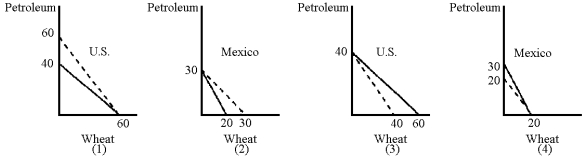 -In Figure 18-3, the solid lines represent the respective production possibilities curves for the United States and Mexico.Which graphs show the correct consumption possibilities curves (dashed lines) after an agreement is reached to trade 1 unit of wheat for 1 unit of petroleum?
 (Multiple Choice)
4.7/5 (86)
(86) Figure 18-7
 -In Figure 18-7, AB represents the production possibilities of Pestoland and CD that of Pastaland.The graph indicates Pestoland has an absolute
 (Multiple Choice)
5.0/5 (82)
(82) Something other than exploiting cheap foreign labor must be driving international trade.
(True/False)
4.9/5 (77)
(77) The world price of a commodity will settle at the level where
(Multiple Choice)
5.0/5 (62)
(62) Figure 18-7
-In Figure 18-7, CF has the same slope as BG.AB and CD are the production possibilities of Pestoland and Pastaland, respectively.If both countries are given the opportunity to trade at prices indicated by CF,
-In Figure 18-7, CF has the same slope as BG.AB and CD are the production possibilities of Pestoland and Pastaland, respectively.If both countries are given the opportunity to trade at prices indicated by CF, (Multiple Choice)
4.9/5 (74)
(74) The trade philosophy of the Clinton administration is best characterized as
(Multiple Choice)
4.9/5 (85)
(85) According to William Safire, "helpfulism" is basically protectionism.
(True/False)
4.8/5 (84)
(84) Suppose that with 1 unit of labor, Canada can produce 40 TVs or 20 computers.With 1 unit of labor, Taiwan can produce 30 TVs or 10 computers.Which of the following is correct?
(Multiple Choice)
4.8/5 (81)
(81) Trade adjustment assistance in the United States began in 1962.The program
(Multiple Choice)
5.0/5 (90)
(90) Table 18-4
Quantity Quantity Quantity Quantity Price per Demanded Supplied Demanded Supplied TV in United States in United States Japan Japan 100 100 10 100 25 200 85 20 85 50 300 70 30 70 70 400 60 40 60 80 500 50 50 50 90 600 40 60 40 100 700 30 70 30 110 800 30 80 20 120
-Table 18-4 presents the demand and supply schedules for television sets in Japan and the United States.If the United States and Japan decide to trade with each other, what will happen to the output of television sets in Japan?
(Multiple Choice)
4.8/5 (86)
(86) 
Filters
- Essay(0)
- Multiple Choice(0)
- Short Answer(0)
- True False(0)
- Matching(0)