



 Chat with AI
Exam 5: Consumer Choice: Individual and Market Demand

Exam 1: What Is Economics?227 Questions
Exam 2: The Economy: Myth and Reality150 Questions
Exam 3: The Fundamental Economic Problem: Scarcity and Choice250 Questions
Exam 4: Supply and Demand: An Initial Look308 Questions
Exam 5: Consumer Choice: Individual and Market Demand202 Questions
Exam 6: Demand and Elasticity209 Questions
Exam 7: Production, Inputs, and Cost: Building Blocks for Supply Analysis216 Questions
Exam 8: Output, Price, and Profit: The Importance of Marginal Analysis189 Questions
Exam 9: Securities: Business Finance, and the Economy: The Tail that Wags the Dog?198 Questions
Exam 10: The Firm and the Industry under Perfect Competition208 Questions
Exam 11: Monopoly203 Questions
Exam 12: Between Competition and Monopoly225 Questions
Exam 13: Limiting Market Power: Regulation and Antitrust152 Questions
Exam 14: The Case for Free Markets I: The Price System220 Questions
Exam 15: The Shortcomings of Free Markets212 Questions
Exam 16: The Market's Prime Achievement: Innovation and Growth110 Questions
Exam 17: Externalities, the Environment, and Natural Resources217 Questions
Exam 18: Taxation and Resource Allocation219 Questions
Exam 19: Pricing the Factors of Production228 Questions
Exam 20: Labor and Entrepreneurship: The Human Inputs223 Questions
Exam 21: Poverty, Inequality, and Discrimination167 Questions
Exam 22: An Introduction to Macroeconomics211 Questions
Exam 23: The Goals of Macroeconomic Policy207 Questions
Exam 24: Economic Growth: Theory and Policy223 Questions
Exam 25: Aggregate Demand and the Powerful Consumer214 Questions
Exam 26: Demand-Side Equilibrium: Unemployment or Inflation?210 Questions
Exam 27: Bringing in the Supply Side: Unemployment and Inflation?223 Questions
Exam 28: Managing Aggregate Demand: Fiscal Policy205 Questions
Exam 29: Money and the Banking System219 Questions
Exam 30: Monetary Policy: Conventional and Unconventional205 Questions
Exam 31: The Financial Crisis and the Great Recession61 Questions
Exam 32: The Debate over Monetary and Fiscal Policy214 Questions
Exam 33: Budget Deficits in the Short and Long Run210 Questions
Exam 34: The Trade-Off between Inflation and Unemployment214 Questions
Exam 35: International Trade and Comparative Advantage226 Questions
Exam 36: The International Monetary System: Order or Disorder?213 Questions
Exam 37: Exchange Rates and the Macroeconomy214 Questions
Select questions type


An inferior good is one that consumers buy in smaller quantities when incomes rise.
(True/False)
4.9/5  (77)
(77) Rolls Royce may actually sell fewer cars at lower prices due to the "snob effect."
(True/False)
4.8/5 (81)
(81) The authors state that mutual gains must exist from trade.Explain their reasoning.
(Essay)
4.9/5 (83)
(83) Marginal utility can fall even as total utility from the consumption of a good is rising.
(True/False)
4.8/5 (90)
(90) Table 5-4
Price Quantity in \ Demanded 80 1 70 2 60 3 50 4 40 5 30 6 20 7 10 8
-Table 5-4 shows the demand schedule for concert tickets for a particular consumer.What will be this consumer's surplus if the price of tickets is $50?
(Multiple Choice)
4.8/5 (71)
(71) Even if all individual demand curves are downwardly sloped, the market demand curve may slope upward.
(True/False)
4.7/5 (74)
(74) The slope of the budget line is the amount of one commodity that a consumer must give up in order to obtain an additional unit of the other commodity.
(True/False)
4.8/5 (78)
(78) A consumer will go to a point on the highest attainable indifference curve.
(True/False)
4.7/5 (83)
(83) Figure 5-19
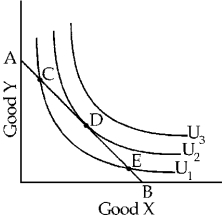 -In Figure 5-19, the consumer experiences at point C
 (Multiple Choice)
4.8/5 (75)
(75) Figure 5-6
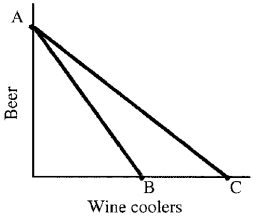 -A shift in the budget line in Figure 5-6 from AB to AC indicates
 (Multiple Choice)
4.8/5 (94)
(94) When the price of a good changes but the price of the only other good bought by a consumer stays constant, his
(Multiple Choice)
4.8/5 (87)
(87) Tom is buying a quantity of wheat at which the marginal utility (in dollars) exceeds price.He should
(Multiple Choice)
4.8/5 (71)
(71) The real cost of a decision is the opportunity cost measured in the commodities forgone.
(True/False)
4.8/5 (83)
(83) If a commodity is inexpensive and its total utility great,
(Multiple Choice)
4.8/5 (91)
(91) The law of diminishing marginal utility holds that at some point consumption of additional units of a commodity adds less to total utility.
(True/False)
4.8/5 (85)
(85) Figure 5-3
 -Assume the market consists of three consumers with the demand curves in Figure 5-3.At a price of 1, the total market demand is
 (Multiple Choice)
4.7/5 (78)
(78) Define the following terms.Give a complete and precise definition in one sentence.
a.total utility
b.marginal utility
c.consumer's surplus
d."law" of demand
(Essay)
4.9/5 (79)
(79) 
Filters
- Essay(0)
- Multiple Choice(0)
- Short Answer(0)
- True False(0)
- Matching(0)