



 Chat with AI
Exam 5: Consumer Choice: Individual and Market Demand

Exam 1: What Is Economics?227 Questions
Exam 2: The Economy: Myth and Reality150 Questions
Exam 3: The Fundamental Economic Problem: Scarcity and Choice250 Questions
Exam 4: Supply and Demand: An Initial Look308 Questions
Exam 5: Consumer Choice: Individual and Market Demand202 Questions
Exam 6: Demand and Elasticity209 Questions
Exam 7: Production, Inputs, and Cost: Building Blocks for Supply Analysis216 Questions
Exam 8: Output, Price, and Profit: The Importance of Marginal Analysis189 Questions
Exam 9: Securities: Business Finance, and the Economy: The Tail that Wags the Dog?198 Questions
Exam 10: The Firm and the Industry under Perfect Competition208 Questions
Exam 11: Monopoly203 Questions
Exam 12: Between Competition and Monopoly225 Questions
Exam 13: Limiting Market Power: Regulation and Antitrust152 Questions
Exam 14: The Case for Free Markets I: The Price System220 Questions
Exam 15: The Shortcomings of Free Markets212 Questions
Exam 16: The Market's Prime Achievement: Innovation and Growth110 Questions
Exam 17: Externalities, the Environment, and Natural Resources217 Questions
Exam 18: Taxation and Resource Allocation219 Questions
Exam 19: Pricing the Factors of Production228 Questions
Exam 20: Labor and Entrepreneurship: The Human Inputs223 Questions
Exam 21: Poverty, Inequality, and Discrimination167 Questions
Exam 22: An Introduction to Macroeconomics211 Questions
Exam 23: The Goals of Macroeconomic Policy207 Questions
Exam 24: Economic Growth: Theory and Policy223 Questions
Exam 25: Aggregate Demand and the Powerful Consumer214 Questions
Exam 26: Demand-Side Equilibrium: Unemployment or Inflation?210 Questions
Exam 27: Bringing in the Supply Side: Unemployment and Inflation?223 Questions
Exam 28: Managing Aggregate Demand: Fiscal Policy205 Questions
Exam 29: Money and the Banking System219 Questions
Exam 30: Monetary Policy: Conventional and Unconventional205 Questions
Exam 31: The Financial Crisis and the Great Recession61 Questions
Exam 32: The Debate over Monetary and Fiscal Policy214 Questions
Exam 33: Budget Deficits in the Short and Long Run210 Questions
Exam 34: The Trade-Off between Inflation and Unemployment214 Questions
Exam 35: International Trade and Comparative Advantage226 Questions
Exam 36: The International Monetary System: Order or Disorder?213 Questions
Exam 37: Exchange Rates and the Macroeconomy214 Questions
Select questions type


A consumer possesses five pounds of bananas and values their total utility at $2.14.If one additional pound is acquired and marginal utility is 11 cents, total utility will
(Multiple Choice)
4.9/5  (66)
(66) Use consumer indifference curves and budget lines to show the optimal consumption curves for a normal good and for an inferior good.(Use two graphs.) Be sure your graphs are completely and correctly labeled.
(Essay)
4.9/5 (76)
(76) For ____, if incomes rise and prices do not change, quantity demanded will increase.
(Multiple Choice)
4.8/5 (80)
(80)  -In Figure 5-16, Adam is
Total utility decreases when diminishing marginal utility is present.
(True/False)
4.9/5 (69)
(69) Table 5-1B
Robinson's marginal utility C \ 2.00 \ 1.88 \ 1.60 \ 1.30
-If a graph of Robinson's marginal utility were constructed from Table 5-1B, it would
(Multiple Choice)
4.8/5 (77)
(77) Table 5-1
-Table 5-1 gives information on George's total utility from consuming milkshakes and sandwiches.If George's income this week is $15, milkshakes are $3 each, and sandwiches $2, he will maximize his utility if he buys
(Multiple Choice)
4.9/5 (84)
(84) If the prices of both goods increase by 10 percent, the budget line
(Multiple Choice)
4.7/5 (77)
(77) Figure 5-5
 -Figure 5-5 shows a consumer budget line for French fries and hamburgers.The household allocates a budget for these two goods..If the price of an order of french fries is $2, how much income is allocated to fries and burgers combined?
 (Multiple Choice)
4.9/5 (82)
(82) Figure 5-4
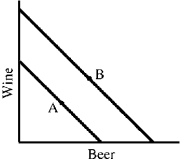 -In Figure 5-4, the rightward shift in budget lines from the one containing point A to the one containing point B
 (Multiple Choice)
4.9/5 (83)
(83) By changing the amount of income a consumer has to spend, a change in the price of one good may affect the quantity demanded of another good.
(True/False)
4.9/5 (77)
(77) Figure 5-5
-In Figure 5-5, if the household is spending enough of its budget to purchase 4 orders of fries and the price of an order of fries is $2, the remainder of the budget available for hamburgers is
-In Figure 5-5, if the household is spending enough of its budget to purchase 4 orders of fries and the price of an order of fries is $2, the remainder of the budget available for hamburgers is (Multiple Choice)
4.9/5 (93)
(93) Bob values the utility of a single scoop of Baskin-Robbins ice cream at $1.50.A double scoop gives total utility of $2.25, while a triple scoop yields $2.60.Baskin-Robbins charges $1.35 for a single, $1.95 for a double, and $2.35 for a triple.How many scoops will Bob buy?
(Essay)
4.8/5 (76)
(76) Figure 5-1
 -Americans choose cola over other flavors 70 percent of the time.Analysts say this is because cola's flavor is more robust and durable.Orange soda, for example, suffers from flavor fatigue faster than cola.Also, because cola contains caffeine, people may be addicted to the stimulant.Which panel in Figure 5-1 best illustrates these facts?
 (Multiple Choice)
5.0/5 (76)
(76) Utility is the pleasure, satisfaction, or enjoyment derived from consumption.
(True/False)
4.8/5 (81)
(81) Which of the following observations is not true of a budget line?
(Multiple Choice)
4.8/5 (77)
(77) Points along a budget line represent the maximum combinations of two commodities that a consumer can afford.
(True/False)
4.8/5 (97)
(97) 
Filters
- Essay(0)
- Multiple Choice(0)
- Short Answer(0)
- True False(0)
- Matching(0)