



 Chat with AI
Exam 5: Consumer Choice: Individual and Market Demand

Exam 1: What Is Economics?227 Questions
Exam 2: The Economy: Myth and Reality150 Questions
Exam 3: The Fundamental Economic Problem: Scarcity and Choice250 Questions
Exam 4: Supply and Demand: An Initial Look308 Questions
Exam 5: Consumer Choice: Individual and Market Demand202 Questions
Exam 6: Demand and Elasticity209 Questions
Exam 7: Production, Inputs, and Cost: Building Blocks for Supply Analysis216 Questions
Exam 8: Output, Price, and Profit: The Importance of Marginal Analysis189 Questions
Exam 9: Securities: Business Finance, and the Economy: The Tail that Wags the Dog?198 Questions
Exam 10: The Firm and the Industry under Perfect Competition208 Questions
Exam 11: Monopoly203 Questions
Exam 12: Between Competition and Monopoly225 Questions
Exam 13: Limiting Market Power: Regulation and Antitrust152 Questions
Exam 14: The Case for Free Markets I: The Price System220 Questions
Exam 15: The Shortcomings of Free Markets212 Questions
Exam 16: The Market's Prime Achievement: Innovation and Growth110 Questions
Exam 17: Externalities, the Environment, and Natural Resources217 Questions
Exam 18: Taxation and Resource Allocation219 Questions
Exam 19: Pricing the Factors of Production228 Questions
Exam 20: Labor and Entrepreneurship: The Human Inputs223 Questions
Exam 21: Poverty, Inequality, and Discrimination167 Questions
Exam 22: An Introduction to Macroeconomics211 Questions
Exam 23: The Goals of Macroeconomic Policy207 Questions
Exam 24: Economic Growth: Theory and Policy223 Questions
Exam 25: Aggregate Demand and the Powerful Consumer214 Questions
Exam 26: Demand-Side Equilibrium: Unemployment or Inflation?210 Questions
Exam 27: Bringing in the Supply Side: Unemployment and Inflation?223 Questions
Exam 28: Managing Aggregate Demand: Fiscal Policy205 Questions
Exam 29: Money and the Banking System219 Questions
Exam 30: Monetary Policy: Conventional and Unconventional205 Questions
Exam 31: The Financial Crisis and the Great Recession61 Questions
Exam 32: The Debate over Monetary and Fiscal Policy214 Questions
Exam 33: Budget Deficits in the Short and Long Run210 Questions
Exam 34: The Trade-Off between Inflation and Unemployment214 Questions
Exam 35: International Trade and Comparative Advantage226 Questions
Exam 36: The International Monetary System: Order or Disorder?213 Questions
Exam 37: Exchange Rates and the Macroeconomy214 Questions
Select questions type


Consumers should purchase quantities of a good to the point where MU > P.
(True/False)
4.8/5  (83)
(83) The budget line and the indifference curve are geometric devices used to provide a closer look at consumer choice.
(True/False)
4.7/5 (61)
(61) Figure 5-6
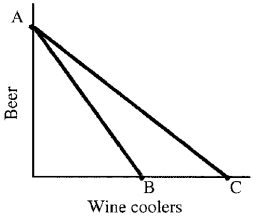 -In Figure 5-6, a shift in the budget line from AC to AB indicates
 (Multiple Choice)
4.9/5 (73)
(73) Which of the following factors is always present in consumer decision making?
(Multiple Choice)
4.7/5 (81)
(81) Consumer surplus is what one consumer is willing to pay for a commodity over what another consumer is willing to pay for the same commodity.
(True/False)
5.0/5 (95)
(95) If I use 1,000 gallons of water a month at a price of $.01 a gallon, is my consumer surplus likely to be large or small? Explain.
(Essay)
4.9/5 (68)
(68) Jason considers a crystal bowl, a silver dish, and a pewter figurine, each priced $45 at the local gift shop.He chooses the silver dish because, according to economic theory
(Multiple Choice)
4.7/5 (99)
(99) The host at a party offers Justin a sixth beer.Justin says, "No thanks, man.The marginal utility of that fifth beer was, like, 20 cents, but the marginal utility of the sixth would be minus 10 cents." From his comments, we deduce that Justin
(Multiple Choice)
4.8/5 (74)
(74) You have five hours left to study for two exams tomorrow.The relationship between hours of study and test scores is as follows:
Economics Sociology 1 50 1 75 2 65 2 85 3 75 3 90 4 80 4 93 5 85 5 5
Use the rule for determining optimal purchases to allocate your time, where each point is one "util" of utility.
(Essay)
4.7/5 (76)
(76) Figure 5-16
 -In Figure 5-16, a decrease in the price of apples will
 (Multiple Choice)
4.9/5 (80)
(80)  -In Figure 5-17, the consumer would prefer
The law of demand holds that as prices of goods decrease, people are willing to buy more.
(True/False)
4.9/5 (70)
(70) Table 5-3
1 50 2 80 3 95 4 95
-Using Table 5-3, graph the marginal utility curve.
(Essay)
4.8/5 (76)
(76) Total utility can be objectively measured in numbers that indicate usefulness or benefit to the consumer.
(True/False)
4.9/5 (82)
(82) If the marginal net utility of beer is negative, the consumer should buy more beer in order to increase the total utility.
(True/False)
4.8/5 (69)
(69) An increase in a consumer's income will always increase the demand for a good.
(True/False)
4.9/5 (89)
(89) Why is gold very expensive, even though it is not essential to life, while water, which is essential to life, is inexpensive?
(Essay)
5.0/5 (78)
(78) 
Filters
- Essay(0)
- Multiple Choice(0)
- Short Answer(0)
- True False(0)
- Matching(0)