



 Chat with AI
Exam 5: Consumer Choice: Individual and Market Demand

Exam 1: What Is Economics?227 Questions
Exam 2: The Economy: Myth and Reality150 Questions
Exam 3: The Fundamental Economic Problem: Scarcity and Choice250 Questions
Exam 4: Supply and Demand: An Initial Look308 Questions
Exam 5: Consumer Choice: Individual and Market Demand202 Questions
Exam 6: Demand and Elasticity209 Questions
Exam 7: Production, Inputs, and Cost: Building Blocks for Supply Analysis216 Questions
Exam 8: Output, Price, and Profit: The Importance of Marginal Analysis189 Questions
Exam 9: Securities: Business Finance, and the Economy: The Tail that Wags the Dog?198 Questions
Exam 10: The Firm and the Industry under Perfect Competition208 Questions
Exam 11: Monopoly203 Questions
Exam 12: Between Competition and Monopoly225 Questions
Exam 13: Limiting Market Power: Regulation and Antitrust152 Questions
Exam 14: The Case for Free Markets I: The Price System220 Questions
Exam 15: The Shortcomings of Free Markets212 Questions
Exam 16: The Market's Prime Achievement: Innovation and Growth110 Questions
Exam 17: Externalities, the Environment, and Natural Resources217 Questions
Exam 18: Taxation and Resource Allocation219 Questions
Exam 19: Pricing the Factors of Production228 Questions
Exam 20: Labor and Entrepreneurship: The Human Inputs223 Questions
Exam 21: Poverty, Inequality, and Discrimination167 Questions
Exam 22: An Introduction to Macroeconomics211 Questions
Exam 23: The Goals of Macroeconomic Policy207 Questions
Exam 24: Economic Growth: Theory and Policy223 Questions
Exam 25: Aggregate Demand and the Powerful Consumer214 Questions
Exam 26: Demand-Side Equilibrium: Unemployment or Inflation?210 Questions
Exam 27: Bringing in the Supply Side: Unemployment and Inflation?223 Questions
Exam 28: Managing Aggregate Demand: Fiscal Policy205 Questions
Exam 29: Money and the Banking System219 Questions
Exam 30: Monetary Policy: Conventional and Unconventional205 Questions
Exam 31: The Financial Crisis and the Great Recession61 Questions
Exam 32: The Debate over Monetary and Fiscal Policy214 Questions
Exam 33: Budget Deficits in the Short and Long Run210 Questions
Exam 34: The Trade-Off between Inflation and Unemployment214 Questions
Exam 35: International Trade and Comparative Advantage226 Questions
Exam 36: The International Monetary System: Order or Disorder?213 Questions
Exam 37: Exchange Rates and the Macroeconomy214 Questions
Select questions type


Given a typical demand curve and a decline in price, the consumer who wishes to maximize total utility must increase the quantity purchased of a good to arrive at an optimal MU = P point.
(True/False)
4.8/5  (85)
(85) The theory of consumer choice is based on the hypothesis that each consumer wants to
(Multiple Choice)
4.8/5 (84)
(84) If the marginal utility to Juan of sleeping an extra hour (from 8 a.m.to 9 a.m.) is negative,
(Multiple Choice)
4.8/5 (70)
(70) Use consumer indifference curves and budget lines to illustrate the effects of an increase in income for a normal good and an inferior good (use two graphs).Be sure your diagrams are fully and correctly labeled.
(Essay)
4.8/5 (72)
(72) Figure 5-5
 -Figure 5-5 shows a consumer budget line for french fries and hamburgers.The price of an order fries is $2.The price of a burger is
 (Multiple Choice)
5.0/5 (95)
(95) A change in the price of one good results in a rotation of the budget line, so that it is steeper or flatter.
(True/False)
4.8/5 (70)
(70) Figure 5-13
 -In Figure 5-13, the slope of the budget line (dropping all minus signs) equals
 (Multiple Choice)
4.8/5 (88)
(88) Vicki consumes meatloaf and pizza.To keep her utility constant, you must give her more of one good if you take some of the other away.This information implies that
(Multiple Choice)
4.9/5 (87)
(87) The law of diminishing marginal utility guarantees that demand curves will have positive slopes.
(True/False)
4.9/5 (91)
(91) Marginal utility is measured by the maximum amount of money a consumer is willing to pay for one more unit of a commodity.
(True/False)
4.9/5 (81)
(81) Elaine values the utility of her first cup of coffee at $1; a second cup, $.75; and a third cup, $.50.If Elaine drinks three cups of coffee for breakfast, her marginal utility is equal to
(Multiple Choice)
5.0/5 (77)
(77) A consumer will consume the combination of goods at the point of tangency between the budget line and the indifference curve.
(True/False)
4.8/5 (71)
(71) An increase in a family's income will cause its budget line to
(Multiple Choice)
4.9/5 (70)
(70) Figure 5-8
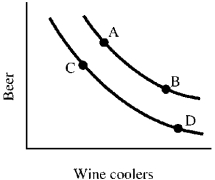 -In Figure 5-8, the consumer is indifferent between the combinations of beer and wine coolers indicated by points
 (Multiple Choice)
4.7/5 (86)
(86) What would happen to the budget line if income as well as prices of both goods increase by the same percentage?
(Multiple Choice)
4.9/5 (82)
(82) Which of the following is characteristic of indifference curves?
(Multiple Choice)
4.9/5 (83)
(83) A change in the price of a good will shift the indifference curves.
(True/False)
4.7/5 (78)
(78) 
Filters
- Essay(0)
- Multiple Choice(0)
- Short Answer(0)
- True False(0)
- Matching(0)