



 Chat with AI
Exam 5: Consumer Choice: Individual and Market Demand

Exam 1: What Is Economics?227 Questions
Exam 2: The Economy: Myth and Reality150 Questions
Exam 3: The Fundamental Economic Problem: Scarcity and Choice250 Questions
Exam 4: Supply and Demand: An Initial Look308 Questions
Exam 5: Consumer Choice: Individual and Market Demand202 Questions
Exam 6: Demand and Elasticity209 Questions
Exam 7: Production, Inputs, and Cost: Building Blocks for Supply Analysis216 Questions
Exam 8: Output, Price, and Profit: The Importance of Marginal Analysis189 Questions
Exam 9: Securities: Business Finance, and the Economy: The Tail that Wags the Dog?198 Questions
Exam 10: The Firm and the Industry under Perfect Competition208 Questions
Exam 11: Monopoly203 Questions
Exam 12: Between Competition and Monopoly225 Questions
Exam 13: Limiting Market Power: Regulation and Antitrust152 Questions
Exam 14: The Case for Free Markets I: The Price System220 Questions
Exam 15: The Shortcomings of Free Markets212 Questions
Exam 16: The Market's Prime Achievement: Innovation and Growth110 Questions
Exam 17: Externalities, the Environment, and Natural Resources217 Questions
Exam 18: Taxation and Resource Allocation219 Questions
Exam 19: Pricing the Factors of Production228 Questions
Exam 20: Labor and Entrepreneurship: The Human Inputs223 Questions
Exam 21: Poverty, Inequality, and Discrimination167 Questions
Exam 22: An Introduction to Macroeconomics211 Questions
Exam 23: The Goals of Macroeconomic Policy207 Questions
Exam 24: Economic Growth: Theory and Policy223 Questions
Exam 25: Aggregate Demand and the Powerful Consumer214 Questions
Exam 26: Demand-Side Equilibrium: Unemployment or Inflation?210 Questions
Exam 27: Bringing in the Supply Side: Unemployment and Inflation?223 Questions
Exam 28: Managing Aggregate Demand: Fiscal Policy205 Questions
Exam 29: Money and the Banking System219 Questions
Exam 30: Monetary Policy: Conventional and Unconventional205 Questions
Exam 31: The Financial Crisis and the Great Recession61 Questions
Exam 32: The Debate over Monetary and Fiscal Policy214 Questions
Exam 33: Budget Deficits in the Short and Long Run210 Questions
Exam 34: The Trade-Off between Inflation and Unemployment214 Questions
Exam 35: International Trade and Comparative Advantage226 Questions
Exam 36: The International Monetary System: Order or Disorder?213 Questions
Exam 37: Exchange Rates and the Macroeconomy214 Questions
Select questions type


Why is it that the consumer can maximize total net utility only if the purchase quantity brings marginal utility as close as possible to equality with price?
(Essay)
4.9/5  (94)
(94) Since price tends to equal marginal utility, the price of water is low and the price of diamonds is high.
(True/False)
4.9/5 (62)
(62) The host at a party offers Justin a sixth beer.Justin says, "No thanks, man.The marginal utility of that fifth beer was, like, 20 cents, but the marginal utility of the sixth would be minus 10 cents." If Justin consumes the sixth beer, his total utility will
(Multiple Choice)
4.9/5 (85)
(85) Figure 5-15
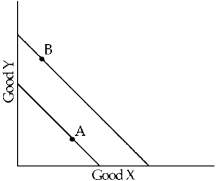 -Hal initially consumes the combination marked as A in Figure 5-15.After his income increases, Hal consumes combination B.We can conclude that Hal views
 (Multiple Choice)
4.9/5 (75)
(75) In Poland's free market, Felix Siemienas is making a fortune in cold cuts.Prices are much higher than formerly.Siemienas says, "Yes, my prices are high.If nobody buys, I bring my prices down.That is the market rule." This "rule" best describes
(Multiple Choice)
4.8/5 (83)
(83) If indifference curves and budget lines are used to analyze consumer choice, an inferior good will
(Multiple Choice)
4.9/5 (95)
(95) Figure 5-17
 -In Figure 5-17, which of the marked points would an economist use to help him construct a single demand curve for X?
 (Multiple Choice)
4.8/5 (73)
(73) The optimal combination of goods for a consumer to purchase is shown by
(Multiple Choice)
4.8/5 (99)
(99) If marginal net utility is positive, the consumer must be buying too small a quantity to maximize total net utility.Why?
(Essay)
4.9/5 (78)
(78) Since price tends to equal total utility, the price of water is low and the price of diamonds is high.
(True/False)
4.8/5 (87)
(87) Use the law of diminishing marginal utility to explain why Domino's and Pizza Hut allow the purchase of a second pizza for only $4 when one pays full price (around $10) for the first pizza.Why not simply charge $7 a pizza instead?
(Essay)
4.8/5 (78)
(78) Figure 5-9
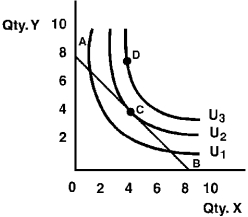 -In Figure 5-9, the consumer's marginal rate of substitution at his optimum choice of X and Y is
 (Multiple Choice)
4.9/5 (68)
(68) What is the relationship between marginal utility and an individual demand curve?
(Essay)
4.9/5 (76)
(76) 
Filters
- Essay(0)
- Multiple Choice(0)
- Short Answer(0)
- True False(0)
- Matching(0)