



 Chat with AI
Exam 5: Consumer Choice: Individual and Market Demand

Exam 1: What Is Economics?227 Questions
Exam 2: The Economy: Myth and Reality150 Questions
Exam 3: The Fundamental Economic Problem: Scarcity and Choice250 Questions
Exam 4: Supply and Demand: An Initial Look308 Questions
Exam 5: Consumer Choice: Individual and Market Demand202 Questions
Exam 6: Demand and Elasticity209 Questions
Exam 7: Production, Inputs, and Cost: Building Blocks for Supply Analysis216 Questions
Exam 8: Output, Price, and Profit: The Importance of Marginal Analysis189 Questions
Exam 9: Securities: Business Finance, and the Economy: The Tail that Wags the Dog?198 Questions
Exam 10: The Firm and the Industry under Perfect Competition208 Questions
Exam 11: Monopoly203 Questions
Exam 12: Between Competition and Monopoly225 Questions
Exam 13: Limiting Market Power: Regulation and Antitrust152 Questions
Exam 14: The Case for Free Markets I: The Price System220 Questions
Exam 15: The Shortcomings of Free Markets212 Questions
Exam 16: The Market's Prime Achievement: Innovation and Growth110 Questions
Exam 17: Externalities, the Environment, and Natural Resources217 Questions
Exam 18: Taxation and Resource Allocation219 Questions
Exam 19: Pricing the Factors of Production228 Questions
Exam 20: Labor and Entrepreneurship: The Human Inputs223 Questions
Exam 21: Poverty, Inequality, and Discrimination167 Questions
Exam 22: An Introduction to Macroeconomics211 Questions
Exam 23: The Goals of Macroeconomic Policy207 Questions
Exam 24: Economic Growth: Theory and Policy223 Questions
Exam 25: Aggregate Demand and the Powerful Consumer214 Questions
Exam 26: Demand-Side Equilibrium: Unemployment or Inflation?210 Questions
Exam 27: Bringing in the Supply Side: Unemployment and Inflation?223 Questions
Exam 28: Managing Aggregate Demand: Fiscal Policy205 Questions
Exam 29: Money and the Banking System219 Questions
Exam 30: Monetary Policy: Conventional and Unconventional205 Questions
Exam 31: The Financial Crisis and the Great Recession61 Questions
Exam 32: The Debate over Monetary and Fiscal Policy214 Questions
Exam 33: Budget Deficits in the Short and Long Run210 Questions
Exam 34: The Trade-Off between Inflation and Unemployment214 Questions
Exam 35: International Trade and Comparative Advantage226 Questions
Exam 36: The International Monetary System: Order or Disorder?213 Questions
Exam 37: Exchange Rates and the Macroeconomy214 Questions
Select questions type


Table 5-2
Robinson's marginal utility C \ 2.00 \ 1.88 \ 1.60 \ 1.30
-According to Table 5-2, Robinson's total utility from having two coconuts is ____.
(Multiple Choice)
5.0/5  (86)
(86) Figure 5-10
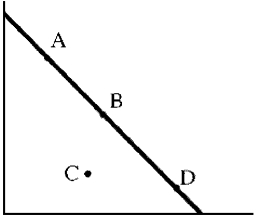 -In the indifference curve pictured in Figure 5-10, which of the following is clearly true?
 (Multiple Choice)
5.0/5 (76)
(76) Marginal utility has a negative slope.This is because of the
(Multiple Choice)
4.9/5 (83)
(83) Elaine values the utility of her first cup of coffee at $1; a second cup, $.75; and a third cup, $.50.If Elaine drinks three cups of coffee for breakfast, her total utility is equal to
(Multiple Choice)
4.8/5 (80)
(80) The budget line represents a consumer's preferences for a commodity.
(True/False)
4.8/5 (68)
(68) Draw the point of consumer equilibrium from an indifference map and budget line.Explain why this is the point of optimization.Be sure your diagram is fully and correctly labeled.
(Essay)
4.9/5 (99)
(99) An increase in income produces a parallel, outward shift in the budget line.
(True/False)
4.7/5 (56)
(56) Gwen's decision to buy a new television instead of a bicycle for the same price
(Multiple Choice)
4.7/5 (58)
(58)  -In Figure 5-13, the line AB is
Figure 5-17
 -Which of the following statements about Figure 5-17 must be correct?
 (Multiple Choice)
4.8/5 (66)
(66) Figure 5-16
 -Figure 5-16 shows Adam's purchases of bananas and apples when apples cost $5 each and bananas $4 each.The information implies that Adam's income
 (Multiple Choice)
5.0/5 (76)
(76) If income rises, most consumers will increase the quantity demanded of an inferior good.
(True/False)
4.8/5 (89)
(89) Figure 5-2
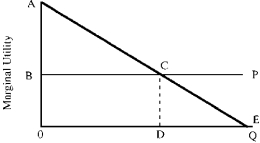 -In Figure 5-2, consumer surplus is measured by the area
 (Multiple Choice)
4.8/5 (74)
(74) Draw individual demands for caviar for Al, Barbara, Chuck, and Denise where Al's demand is relatively inelastic, Barbara's is elastic, Chuck's is upward sloping, and Denise refuses to eat caviar at any price.Then draw the corresponding market demand.
(Essay)
4.7/5 (75)
(75) A well-known women's college whose tuition lagged below similar schools found recruiting difficult and enrollment falling.A substantial tuition increase was implemented, and dormitories were soon full again.This can be explained by
(Multiple Choice)
4.8/5 (83)
(83) 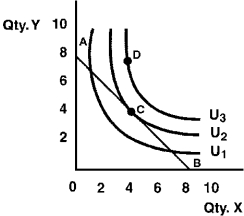 -In Figure 5-18, point D for the consumer
Plot the demand for caviar given the following information on quantity consumed and total utility; then explain why caviar sells for such a high price.
1 50 2 75 3 88 4 95 5 99
(Essay)
4.8/5 (83)
(83) If the slope of an indifference curve between two goods decreases as we move from left to right (dropping all minus signs), we infer that the consumer
(Multiple Choice)
4.8/5 (92)
(92) 
Filters
- Essay(0)
- Multiple Choice(0)
- Short Answer(0)
- True False(0)
- Matching(0)