



 Chat with AI
Exam 2: Economic Models: Trade-Offs and Trade 25

Exam 1: First Principles233 Questions
Exam 2: Economic Models: Trade-Offs and Trade 25382 Questions
Exam 3: Supply and Demand290 Questions
Exam 4: Consumer and Producer Surplus224 Questions
Exam 5: Price Controls and Quotas: Meddling With Markets227 Questions
Exam 6: Elasticity300 Questions
Exam 7: Taxes298 Questions
Exam 8: International Trade272 Questions
Exam 9: Decision Making by Individuals Firms201 Questions
Exam 10: The Rational Consumer372 Questions
Exam 11: Behind the Supply Curve: Inputs and Costs362 Questions
Exam 12: Perfect Competition and the Supply Curve355 Questions
Exam 13: Monopoly350 Questions
Exam 14: Oligopoly294 Questions
Exam 15: Monopolistic Competition and Product Differentiation262 Questions
Exam 16: Externalities199 Questions
Exam 17: Public Goods Common Resources224 Questions
Exam 18: The Economics of the Welfare140 Questions
Exam 19: Factor Markets and the Distribution of Income369 Questions
Exam 20: Uncertainty, Risk, and Private Information202 Questions
Select questions type


Use the following to answer questions: 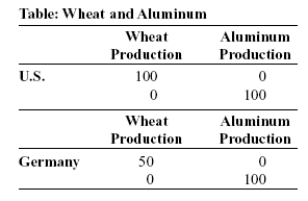 -(Table: Wheat and Aluminum) Look at the table Wheat and Aluminum. The United States and Germany can produce both wheat and aluminum. The table shows the maximum annual output combinations of wheat and aluminum that can be produced. Based on the table:
 (Multiple Choice)
4.9/5  (80)
(80) Use the following to answer questions: 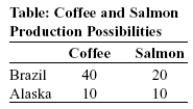 -(Table: Coffee and Salmon Production Possibilities) Look at the table Coffee and Salmon Production Possibilities. The table shows the maximum amounts of coffee and salmon that Brazil and Alaska can produce if they just produce one good. The opportunity cost of producing 1 unit of coffee for Brazil is:
 (Multiple Choice)
4.9/5 (82)
(82) A linear curve has the same slope between every pair of points.
(True/False)
4.8/5 (74)
(74) Use the following to answer questions:  -(Table: Production Possibilities Schedule I) Look at the table Production Possibilities Schedule I. If the economy produces two units of consumer goods per period, it also can produce at most _____ units of capital goods per period.
 (Multiple Choice)
4.8/5 (80)
(80) Use the following to answer questions:
Figure: Consumer and Capital Goods 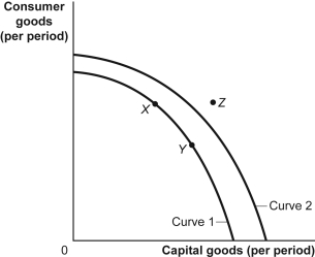 -(Figure: Consumer and Capital Goods) Look at the figure Consumer and Capital Goods. The movement from curve 1 to curve 2 indicates:
 (Multiple Choice)
4.7/5 (79)
(79) "Many economists agree that income taxes should be increased for rich people" is a positive statement.
(True/False)
4.8/5 (83)
(83) Use the following to answer questions:  -(Figure: Wine and Wheat) Look at the figure Wine and Wheat. If this economy is producing at point A and wants to produce at point B, it must:
 (Multiple Choice)
4.9/5 (106)
(106) Use the following to answer questions:  -(Table: Production Possibilities Schedule II) Look at the table Production Possibilities Schedule II. If the economy is producing at alternative X, the opportunity cost of producing at Y instead of X is _____ units of consumer goods per period.
 (Multiple Choice)
4.8/5 (76)
(76) In one hour, the United States can produce 25 tons of steel or 250 automobiles. In one hour, Japan can produce 30 tons of steel or 275 automobiles. This information implies that:
(Multiple Choice)
4.9/5 (91)
(91) Use the following to answer questions:
Figure: Cold Drinks Sold and Temperature 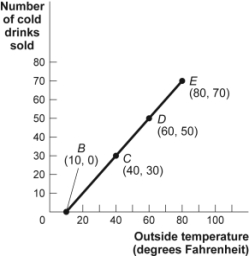 -(Figure: Cold Drinks Sold and Temperature) Look at the figure Cold Drinks Sold and Temperature. If we move from point B to point C in the figure, the outside temperature has ______ degrees and the number of cold drinks sold has ______.
 (Multiple Choice)
4.8/5 (71)
(71) Use the following to answer questions:
Figure: Slope 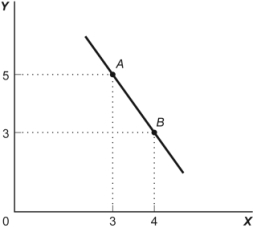 -(Figure: Slope) Look at the figure Slope. In the graph, the slope of the line between points A and B is:
 (Multiple Choice)
4.9/5 (82)
(82) All points inside the production possibility frontier represent:
(Multiple Choice)
4.9/5 (75)
(75) Use the following to answer questions:
Figure: Production Possibility Frontier 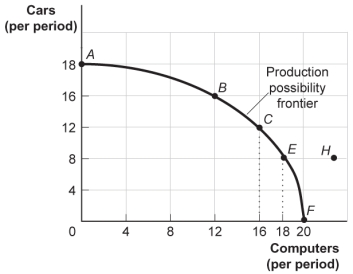 -(Figure: Production Possibility Frontier) Look at the figure Production Possibilities Frontier. The combination of cars and computers at point H:
 (Multiple Choice)
4.9/5 (67)
(67) The assumption ceteris paribus in a model means "other things equal."
(True/False)
4.9/5 (67)
(67) 
Filters
- Essay(0)
- Multiple Choice(0)
- Short Answer(0)
- True False(0)
- Matching(0)