



 Chat with AI
Exam 2: Economic Models: Trade-Offs and Trade 25

Exam 1: First Principles233 Questions
Exam 2: Economic Models: Trade-Offs and Trade 25382 Questions
Exam 3: Supply and Demand290 Questions
Exam 4: Consumer and Producer Surplus224 Questions
Exam 5: Price Controls and Quotas: Meddling With Markets227 Questions
Exam 6: Elasticity300 Questions
Exam 7: Taxes298 Questions
Exam 8: International Trade272 Questions
Exam 9: Decision Making by Individuals Firms201 Questions
Exam 10: The Rational Consumer372 Questions
Exam 11: Behind the Supply Curve: Inputs and Costs362 Questions
Exam 12: Perfect Competition and the Supply Curve355 Questions
Exam 13: Monopoly350 Questions
Exam 14: Oligopoly294 Questions
Exam 15: Monopolistic Competition and Product Differentiation262 Questions
Exam 16: Externalities199 Questions
Exam 17: Public Goods Common Resources224 Questions
Exam 18: The Economics of the Welfare140 Questions
Exam 19: Factor Markets and the Distribution of Income369 Questions
Exam 20: Uncertainty, Risk, and Private Information202 Questions
Select questions type


One of the controversies surrounding the United States' energy markets is the trade-off between energy production and clean air. Assuming clean air has value, the United States will be on its production possibility frontier if and only if:
(Multiple Choice)
5.0/5  (90)
(90) The effect of an increase in productive inputs such as labor and capital can be shown by:
(Multiple Choice)
4.9/5 (94)
(94) Use the following to answer questions:
Figure: Guns and Butter  -(Figure: Guns and Butter) Look at the figure Guns and Butter. If the economy is operating at point B, producing 16 guns and 12 pounds of butter per period, a decision to move to point E and produce 18 pounds of butter:
 (Multiple Choice)
4.7/5 (73)
(73) Use the following to answer questions: 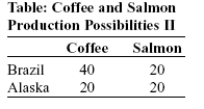 -(Table: Coffee and Salmon Production Possibilities II) Look at the table Coffee and Salmon Production Possibilities II. This table shows the maximum amounts of coffee and salmon, both measured in pounds, that Brazil and Alaska can produce if they just produce one good. Brazil has an absolute advantage in producing:
 (Multiple Choice)
4.9/5 (81)
(81) Mark and Julie are going to sell brownies and cookies for their third annual fundraiser bake sale. In one day, Mark can make 40 brownies or 20 cookies, and Julie can make 15 brownies or 15 cookies. With specialization, _____ brownies and _____ cookies will be made in one day.
(Multiple Choice)
4.9/5 (81)
(81) Use the following to answer questions:  -(Table: Production Possibilities Schedule I) Look at the table Production Possibilities Schedule I. The opportunity cost of producing the fourth unit of consumer goods is _____ units of capital goods.
 (Multiple Choice)
4.9/5 (76)
(76) Consider a nation with a large economy, like the United States, and a nation with a small economy, like the Dominican Republic. How can the United States, with absolute advantage in production of almost all goods, benefit from trade with the Dominican Republic?
(Essay)
4.8/5 (79)
(79) A town hires more police officers and then has an increase in arrests. One can conclude that the larger police force caused more crime.
(True/False)
4.8/5 (79)
(79) Use the following to answer questions:
Figure: Consumer and Capital Goods 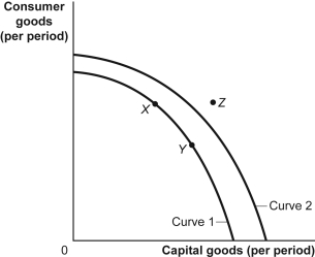 -(Figure: Consumer and Capital Goods) Look at the figure Consumer and Capital Goods. Technological improvements will likely:
 (Multiple Choice)
4.9/5 (63)
(63) Use the following to answer questions: 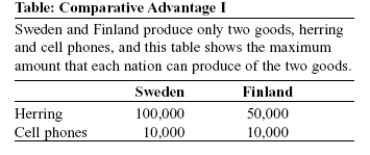 -(Table: Comparative Advantage I) Look at the table Comparative Advantage I. The opportunity cost of producing 1 box of cell phones for Sweden is _____ box(es) of herring.
 (Multiple Choice)
4.8/5 (92)
(92) Use the following to answer questions:
Figure: Comparative Advantage
Eastland and Westland produce only two goods, boxes of peaches and boxes of oranges, and this figure shows each nation's production possibility frontier for the two goods. 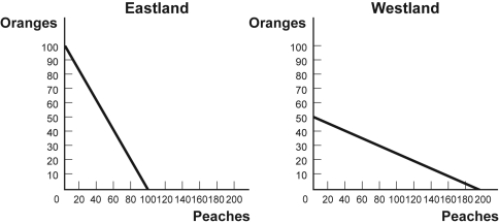 -(Figure: Comparative Advantage) Look at the figure Comparative Advantage. The opportunity cost of producing 1 box of peaches for Westland is _____ box(es) of oranges.
 (Multiple Choice)
4.8/5 (90)
(90) Use the following to answer questions: 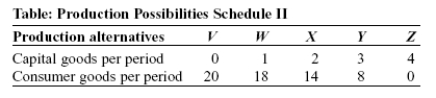 -(Table: Production Possibilities Schedule II) Look at the table Production Possibilities Schedule II. If an economy is producing at X, the opportunity cost to it of producing at Y is _____ units of consumer goods per period.
 (Multiple Choice)
4.9/5 (82)
(82) Use the following to answer questions:
Figure: Comparative Advantage
Eastland and Westland produce only two goods, boxes of peaches and boxes of oranges, and this figure shows each nation's production possibility frontier for the two goods.
-(Figure: Comparative Advantage) Look at the figure Comparative Advantage. Westland has a comparative advantage in producing:
-(Figure: Comparative Advantage) Look at the figure Comparative Advantage. Westland has a comparative advantage in producing: (Multiple Choice)
4.9/5 (87)
(87) If an economy has to sacrifice only one unit of good X for each unit of good Y produced throughout the relevant range, then its production possibility frontier has:
(Multiple Choice)
4.9/5 (82)
(82) Use the following to answer questions:
Scenario: Countries A and B
Two countries, A and B, produce two goods, wheat (W) and steel (S). Each has a linear production possibility frontier in both goods. If country A spends all of its available resources to produce wheat, it can produce 500 tons of wheat and no steel. If it uses all of its resources to produce steel, it can produce 250 tons of steel and no wheat. If country B spends all of its available resources producing wheat, it can produce 400 tons of wheat, and if it spends all of its resources on the production of steel, it can produce 400 tons of steel.
-(Scenario: Countries A and B) Look at the scenario Countries A and B. Given this information, country _____ has a comparative advantage in the production of wheat, and country _____ has a comparative advantage in the production of steel.
(Multiple Choice)
5.0/5 (73)
(73) 
Filters
- Essay(0)
- Multiple Choice(0)
- Short Answer(0)
- True False(0)
- Matching(0)