



 Chat with AI
Exam 2: Economic Models: Trade-Offs and Trade 25

Exam 1: First Principles233 Questions
Exam 2: Economic Models: Trade-Offs and Trade 25382 Questions
Exam 3: Supply and Demand290 Questions
Exam 4: Consumer and Producer Surplus224 Questions
Exam 5: Price Controls and Quotas: Meddling With Markets227 Questions
Exam 6: Elasticity300 Questions
Exam 7: Taxes298 Questions
Exam 8: International Trade272 Questions
Exam 9: Decision Making by Individuals Firms201 Questions
Exam 10: The Rational Consumer372 Questions
Exam 11: Behind the Supply Curve: Inputs and Costs362 Questions
Exam 12: Perfect Competition and the Supply Curve355 Questions
Exam 13: Monopoly350 Questions
Exam 14: Oligopoly294 Questions
Exam 15: Monopolistic Competition and Product Differentiation262 Questions
Exam 16: Externalities199 Questions
Exam 17: Public Goods Common Resources224 Questions
Exam 18: The Economics of the Welfare140 Questions
Exam 19: Factor Markets and the Distribution of Income369 Questions
Exam 20: Uncertainty, Risk, and Private Information202 Questions
Select questions type


If two variables are negatively related, they will always be represented by:
(Multiple Choice)
4.8/5  (78)
(78) The basis of the circular-flow diagram is that the money flowing into each sector or market is greater than the money that flows out.
(True/False)
4.8/5 (70)
(70) Nations can gain from trade with other nations even if they are less productive in all industries than the nations they trade with.
(True/False)
4.9/5 (73)
(73) In one day, Kessy can bake 10 cookies or mix 15 glasses of lemonade. His friend Ava can make 10 cookies or 10 glasses of lemonade. His other friend, Ian, can make 10 cookies or 20 glasses of lemonade. Who has the lowest opportunity cost in cookie production?
(Multiple Choice)
4.7/5 (79)
(79) If farmer Sam MacDonald can produce 200 pounds of cabbages and no potatoes or no cabbages and 100 pounds of potatoes and if he faces a linear production possibility frontier, the opportunity cost of producing an additional pound of potatoes is _____ pound(s) of cabbage.
(Multiple Choice)
4.7/5 (87)
(87) Suppose residents of Montana operate on their production possibility frontier, and they want to increase production of both wheat and fly-fishing rods. According to the production possibility frontier, this cannot happen without new resources or technological improvement.
(True/False)
4.8/5 (93)
(93) Use the following to answer questions:  -(Figure: Wine and Wheat) Look at the figure Wine and Wheat. The opportunity cost of moving from producing ONLY wheat to producing at point D is _____ tons of wheat.
 (Multiple Choice)
4.7/5 (85)
(85) In the simplest circular-flow model, households supply _____ and demand _____.
(Multiple Choice)
4.8/5 (91)
(91) Use the following to answer questions:
Figure: Production Possibility Frontier Curve for Tealand  -(Figure: Production Possibility Frontier for Tealand) Look at the figure Production Possibility Frontier for Tealand. If Tealand is producing 10 million scones and 10 million cups of tea (point A), we know that the economy:
 (Multiple Choice)
4.7/5 (70)
(70) The process observed when an economy's production possibility frontier shifts outward is:
(Multiple Choice)
4.8/5 (73)
(73) In the circular-flow diagram, an organization that produces goods or services for sale is a:
(Multiple Choice)
4.8/5 (74)
(74) Abe starts exercising regularly, and after a few months he can do twice as much of everything. In a single day Abe can now make 10 hamburgers or 8 milkshakes rather than the 5 hamburgers and 4 milkshakes he made in the past. We now know that Abe's production possibility frontier has _____, but his opportunity costs of making milkshakes _____.
(Multiple Choice)
4.9/5 (62)
(62) Use the following to answer questions:
-(Figure: Wine and Wheat) Look at the figure Wine and Wheat. If this economy is producing on the production possibility frontier, what would allow it to produce at point C?
-(Figure: Wine and Wheat) Look at the figure Wine and Wheat. If this economy is producing on the production possibility frontier, what would allow it to produce at point C? (Multiple Choice)
4.9/5 (83)
(83) In the circular-flow diagram households buy _____ in the _____ market.
(Multiple Choice)
4.8/5 (94)
(94) Use the following to answer questions:
Scenario: Linear Production Possibility Frontier
Largetown has a linear production possibility frontier, and it produces socks and shirts with 80 hours of labor. The table shows the number of hours of labor necessary to produce one pair of socks or one shirt. 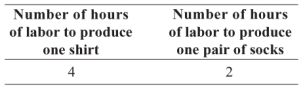 -(Scenario: Linear Production Possibility Frontier) Look at the scenario Linear Production Possibility Frontier. Largetown CANNOT produce _____ shirts and _____ pairs of socks.
 (Multiple Choice)
4.7/5 (88)
(88) Mark and Julie are going to sell brownies and cookies for their third annual fundraiser bake sale. In one day, Mark can make 40 brownies or 20 cookies, and Julie can make 15 brownies or 15 cookies. Based on this information, _____ has the comparative advantage in making brownies and _____ has the comparative advantage in making cookies.
(Multiple Choice)
4.9/5 (89)
(89) Use the following to answer questions:
Figure: Illustrating Slope 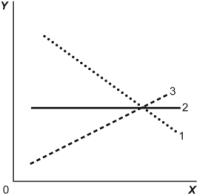 -(Figure: Illustrating Slope) Look at the figure Illustrating Slope. In the graph, line 1 depicts X and Y to be:
 (Multiple Choice)
4.9/5 (80)
(80) 
Filters
- Essay(0)
- Multiple Choice(0)
- Short Answer(0)
- True False(0)
- Matching(0)