



 Chat with AI
Exam 7: Sedimentary Environments

Exam 1: The Nature of Geology110 Questions
Exam 2: Investigating Geologic Questions106 Questions
Exam 3: Plate Tectonics152 Questions
Exam 4: Earth Materials131 Questions
Exam 5: Igneous Environments147 Questions
Exam 6: Volcanoes and Volcanic Hazards186 Questions
Exam 7: Sedimentary Environments155 Questions
Exam 8: Deformation and Metamorphism144 Questions
Exam 9: Geologic Time126 Questions
Exam 10: Seafloor and Continental Margins105 Questions
Exam 11: Mountains, Basins, and Continents124 Questions
Exam 12: Earthquakes and Earths Interior119 Questions
Exam 13: Climate and Weathering109 Questions
Exam 14: Glaciers, Shorelines, and Changing Sea Levels109 Questions
Exam 15: Weathering, Soil, and Unstable Slopes92 Questions
Exam 16: Streams and Flooding137 Questions
Exam 17: Water Resources142 Questions
Exam 18: Energy and Mineral Resources95 Questions
Exam 19: Geology of the Solar System77 Questions
Select questions type


Which of the following sites would have the slowest moving or least energetic current? 
(Multiple Choice)
4.9/5  (68)
(68) Which of the following situations would result in angular clasts?
(Multiple Choice)
5.0/5 (90)
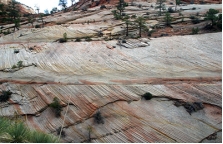
(90) Which way was the current either wind or water) moving during deposition of this section of rocks? 
(Multiple Choice)
4.8/5 (78)
(78) 
Which of the following environments would likely have large clasts?
(Multiple Choice)
4.9/5 (77)
(77) Many sedimentary rocks exposed in the Denver region are tilted at a high angle to the horizontal, indicating that: 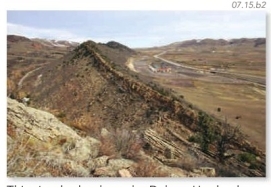
(Multiple Choice)
4.8/5 (86)
(86) What type of rock would you form in this plant-rich swamp? 
(Multiple Choice)
4.8/5 (85)
(85) What do the characteristics of the rock in this photograph tell you about its environment? 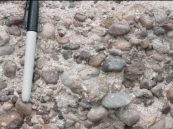
(Multiple Choice)
4.8/5 (82)
(82) 
Using the stratigraphic section and photographs located in the textbook Chapter 7 Investigation), determine the possible environments of deposition for the lower basal conglomerate. 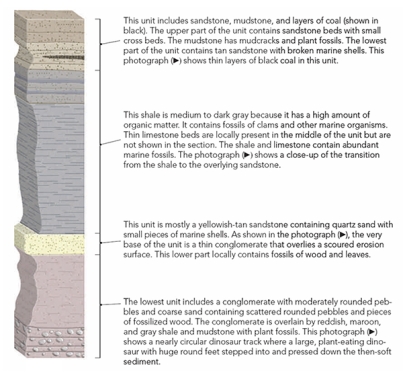
(Multiple Choice)
5.0/5 (69)
(69) The uniformly-sized sand shown here would be described as: 
(Multiple Choice)
4.8/5 (77)
(77) Which of the following characteristics are NOT used to classify and name clastic sediments?
(Multiple Choice)
4.9/5 (75)
(75) Which of the following can we understand by studying sedimentary rocks?
(Multiple Choice)
4.9/5 (88)
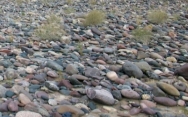
(88) 
What do the characteristics of the rock in this photograph tell you about its environment? 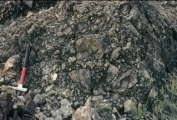
(Multiple Choice)
4.8/5 (76)
(76) 
Filters
- Essay(0)
- Multiple Choice(0)
- Short Answer(0)
- True False(0)
- Matching(0)