



 Chat with AI
Exam 7: Sedimentary Environments

Exam 1: The Nature of Geology110 Questions
Exam 2: Investigating Geologic Questions106 Questions
Exam 3: Plate Tectonics152 Questions
Exam 4: Earth Materials131 Questions
Exam 5: Igneous Environments147 Questions
Exam 6: Volcanoes and Volcanic Hazards186 Questions
Exam 7: Sedimentary Environments155 Questions
Exam 8: Deformation and Metamorphism144 Questions
Exam 9: Geologic Time126 Questions
Exam 10: Seafloor and Continental Margins105 Questions
Exam 11: Mountains, Basins, and Continents124 Questions
Exam 12: Earthquakes and Earths Interior119 Questions
Exam 13: Climate and Weathering109 Questions
Exam 14: Glaciers, Shorelines, and Changing Sea Levels109 Questions
Exam 15: Weathering, Soil, and Unstable Slopes92 Questions
Exam 16: Streams and Flooding137 Questions
Exam 17: Water Resources142 Questions
Exam 18: Energy and Mineral Resources95 Questions
Exam 19: Geology of the Solar System77 Questions
Select questions type


Clastic sedimentary rocks are classified primarily on the basis of:
(Multiple Choice)
4.9/5  (75)
(75) What is the geologic setting of Vancouver, British Columbia?
(Multiple Choice)
4.8/5 (78)
(78) What type of weathering is best expressed in this weathered limestone? 
(Multiple Choice)
5.0/5 (94)
(94) Does the change of environment from the base of the section up to the thick gray shale indicate an advance transgression) or retreat regression) of the sea? 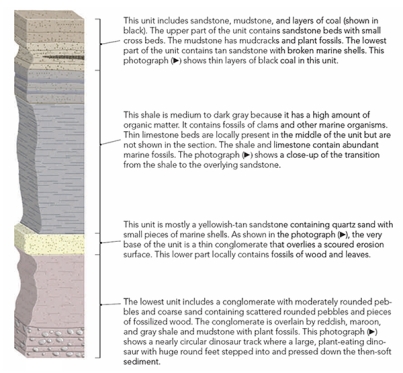
(Multiple Choice)
4.8/5 (63)
(63) Rocks rich in what mineral tend to have a poor solubility during weathering?
(Multiple Choice)
4.7/5 (84)
(84) Which of the following is most likely to deposit a conglomerate?
(Multiple Choice)
4.9/5 (77)
(77) Which of the following is a good interpretation of the environmental significance of an attribute of a sedimentary rock?
(Multiple Choice)
4.8/5 (91)
(91) Which of the following is the most used sedimentary resource?
(Multiple Choice)
4.8/5 (87)
(87) The cross beds shown here indicate what about the environment the sandstone was deposited in? 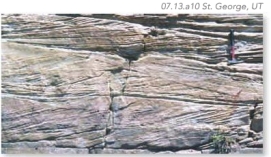
(Multiple Choice)
4.8/5 (81)
(81) Which of the following is NOT a way in which sandstones are commonly expressed in the landscape?
(Multiple Choice)
4.8/5 (66)
(66) Using the stratigraphic section and photographs located in the textbook Chapter 7 Investigation), determine the possible environments of deposition for the yellowish-tan sandstone. 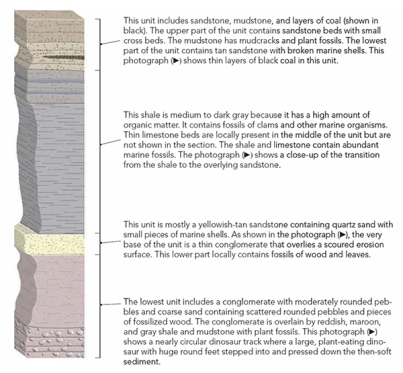
(Multiple Choice)
4.7/5 (66)
(66) In this section, a lower gray rock is successively overlain by beach sandstone, lagoon mudstone, and limestone. What is the best interpretation of what was going on? 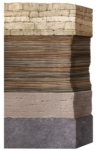
(Multiple Choice)
4.8/5 (68)
(68) Which of the following units was most likely deposited at least partly in sand dunes? 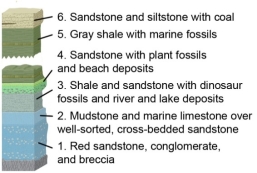
(Multiple Choice)
4.8/5 (87)
(87) The natural cements that hold clasts together precipitate in the empty pore spaces after compaction. Those precipitates come from:
(Multiple Choice)
5.0/5 (87)
(87) 
Sedimentary facies shift toward the sea as the sea moves out during a:
(Multiple Choice)
5.0/5 (83)
(83) The contact between the shale, which dominates the bottom part of this sedimentary sequence, and the sandstone, which dominates the upper part, is best described as: 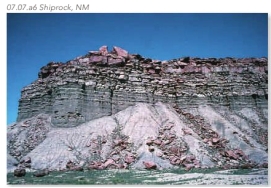
(Multiple Choice)
4.8/5 (77)
(77) 
Filters
- Essay(0)
- Multiple Choice(0)
- Short Answer(0)
- True False(0)
- Matching(0)