



 Chat with AI
Exam 6: Supply, Demand, and Government Policies

Exam 1: Ten Principles of Economics220 Questions
Exam 2: Thinking Like an Economist284 Questions
Exam 3: Interdependence and the Gains From Trade192 Questions
Exam 4: The Market Forces of Supply and Demand277 Questions
Exam 5: Elasticity and Its Application222 Questions
Exam 6: Supply, Demand, and Government Policies321 Questions
Exam 7: Consumers, Producers, and the Efficiency of Markets218 Questions
Exam 8: Applications: The Costs of Taxation203 Questions
Exam 9: Application: International Trade214 Questions
Exam 10: Externalities204 Questions
Exam 11: Public Goods and Common Resources182 Questions
Exam 12: The Design of the Tax System225 Questions
Exam 13: The Costs of Production261 Questions
Exam 14: Firms in Competitive Markets243 Questions
Exam 15: Monopoly231 Questions
Exam 16: Monopolistic Competition246 Questions
Exam 17: Oligopoly204 Questions
Exam 18: The Markets for the Factors of Production232 Questions
Exam 19: Earnings and Discrimination230 Questions
Exam 20: Income Inequality and Poverty194 Questions
Exam 21: The Theory of Consumer Choice209 Questions
Exam 22: Frontiers in Microeconomics185 Questions
Exam 23: Measuring a Nations Income231 Questions
Exam 24: Measuring the Cost of Living214 Questions
Exam 25: Production and Growth187 Questions
Exam 26: Saving, Investment, and the Financial System225 Questions
Exam 27: Tools of Finance198 Questions
Exam 28: Unemployment and Its Natural Rate361 Questions
Exam 29: The Monetary System210 Questions
Exam 30: Money Growth and Inflation201 Questions
Exam 31: Open-Economy Macroeconomics: Basic Concepts194 Questions
Exam 32: A Macroeconomic Theory of the Open Economy188 Questions
Exam 33: Aggregate Demand and Aggregate Supply189 Questions
Exam 34: The Influence of Monetary and Fiscal Policy on Aggregate Demand207 Questions
Exam 35: The Short-Run Tradeoff Between Inflation and Unemployment223 Questions
Exam 36: Six Debates Over Macroeconomic Policy154 Questions
Select questions type


In an unregulated labor market, the wage adjusts to balance labor supply and labor demand.
(True/False)
4.8/5  (83)
(83) Figure 6-20
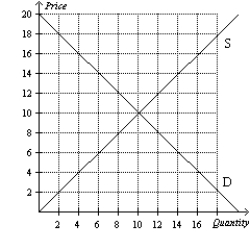
-Refer to Figure 6-20. Suppose a $3 per-unit tax is imposed on the sellers of this good. How much is the burden of this tax on the buyers in this market?
-Refer to Figure 6-20. Suppose a $3 per-unit tax is imposed on the sellers of this good. How much is the burden of this tax on the buyers in this market? (Short Answer)
4.9/5 (81)
(81) When OPEC raised the price of crude oil in the 1970s, it caused the United States'
(Multiple Choice)
4.9/5 (82)
(82) Table 6-2
-Refer to Table 6-2. In this market, over what range of prices would a price floor set by the government be binding?
(Essay)
4.8/5 (83)
(83) The goal of rent control is to help the poor by making housing more affordable.
(True/False)
4.9/5 (91)
(91) If the government removes a binding price floor from a market, then the price paid by buyers will
(Multiple Choice)
4.8/5 (66)
(66) Figure 6-13
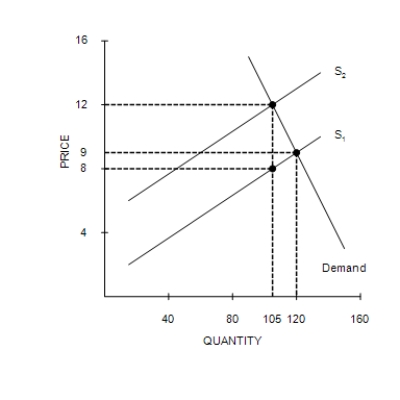 -Refer to Figure 6-13. How is the burden of the tax shared between buyers and sellers? Buyers bear
 (Multiple Choice)
4.8/5 (87)
(87) Figure 6-20
-Refer to Figure 6-20. Suppose a $3 per-unit tax is imposed on the sellers of this good. How much is the burden of this tax on the sellers in this market?
-Refer to Figure 6-20. Suppose a $3 per-unit tax is imposed on the sellers of this good. How much is the burden of this tax on the sellers in this market? (Short Answer)
4.8/5 (84)
(84) A price ceiling set below the equilibrium price causes quantity demanded to exceed quantity supplied.
(True/False)
4.9/5 (86)
(86) Figure 6-17
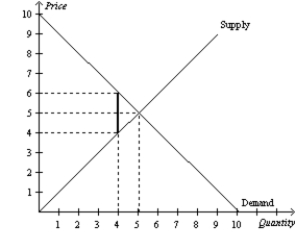
-Refer to Figure 6-17. If the government places a $2 tax in the market, the seller bears $1 of the tax burden.
-Refer to Figure 6-17. If the government places a $2 tax in the market, the seller bears $1 of the tax burden. (True/False)
4.8/5 (66)
(66) Even though federal law mandates that workers and firms each pay half of the total FICA tax, the tax burden may not fall equally on workers and firms.
(True/False)
4.8/5 (65)
(65) A price ceiling set above the equilibrium price causes a surplus in the market.
(True/False)
4.9/5 (80)
(80) Figure 6-20
-Refer to Figure 6-20. Suppose a $3 per-unit tax is imposed on the sellers of this good. What is the effective price that sellers will receive for the good after the tax is imposed?
-Refer to Figure 6-20. Suppose a $3 per-unit tax is imposed on the sellers of this good. What is the effective price that sellers will receive for the good after the tax is imposed? (Essay)
4.7/5 (75)
(75) Scenario 6-1
Suppose that demand in the market for good X is given by the equation
and that supply in the market for good X is given by the equation
-Refer to Scenario 6-1. If the government set a price floor at $7, would there be a shortage or surplus, and how large would be the shortage/surplus?
(Essay)
5.0/5 (81)
(81) Figure 6-21
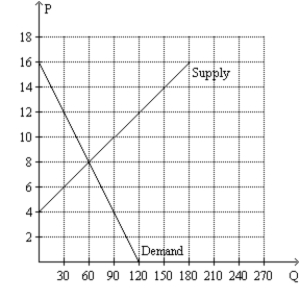
-Refer to Figure 6-21. If the government imposes a tax of $6 per unit in this market, what price will buyers pay per unit after the tax is imposed?
-Refer to Figure 6-21. If the government imposes a tax of $6 per unit in this market, what price will buyers pay per unit after the tax is imposed? (Essay)
4.8/5 (81)
(81) Whether the minimum wage is a binding price floor always depends upon whether the economy is in a recession.
(True/False)
4.7/5 (71)
(71) Studies by economists have found that a 10 percent increase in the minimum wage decreases teenage employment 10 percent.
(True/False)
5.0/5 (77)
(77) 
Filters
- Essay(0)
- Multiple Choice(0)
- Short Answer(0)
- True False(0)
- Matching(0)