



 Chat with AI
Exam 6: Supply, Demand, and Government Policies

Exam 1: Ten Principles of Economics220 Questions
Exam 2: Thinking Like an Economist284 Questions
Exam 3: Interdependence and the Gains From Trade192 Questions
Exam 4: The Market Forces of Supply and Demand277 Questions
Exam 5: Elasticity and Its Application222 Questions
Exam 6: Supply, Demand, and Government Policies321 Questions
Exam 7: Consumers, Producers, and the Efficiency of Markets218 Questions
Exam 8: Applications: The Costs of Taxation203 Questions
Exam 9: Application: International Trade214 Questions
Exam 10: Externalities204 Questions
Exam 11: Public Goods and Common Resources182 Questions
Exam 12: The Design of the Tax System225 Questions
Exam 13: The Costs of Production261 Questions
Exam 14: Firms in Competitive Markets243 Questions
Exam 15: Monopoly231 Questions
Exam 16: Monopolistic Competition246 Questions
Exam 17: Oligopoly204 Questions
Exam 18: The Markets for the Factors of Production232 Questions
Exam 19: Earnings and Discrimination230 Questions
Exam 20: Income Inequality and Poverty194 Questions
Exam 21: The Theory of Consumer Choice209 Questions
Exam 22: Frontiers in Microeconomics185 Questions
Exam 23: Measuring a Nations Income231 Questions
Exam 24: Measuring the Cost of Living214 Questions
Exam 25: Production and Growth187 Questions
Exam 26: Saving, Investment, and the Financial System225 Questions
Exam 27: Tools of Finance198 Questions
Exam 28: Unemployment and Its Natural Rate361 Questions
Exam 29: The Monetary System210 Questions
Exam 30: Money Growth and Inflation201 Questions
Exam 31: Open-Economy Macroeconomics: Basic Concepts194 Questions
Exam 32: A Macroeconomic Theory of the Open Economy188 Questions
Exam 33: Aggregate Demand and Aggregate Supply189 Questions
Exam 34: The Influence of Monetary and Fiscal Policy on Aggregate Demand207 Questions
Exam 35: The Short-Run Tradeoff Between Inflation and Unemployment223 Questions
Exam 36: Six Debates Over Macroeconomic Policy154 Questions
Select questions type


Scenario 6-1
Suppose that demand in the market for good X is given by the equation
and that supply in the market for good X is given by the equation
-Refer to Scenario 6-1. If the government set a price floor at $13, would there be a shortage or surplus, and how large would be the shortage/surplus?
(Essay)
4.9/5  (79)
(79) If the government levies a $1600 tax per boat on sellers of boats, then the price paid by buyers of boats would
(Multiple Choice)
4.8/5 (85)
(85) When a tax of $1.00 per gallon is imposed on sellers of gasoline, the supply curve for gasoline shifts upward, but by less than $1.00.
(True/False)
4.9/5 (74)
(74) A tax of $1 on sellers always increases the equilibrium price by $1.
(True/False)
4.9/5 (85)
(85) Figure 6-19
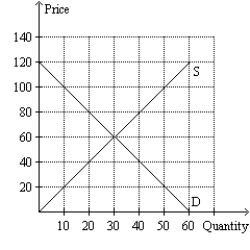
-Refer to Figure 6-19. If the government set a price floor at $55, would there be a shortage or surplus, and how large would be the shortage/surplus?
-Refer to Figure 6-19. If the government set a price floor at $55, would there be a shortage or surplus, and how large would be the shortage/surplus? (Essay)
4.8/5 (73)
(73) The minimum wage is more often binding for teenagers than for other members of the labor force.
(True/False)
4.7/5 (74)
(74) Figure 6-11
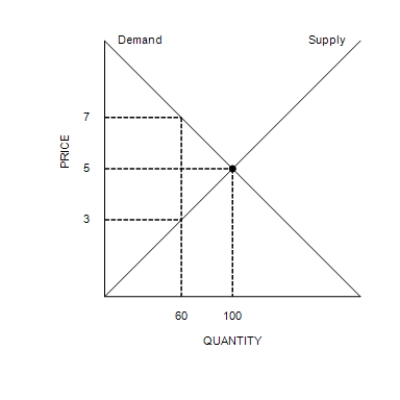 -Refer to Figure 6-11. Suppose a tax of $2 per unit is imposed on this market. How much will buyers pay per unit after the tax is imposed?
 (Multiple Choice)
5.0/5 (86)
(86) One disadvantage of government subsidies over price controls is that subsidies
(Multiple Choice)
4.8/5 (79)
(79) When the government imposes a binding price ceiling on a competitive market, a surplus of the good arises, and sellers must ration the scarce goods among the large number of potential buyers.
(True/False)
4.9/5 (89)
(89) Figure 6-1
Graph (a)
Graph (b)


-Refer to Figure 6-1. The price ceiling shown in graph (a)
-Refer to Figure 6-1. The price ceiling shown in graph (a) (Multiple Choice)
4.8/5 (69)
(69) Rent-control laws dictate a minimum rent that landlords may charge tenants.
(True/False)
4.9/5 (70)
(70) The economy contains many labor markets for different types of workers.
(True/False)
4.8/5 (77)
(77) If the equilibrium price of an airline ticket is $400 and the government imposes a price floor of $500 on airline tickets, then fewer airline tickets will be sold than at the market equilibrium.
(True/False)
4.8/5 (72)
(72) Scenario 6-1
Suppose that demand in the market for good X is given by the equation
and that supply in the market for good X is given by the equation
-Refer to Scenario 6-1. If the government set a price ceiling at $8, would there be a shortage or surplus, and how large would be the shortage/surplus?
(Essay)
4.8/5 (70)
(70) A large majority of economists favor eliminating the minimum wage.
(True/False)
4.9/5 (76)
(76) Minimum-wage laws benefit society by creating a surplus of labor.
(True/False)
4.8/5 (80)
(80) A price floor set below the equilibrium price causes quantity supplied to exceed quantity demanded.
(True/False)
4.8/5 (86)
(86) 
Filters
- Essay(0)
- Multiple Choice(0)
- Short Answer(0)
- True False(0)
- Matching(0)