



 Chat with AI
Exam 6: Supply, Demand, and Government Policies

Exam 1: Ten Principles of Economics220 Questions
Exam 2: Thinking Like an Economist284 Questions
Exam 3: Interdependence and the Gains From Trade192 Questions
Exam 4: The Market Forces of Supply and Demand277 Questions
Exam 5: Elasticity and Its Application222 Questions
Exam 6: Supply, Demand, and Government Policies321 Questions
Exam 7: Consumers, Producers, and the Efficiency of Markets218 Questions
Exam 8: Applications: The Costs of Taxation203 Questions
Exam 9: Application: International Trade214 Questions
Exam 10: Externalities204 Questions
Exam 11: Public Goods and Common Resources182 Questions
Exam 12: The Design of the Tax System225 Questions
Exam 13: The Costs of Production261 Questions
Exam 14: Firms in Competitive Markets243 Questions
Exam 15: Monopoly231 Questions
Exam 16: Monopolistic Competition246 Questions
Exam 17: Oligopoly204 Questions
Exam 18: The Markets for the Factors of Production232 Questions
Exam 19: Earnings and Discrimination230 Questions
Exam 20: Income Inequality and Poverty194 Questions
Exam 21: The Theory of Consumer Choice209 Questions
Exam 22: Frontiers in Microeconomics185 Questions
Exam 23: Measuring a Nations Income231 Questions
Exam 24: Measuring the Cost of Living214 Questions
Exam 25: Production and Growth187 Questions
Exam 26: Saving, Investment, and the Financial System225 Questions
Exam 27: Tools of Finance198 Questions
Exam 28: Unemployment and Its Natural Rate361 Questions
Exam 29: The Monetary System210 Questions
Exam 30: Money Growth and Inflation201 Questions
Exam 31: Open-Economy Macroeconomics: Basic Concepts194 Questions
Exam 32: A Macroeconomic Theory of the Open Economy188 Questions
Exam 33: Aggregate Demand and Aggregate Supply189 Questions
Exam 34: The Influence of Monetary and Fiscal Policy on Aggregate Demand207 Questions
Exam 35: The Short-Run Tradeoff Between Inflation and Unemployment223 Questions
Exam 36: Six Debates Over Macroeconomic Policy154 Questions
Select questions type


Which of the following observations would be consistent with the imposition of a price ceiling that is higher than equilibrium price? After the price ceiling is established,
(Multiple Choice)
4.8/5  (88)
(88) When a price floor is binding, is the price floor set above or below the market equilibrium price?
(Essay)
4.7/5 (88)
(88) The distribution of the burden of a tax depends strictly on the elasticity of supply.
(True/False)
4.8/5 (78)
(78) Suppose that a tax is placed on books. If the buyers pay the majority of the tax, then we know that the
(Multiple Choice)
4.8/5 (76)
(76) The wedge between the buyers' price and the sellers' price is the same, regardless of whether the tax is levied on buyers or sellers.
(True/False)
4.9/5 (80)
(80) In the market for apartments, rent control causes the quantity supplied
(Multiple Choice)
4.9/5 (85)
(85) The imposition of a binding price ceiling on a market causes
(Multiple Choice)
4.8/5 (88)
(88) A tax of $1 on buyers shifts the demand curve downward by exactly $1.
(True/False)
4.8/5 (77)
(77) The burden of a luxury tax most likely falls more heavily on sellers because demand is more elastic and supply is more inelastic.
(True/False)
4.9/5 (88)
(88) Binding price ceilings benefit consumers because they allow consumers to buy all the goods they demand at a lower price.
(True/False)
4.8/5 (70)
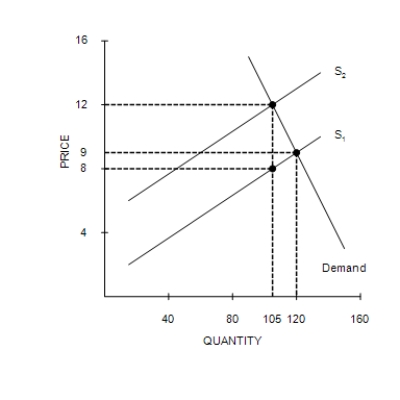
(70) Figure 6-8
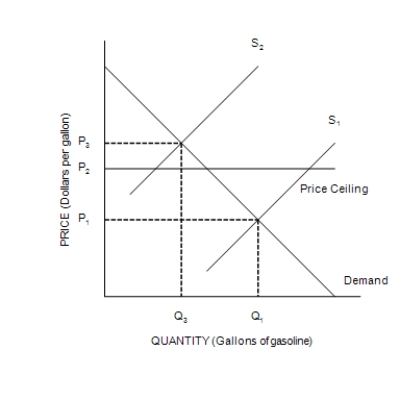 -Refer to Figure 6-8. When the price ceiling is enforced in this market, and the supply curve for gasoline shifts from S1 to S2, the resulting quantity of gasoline that is bought and sold is
 (Multiple Choice)
5.0/5 (72)
(72) Figure 6-15
Graph (a)
Graph (b)
Graph (c)
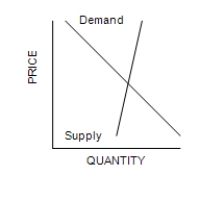
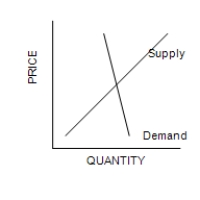
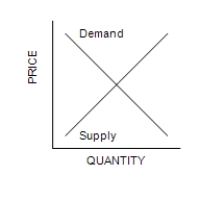
-Refer to Figure 6-15. In which market will the majority of the tax burden fall on buyers?
-Refer to Figure 6-15. In which market will the majority of the tax burden fall on buyers? (Multiple Choice)
4.8/5 (78)
(78) A $1.55 tax levied on the buyers of milkshakes will shift the demand curve
(Multiple Choice)
4.8/5 (73)
(73) Suppose that the demand for picture frames is highly inelastic, and the supply of picture frames is highly elastic. A tax of $1 per frame levied on picture frames will increase the price paid by buyers of picture frames by
(Multiple Choice)
4.9/5 (83)
(83) Workers determine the supply of labor, and firms determine the demand for labor.
(True/False)
4.8/5 (78)
(78) When policymakers set prices by legal decree, they obscure the signals that normally guide the allocation of society's resources.
(True/False)
4.9/5 (97)
(97) Figure 6-13
 -Refer to Figure 6-13. Suppose buyers, rather than sellers, were required to pay this tax (in the same amount per unit as shown in the graph). Relative to the tax on sellers, the tax on buyers would result in
 (Multiple Choice)
4.8/5 (74)
(74) Table 6-1
The following table contains the demand schedule and supply schedule for a market for a particular good. Suppose sellers of the good successfully lobby Congress to impose a price floor $2 above the equilibrium price in this market.
Price (Dollars per unit) Quantity Demanded (Units) Quantity Supplied (Units) 0 15 0 1 13 3 2 11 6 3 9 9 4 7 12 5 5 15 6 3 18
-Refer to Table 6-1. How many units of the good are purchased after the imposition of the price floor?
(Multiple Choice)
4.9/5 (72)
(72) Figure 6-6
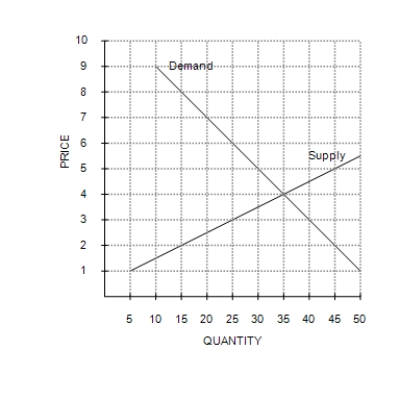 -Refer to Figure 6-6. When a certain price control is imposed on this market, the resulting quantity of the good that is actually bought and sold is such that buyers are willing and able to pay a maximum of P1 dollars per unit for that quantity and sellers are willing and able to accept a minimum of P2 dollars per unit for that quantity. If P1 − P2 = $3, then the price control is
 (Multiple Choice)
4.9/5 (89)
(89) 
Filters
- Essay(0)
- Multiple Choice(0)
- Short Answer(0)
- True False(0)
- Matching(0)