



 Chat with AI
Exam 6: Supply, Demand, and Government Policies

Exam 1: Ten Principles of Economics220 Questions
Exam 2: Thinking Like an Economist284 Questions
Exam 3: Interdependence and the Gains From Trade192 Questions
Exam 4: The Market Forces of Supply and Demand277 Questions
Exam 5: Elasticity and Its Application222 Questions
Exam 6: Supply, Demand, and Government Policies321 Questions
Exam 7: Consumers, Producers, and the Efficiency of Markets218 Questions
Exam 8: Applications: The Costs of Taxation203 Questions
Exam 9: Application: International Trade214 Questions
Exam 10: Externalities204 Questions
Exam 11: Public Goods and Common Resources182 Questions
Exam 12: The Design of the Tax System225 Questions
Exam 13: The Costs of Production261 Questions
Exam 14: Firms in Competitive Markets243 Questions
Exam 15: Monopoly231 Questions
Exam 16: Monopolistic Competition246 Questions
Exam 17: Oligopoly204 Questions
Exam 18: The Markets for the Factors of Production232 Questions
Exam 19: Earnings and Discrimination230 Questions
Exam 20: Income Inequality and Poverty194 Questions
Exam 21: The Theory of Consumer Choice209 Questions
Exam 22: Frontiers in Microeconomics185 Questions
Exam 23: Measuring a Nations Income231 Questions
Exam 24: Measuring the Cost of Living214 Questions
Exam 25: Production and Growth187 Questions
Exam 26: Saving, Investment, and the Financial System225 Questions
Exam 27: Tools of Finance198 Questions
Exam 28: Unemployment and Its Natural Rate361 Questions
Exam 29: The Monetary System210 Questions
Exam 30: Money Growth and Inflation201 Questions
Exam 31: Open-Economy Macroeconomics: Basic Concepts194 Questions
Exam 32: A Macroeconomic Theory of the Open Economy188 Questions
Exam 33: Aggregate Demand and Aggregate Supply189 Questions
Exam 34: The Influence of Monetary and Fiscal Policy on Aggregate Demand207 Questions
Exam 35: The Short-Run Tradeoff Between Inflation and Unemployment223 Questions
Exam 36: Six Debates Over Macroeconomic Policy154 Questions
Select questions type


Figure 6-21
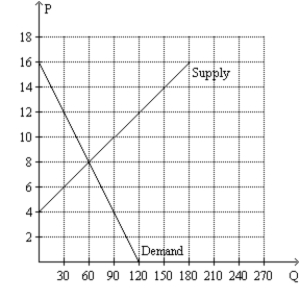
-Refer to Figure 6-21. If the government imposes a tax of $6 per unit in this market, how much is the burden of the tax on the sellers in this market?
-Refer to Figure 6-21. If the government imposes a tax of $6 per unit in this market, how much is the burden of the tax on the sellers in this market? (Essay)
4.7/5  (89)
(89) If the supply curve is more price elastic than the demand curve, will the buyers or the sellers bear a greater burden of a tax? Draw a diagram to illustrate your answer.
(Essay)
4.8/5 (67)
(67) Figure 6-18
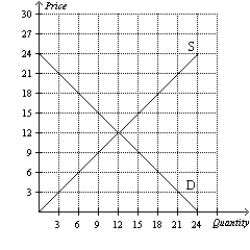
-Refer to Figure 6-18. If the government set a price ceiling at $15, would there be a shortage or surplus, and how large would be the shortage/surplus?
-Refer to Figure 6-18. If the government set a price ceiling at $15, would there be a shortage or surplus, and how large would be the shortage/surplus? (Essay)
4.9/5 (70)
(70) A tax on sellers usually causes buyers to pay more for the good and sellers to receive less for the good than they did before the tax was levied.
(True/False)
4.8/5 (86)
(86) If the supply curve is more price elastic than the demand curve in a particular market, will the buyers or the sellers bear a larger burden of a per-unit tax imposed on the market?
(Essay)
4.8/5 (78)
(78) Figure 6-18
-Refer to Figure 6-18. If the government set a price ceiling at $8, would there be a shortage or surplus, and how large would be the shortage/surplus?
-Refer to Figure 6-18. If the government set a price ceiling at $8, would there be a shortage or surplus, and how large would be the shortage/surplus? (Essay)
4.8/5 (79)
(79) The primary effect of rent control in the short run is to reduce rents.
(True/False)
4.9/5 (62)
(62) A binding price ceiling causes quantity demanded to be less than quantity supplied.
(True/False)
4.9/5 (75)
(75) Figure 6-10
The vertical distance between points A and B represents the tax in the market.
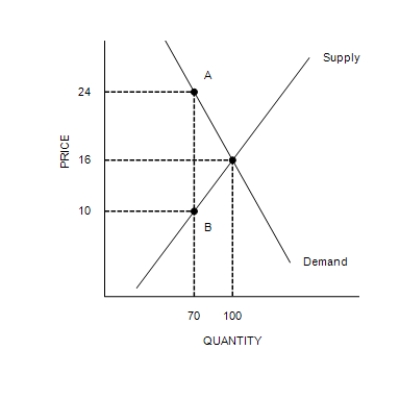 -Refer to Figure 6-10. The amount of the tax per unit is
 (Multiple Choice)
4.8/5 (79)
(79) Figure 6-16

-Refer to Figure 6-16. A price ceiling set at $70 would create a shortage of 40 units.
-Refer to Figure 6-16. A price ceiling set at $70 would create a shortage of 40 units. (True/False)
4.9/5 (72)
(72) A price ceiling is always a binding price control, whereas a price floor may be either binding or not binding.
(True/False)
4.8/5 (77)
(77) Figure 6-4
Graph (a)
Graph (b)
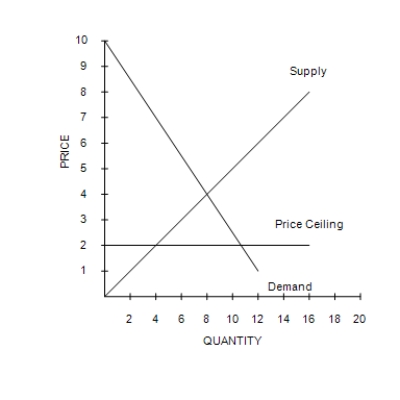
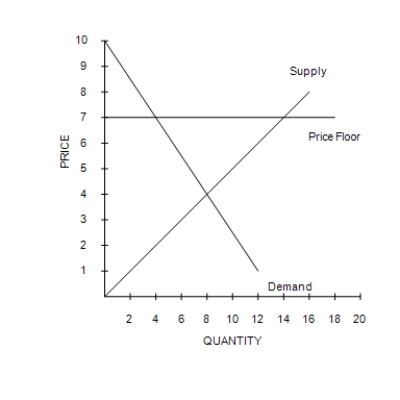
-Refer to Figure 6-4. In graph (b), there will be
-Refer to Figure 6-4. In graph (b), there will be (Multiple Choice)
4.8/5 (76)
(76) When a tax is placed on the sellers of smart watches, the size of the smart watch market
(Multiple Choice)
5.0/5 (74)
(74) A tax on sellers increases the quantity of the good sold in the market.
(True/False)
4.9/5 (81)
(81) If the demand curve is very inelastic and the supply curve is very elastic in a market, then the sellers will bear a greater burden of a tax imposed on the market, even if the tax is imposed on the buyers.
(True/False)
4.8/5 (71)
(71) 
Filters
- Essay(0)
- Multiple Choice(0)
- Short Answer(0)
- True False(0)
- Matching(0)