



 Chat with AI
Exam 6: Supply, Demand, and Government Policies

Exam 1: Ten Principles of Economics220 Questions
Exam 2: Thinking Like an Economist284 Questions
Exam 3: Interdependence and the Gains From Trade192 Questions
Exam 4: The Market Forces of Supply and Demand277 Questions
Exam 5: Elasticity and Its Application222 Questions
Exam 6: Supply, Demand, and Government Policies321 Questions
Exam 7: Consumers, Producers, and the Efficiency of Markets218 Questions
Exam 8: Applications: The Costs of Taxation203 Questions
Exam 9: Application: International Trade214 Questions
Exam 10: Externalities204 Questions
Exam 11: Public Goods and Common Resources182 Questions
Exam 12: The Design of the Tax System225 Questions
Exam 13: The Costs of Production261 Questions
Exam 14: Firms in Competitive Markets243 Questions
Exam 15: Monopoly231 Questions
Exam 16: Monopolistic Competition246 Questions
Exam 17: Oligopoly204 Questions
Exam 18: The Markets for the Factors of Production232 Questions
Exam 19: Earnings and Discrimination230 Questions
Exam 20: Income Inequality and Poverty194 Questions
Exam 21: The Theory of Consumer Choice209 Questions
Exam 22: Frontiers in Microeconomics185 Questions
Exam 23: Measuring a Nations Income231 Questions
Exam 24: Measuring the Cost of Living214 Questions
Exam 25: Production and Growth187 Questions
Exam 26: Saving, Investment, and the Financial System225 Questions
Exam 27: Tools of Finance198 Questions
Exam 28: Unemployment and Its Natural Rate361 Questions
Exam 29: The Monetary System210 Questions
Exam 30: Money Growth and Inflation201 Questions
Exam 31: Open-Economy Macroeconomics: Basic Concepts194 Questions
Exam 32: A Macroeconomic Theory of the Open Economy188 Questions
Exam 33: Aggregate Demand and Aggregate Supply189 Questions
Exam 34: The Influence of Monetary and Fiscal Policy on Aggregate Demand207 Questions
Exam 35: The Short-Run Tradeoff Between Inflation and Unemployment223 Questions
Exam 36: Six Debates Over Macroeconomic Policy154 Questions
Select questions type


Which of the following is not a rationing mechanism used by landlords in cities with rent control?
(Multiple Choice)
4.9/5  (81)
(81) When a binding price floor is imposed on a market for a good, some people who want to sell the good cannot do so.
(True/False)
4.8/5 (80)
(80) Policymakers use taxes to raise revenue for public purposes and to influence market outcomes.
(True/False)
4.8/5 (88)
(88) When a tax is placed on the sellers of a product, buyers pay
(Multiple Choice)
4.8/5 (83)
(83) Using a supply and demand diagram, show a labor market with a binding minimum wage. Use the diagram to show those who are helped by the minimum wage and those who are hurt by the minimum wage.
(Essay)
4.9/5 (74)
(74) Figure 6-20
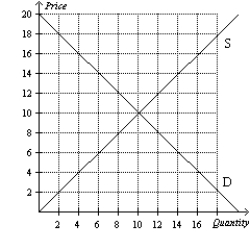
-Refer to Figure 6-20. Suppose a $4 per-unit tax is imposed on the sellers of this good. How many units of this good will be sold after the tax is imposed?
-Refer to Figure 6-20. Suppose a $4 per-unit tax is imposed on the sellers of this good. How many units of this good will be sold after the tax is imposed? (Essay)
4.9/5 (91)
(91) Figure 6-12
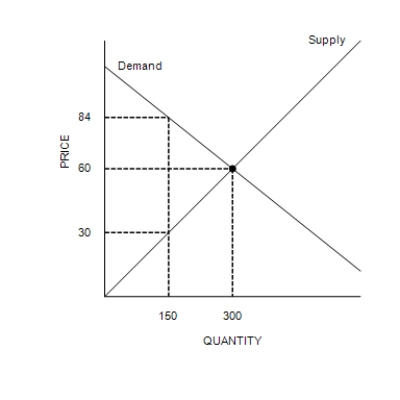
-Refer to Figure 6-12. Suppose a tax of $84 per unit is imposed on this market. Which of the following is correct?
-Refer to Figure 6-12. Suppose a tax of $84 per unit is imposed on this market. Which of the following is correct? (Multiple Choice)
4.7/5 (76)
(76) If the equilibrium wage is $4 per hour and the minimum wage is $5.15 per hour, then a shortage of labor will exist.
(True/False)
4.8/5 (67)
(67) A binding price ceiling may not help all consumers, but it does not hurt any consumers.
(True/False)
4.8/5 (83)
(83) Regardless of whether a tax is levied on sellers or buyers, taxes discourage market activity.
(True/False)
4.8/5 (71)
(71) Minimum-wage laws are precise policy instruments that can specifically target workers whose family incomes are low.
(True/False)
4.8/5 (79)
(79) Figure 6-14
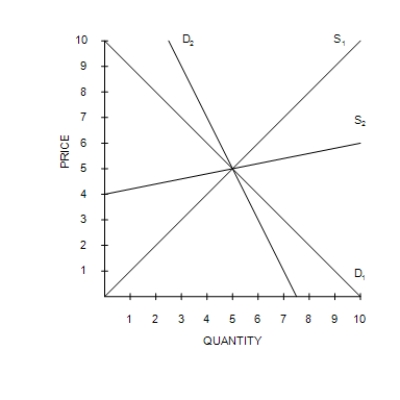
-Refer to Figure 6-14. The buyers will bear the highest share of the tax burden compared to sellers if the demand is
-Refer to Figure 6-14. The buyers will bear the highest share of the tax burden compared to sellers if the demand is (Multiple Choice)
4.9/5 (81)
(81) Scenario 6-1
Suppose that demand in the market for good X is given by the equation
and that supply in the market for good X is given by the equation
-Refer to Scenario 6-1. What are the equilibrium price and quantity in the market for good X?
(Essay)
4.9/5 (87)
(87) The true burden of a payroll tax has nothing to do with the percentage of the tax that employers are required to pay.
(True/False)
4.8/5 (76)
(76) Rent control may lead to lower rents for those who find housing, but the quality of the housing may also be lower.
(True/False)
4.7/5 (72)
(72) Workers with high skills and much experience are not typically affected by the minimum wage.
(True/False)
4.9/5 (91)
(91) 
Filters
- Essay(0)
- Multiple Choice(0)
- Short Answer(0)
- True False(0)
- Matching(0)