



 Chat with AI
Exam 6: Supply, Demand, and Government Policies

Exam 1: Ten Principles of Economics220 Questions
Exam 2: Thinking Like an Economist284 Questions
Exam 3: Interdependence and the Gains From Trade192 Questions
Exam 4: The Market Forces of Supply and Demand277 Questions
Exam 5: Elasticity and Its Application222 Questions
Exam 6: Supply, Demand, and Government Policies321 Questions
Exam 7: Consumers, Producers, and the Efficiency of Markets218 Questions
Exam 8: Applications: The Costs of Taxation203 Questions
Exam 9: Application: International Trade214 Questions
Exam 10: Externalities204 Questions
Exam 11: Public Goods and Common Resources182 Questions
Exam 12: The Design of the Tax System225 Questions
Exam 13: The Costs of Production261 Questions
Exam 14: Firms in Competitive Markets243 Questions
Exam 15: Monopoly231 Questions
Exam 16: Monopolistic Competition246 Questions
Exam 17: Oligopoly204 Questions
Exam 18: The Markets for the Factors of Production232 Questions
Exam 19: Earnings and Discrimination230 Questions
Exam 20: Income Inequality and Poverty194 Questions
Exam 21: The Theory of Consumer Choice209 Questions
Exam 22: Frontiers in Microeconomics185 Questions
Exam 23: Measuring a Nations Income231 Questions
Exam 24: Measuring the Cost of Living214 Questions
Exam 25: Production and Growth187 Questions
Exam 26: Saving, Investment, and the Financial System225 Questions
Exam 27: Tools of Finance198 Questions
Exam 28: Unemployment and Its Natural Rate361 Questions
Exam 29: The Monetary System210 Questions
Exam 30: Money Growth and Inflation201 Questions
Exam 31: Open-Economy Macroeconomics: Basic Concepts194 Questions
Exam 32: A Macroeconomic Theory of the Open Economy188 Questions
Exam 33: Aggregate Demand and Aggregate Supply189 Questions
Exam 34: The Influence of Monetary and Fiscal Policy on Aggregate Demand207 Questions
Exam 35: The Short-Run Tradeoff Between Inflation and Unemployment223 Questions
Exam 36: Six Debates Over Macroeconomic Policy154 Questions
Select questions type


In the 1970s, long lines at gas stations in the United States were primarily a result of the fact that
(Multiple Choice)
4.9/5  (86)
(86) Figure 6-7
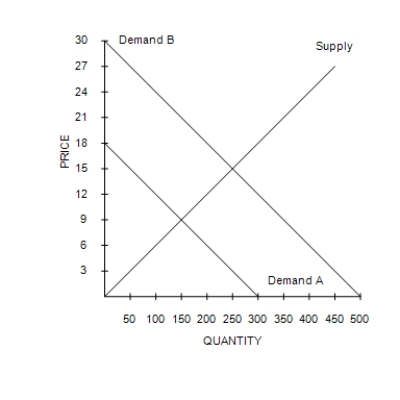 -Refer to Figure 6-7. If the government imposes a price ceiling at $9, it would be
 (Multiple Choice)
4.9/5 (77)
(77) Price controls are usually enacted when policymakers believe that the market price of a good or service is unfair to buyers or sellers.
(True/False)
4.8/5 (84)
(84) Figure 6-16

-Refer to Figure 6-16. A price floor set at $40 would create a surplus of 20 units.
-Refer to Figure 6-16. A price floor set at $40 would create a surplus of 20 units. (True/False)
4.8/5 (75)
(75) Scenario 6-2
Suppose demand for a product is given by the equation
QD = 120 - 4P
and supply for the product is given by the equation
QS = 4P
-Refer to Scenario 6-2. Suppose the government sets a price floor at $13 for this product. Is this price floor binding, and what will be the size of the shortage/surplus in this market?
(Essay)
4.9/5 (74)
(74) Suppose the government imposes a 50-cent tax on the sellers of packets of chewing gum. The tax would
(Multiple Choice)
4.9/5 (80)
(80) Binding price floors benefit sellers because they allow sellers to sell all the goods they want at a higher price.
(True/False)
4.7/5 (78)
(78) Table 6-2
-Refer to Table 6-2. If the government set a price floor at $2, would there be a shortage or surplus, and how large would be the shortage/surplus?
(Essay)
4.9/5 (83)
(83) The presence of a price control in a market for a good or service usually is an indication that
(Multiple Choice)
4.8/5 (76)
(76) Figure 6-9
 -Refer to Figure 6-9. In this market, a minimum wage of $7 is
 (Multiple Choice)
4.9/5 (78)
(78) Figure 6-14
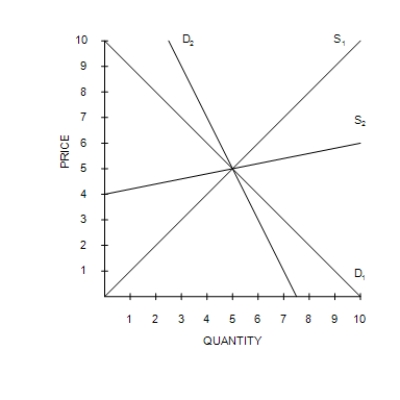
-Refer to Figure 6-14. Suppose D1 represents the demand curve for gasoline in both the short run and long run, S1 represents the supply curve for gasoline in the short run, and S2 represents the supply curve for gasoline in the long run. After the imposition of the $2 tax, the price paid by buyers will be
-Refer to Figure 6-14. Suppose D1 represents the demand curve for gasoline in both the short run and long run, S1 represents the supply curve for gasoline in the short run, and S2 represents the supply curve for gasoline in the long run. After the imposition of the $2 tax, the price paid by buyers will be (Multiple Choice)
4.8/5 (81)
(81) The burden that results from a tax on yachts falls more heavily on the buyers of yachts than on the sellers of yachts.
(True/False)
4.7/5 (71)
(71) Figure 6-19
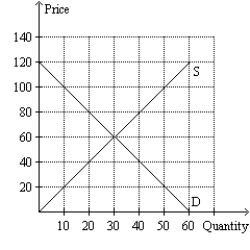
-Refer to Figure 6-19. If the government set a price ceiling at $40, would there be a shortage or surplus, and how large would be the shortage/surplus?
-Refer to Figure 6-19. If the government set a price ceiling at $40, would there be a shortage or surplus, and how large would be the shortage/surplus? (Short Answer)
4.8/5 (84)
(84) Figure 6-19
-Refer to Figure 6-19. If the government set a price ceiling at $80, would there be a shortage or surplus, and how large would be the shortage/surplus?
-Refer to Figure 6-19. If the government set a price ceiling at $80, would there be a shortage or surplus, and how large would be the shortage/surplus? (Essay)
4.7/5 (82)
(82) Scenario 6-2
Suppose demand for a product is given by the equation
QD = 120 - 4P
and supply for the product is given by the equation
QS = 4P
-Refer to Scenario 6-2. Suppose the government sets a price floor at $13 for this product. Initially, is this price floor binding? Suppose that for some reason demand were to decrease to
Would the $13 price floor be binding after the shift in the demand curve? If so, what is the size of the resulting shortage/surplus?
(Essay)
4.8/5 (77)
(77) In a particular market, market demand is given by the equation
QD = 60 - P
and market supply is given by the equation
QS = P
Suppose a per-unit tax is imposed that reduces the number of units bought and sold in the market to 25 units. What is the size of the tax, and who bears the greater burden of the tax, buyers or sellers?
(Essay)
4.8/5 (83)
(83) The rationing mechanisms that develop under binding price ceilings are usually inefficient.
(True/False)
4.8/5 (81)
(81) Whether a tax is levied on sellers or buyers, buyers and sellers usually share the burden of taxes.
(True/False)
4.7/5 (93)
(93) 
Filters
- Essay(0)
- Multiple Choice(0)
- Short Answer(0)
- True False(0)
- Matching(0)