



 Chat with AI
Exam 14: Firms in Competitive Markets

Exam 1: Ten Principles of Economics220 Questions
Exam 2: Thinking Like an Economist284 Questions
Exam 3: Interdependence and the Gains From Trade192 Questions
Exam 4: The Market Forces of Supply and Demand277 Questions
Exam 5: Elasticity and Its Application222 Questions
Exam 6: Supply, Demand, and Government Policies321 Questions
Exam 7: Consumers, Producers, and the Efficiency of Markets218 Questions
Exam 8: Applications: The Costs of Taxation203 Questions
Exam 9: Application: International Trade214 Questions
Exam 10: Externalities204 Questions
Exam 11: Public Goods and Common Resources182 Questions
Exam 12: The Design of the Tax System225 Questions
Exam 13: The Costs of Production261 Questions
Exam 14: Firms in Competitive Markets243 Questions
Exam 15: Monopoly231 Questions
Exam 16: Monopolistic Competition246 Questions
Exam 17: Oligopoly204 Questions
Exam 18: The Markets for the Factors of Production232 Questions
Exam 19: Earnings and Discrimination230 Questions
Exam 20: Income Inequality and Poverty194 Questions
Exam 21: The Theory of Consumer Choice209 Questions
Exam 22: Frontiers in Microeconomics185 Questions
Exam 23: Measuring a Nations Income231 Questions
Exam 24: Measuring the Cost of Living214 Questions
Exam 25: Production and Growth187 Questions
Exam 26: Saving, Investment, and the Financial System225 Questions
Exam 27: Tools of Finance198 Questions
Exam 28: Unemployment and Its Natural Rate361 Questions
Exam 29: The Monetary System210 Questions
Exam 30: Money Growth and Inflation201 Questions
Exam 31: Open-Economy Macroeconomics: Basic Concepts194 Questions
Exam 32: A Macroeconomic Theory of the Open Economy188 Questions
Exam 33: Aggregate Demand and Aggregate Supply189 Questions
Exam 34: The Influence of Monetary and Fiscal Policy on Aggregate Demand207 Questions
Exam 35: The Short-Run Tradeoff Between Inflation and Unemployment223 Questions
Exam 36: Six Debates Over Macroeconomic Policy154 Questions
Select questions type


When fixed costs are ignored because they are irrelevant to a business's production decision, they are called
(Multiple Choice)
4.9/5  (89)
(89) Figure 14-3
Suppose a firm operating in a competitive market has the following cost curves: 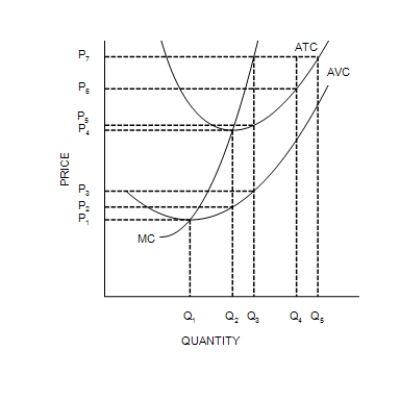 -Refer to Figure 14-3. Firms would be encouraged to enter this market for all prices that exceed
 (Multiple Choice)
4.8/5 (83)
(83) Table 14-2
The table represents a demand curve faced by a firm in a competitive market.
Price (Dollarsper unit) Quantity Demanded (Units) 5 0 5 1 5 2 5 3 5 4 5 5
-Refer to Table 14-2. This firm maximizes total revenue by producing
(Multiple Choice)
4.9/5 (77)
(77) Suppose a firm in a competitive market produces and sells 150 units of output and earns $1,800 in total revenue from the sales. If the firm increases its output to 200 units, the average revenue of the 200th unit will be
(Multiple Choice)
4.8/5 (69)
(69) Figure 14-2
Suppose a firm operating in a competitive market has the following cost curves:
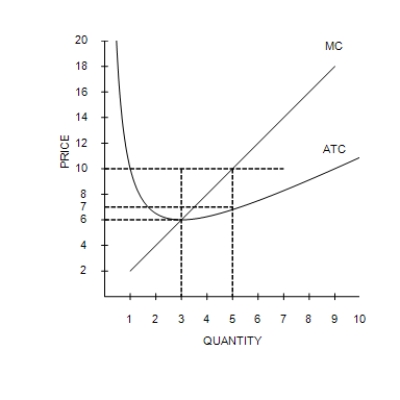 -Refer to Figure 14-2. If the market price is $10, what is the firm's short-run economic profit?
 (Multiple Choice)
4.8/5 (69)
(69) In a shopping mall in a large city, the Rudolph the Reindeer store sells only merchandise for the Christmas holiday season. Most of the store's revenue and profit are attributable to the months of October, November, and December. However, the store is open throughout the year. If the owner of the store is rational, what criterion does he or she use in deciding to keep the store open year-round?
(Essay)
4.8/5 (87)
(87) When it produces 500 units of output, a firm earns a profit of $20,000. If the firm sells its output for $65 per unit, then what is its average total cost?
(Essay)
4.8/5 (80)
(80) All firms maximize profits by producing an output level where marginal revenue equals marginal cost; for firms operating in perfectly competitive industries, maximizing profits also means producing an output level where price equals marginal cost.
(True/False)
5.0/5 (85)
(85) A competitive market begins in a situation of long-run equilibrium. Then, there is a decrease in demand. Describe the process that eventually leads to a new long-run equilibrium.
(Essay)
4.8/5 (93)
(93) Robin owns a horse stable and riding academy and gives riding lessons for children at "pony camp." His business operates in a competitive industry. Robin gives riding lessons to 20 children per month. His monthly total revenue is $4,000. The marginal cost of pony camp is $250 per child. In order to maximize profits, Robin should
(Multiple Choice)
4.8/5 (81)
(81) The marginal firm in a competitive market will earn zero economic profit in the long run.
(True/False)
4.8/5 (86)
(86) Scenario 14-4
A competitive firm sells its output for $20 per unit. When the firm produces 200 units of output, average variable cost is $16, marginal cost is $18, and average total cost is $23.
-Refer to Scenario 14-4. Compare the firm's profit or loss at 200 units of output with its profit or loss if it were to shut down.
(Essay)
4.8/5 (60)
(60) The expression "Let bygones be bygones" is associated with what type of cost?
(Essay)
4.8/5 (77)
(77) If some resources used in the production of a good are only available in limited quantities, then the long run market supply curve will be perfectly elastic.
(True/False)
4.9/5 (86)
(86) A firm operating in a perfectly competitive industry will continue to operate in the short run but earn losses if the market price is less than that firm's average variable cost but greater than the firm's average fixed cost.
(True/False)
4.8/5 (80)
(80) In the long-run equilibrium of a competitive market with free entry and exit, firms operate at their __________ scale.
(Short Answer)
4.8/5 (79)
(79) When a profit-maximizing firm in a competitive market experiences rising prices, it will respond with an increase in production.
(True/False)
4.9/5 (75)
(75) Suppose a firm in each of the two markets listed below were to increase its price by 25 percent. In which pair would the firm in the first market listed experience a dramatic decline in sales, but the firm in the second market listed might not?
(Multiple Choice)
4.8/5 (88)
(88) 
Filters
- Essay(0)
- Multiple Choice(0)
- Short Answer(0)
- True False(0)
- Matching(0)