



 Chat with AI
Exam 14: Firms in Competitive Markets

Exam 1: Ten Principles of Economics220 Questions
Exam 2: Thinking Like an Economist284 Questions
Exam 3: Interdependence and the Gains From Trade192 Questions
Exam 4: The Market Forces of Supply and Demand277 Questions
Exam 5: Elasticity and Its Application222 Questions
Exam 6: Supply, Demand, and Government Policies321 Questions
Exam 7: Consumers, Producers, and the Efficiency of Markets218 Questions
Exam 8: Applications: The Costs of Taxation203 Questions
Exam 9: Application: International Trade214 Questions
Exam 10: Externalities204 Questions
Exam 11: Public Goods and Common Resources182 Questions
Exam 12: The Design of the Tax System225 Questions
Exam 13: The Costs of Production261 Questions
Exam 14: Firms in Competitive Markets243 Questions
Exam 15: Monopoly231 Questions
Exam 16: Monopolistic Competition246 Questions
Exam 17: Oligopoly204 Questions
Exam 18: The Markets for the Factors of Production232 Questions
Exam 19: Earnings and Discrimination230 Questions
Exam 20: Income Inequality and Poverty194 Questions
Exam 21: The Theory of Consumer Choice209 Questions
Exam 22: Frontiers in Microeconomics185 Questions
Exam 23: Measuring a Nations Income231 Questions
Exam 24: Measuring the Cost of Living214 Questions
Exam 25: Production and Growth187 Questions
Exam 26: Saving, Investment, and the Financial System225 Questions
Exam 27: Tools of Finance198 Questions
Exam 28: Unemployment and Its Natural Rate361 Questions
Exam 29: The Monetary System210 Questions
Exam 30: Money Growth and Inflation201 Questions
Exam 31: Open-Economy Macroeconomics: Basic Concepts194 Questions
Exam 32: A Macroeconomic Theory of the Open Economy188 Questions
Exam 33: Aggregate Demand and Aggregate Supply189 Questions
Exam 34: The Influence of Monetary and Fiscal Policy on Aggregate Demand207 Questions
Exam 35: The Short-Run Tradeoff Between Inflation and Unemployment223 Questions
Exam 36: Six Debates Over Macroeconomic Policy154 Questions
Select questions type


In the short run, if the market price is below the firm's average total cost of production, the firm will always shut down.
(True/False)
5.0/5  (68)
(68) Scenario 14-1
Assume a certain firm in a competitive market is producing Q = 1,000 units of output. At Q = 1,000, the firm's marginal cost equals $15 and its average total cost equals $11. The firm sells its output for $12 per unit.
-Refer to Scenario 14-1. To maximize its profit, the firm should
(Multiple Choice)
4.8/5 (65)
(65) The intersection of a firm's marginal revenue and marginal cost curves determines the level of output at which
(Multiple Choice)
4.8/5 (78)
(78) Describe the difference between average revenue and marginal revenue. Why are both of these revenue measures important to a profit-maximizing firm?
(Essay)
4.9/5 (90)
(90) Farmer McDonald sells wheat to a broker in Kansas City, Missouri. Because the market for wheat is generally considered to be competitive, Mr. McDonald maximizes his profit by choosing
(Multiple Choice)
4.8/5 (81)
(81) A competitive firm currently produces and sells 500 units of output. Its total revenue is $3,500; the marginal cost of producing the 500th unit of output is $5.75; and the average total cost of producing the 500th unit of output is $4.00. Is the firm maximizing its profit, or should it increase or decrease output in order to increase its profit?
(Essay)
4.8/5 (91)
(91) A miniature golf course is a good example of where fixed costs become relevant to the decision of when to open and when to close for the season.
(True/False)
4.8/5 (75)
(75) When a firm produces 2,000 units of output, its average total cost is $3.00 and its average revenue is $2.90. What is the firm's profit or loss?
(Essay)
4.8/5 (86)
(86) A competitive firm currently produces and sells 500 units of output. Its total revenue is $6,000; the marginal cost of producing the 500th unit of output is $14.50; and the average total cost of producing the 500th unit of output is $9.50. Is the firm maximizing its profit, or should it increase or decrease output in order to increase its profit?
(Essay)
4.7/5 (90)
(90) Which of the following statements regarding a competitive firm is correct?
(Multiple Choice)
4.9/5 (65)
(65) In competitive markets where firms are observed to be exiting the market, the firms that remain will obtain economic profits in the long run.
(True/False)
4.9/5 (80)
(80) A competitive firm maximizes its profit by producing output up to the point at which price is equal to ______.
(Essay)
4.9/5 (78)
(78) Figure 14-4
In the following figure, graph (a) depicts the linear marginal cost (MC) of a firm in a competitive market, and graph (b) depicts the linear market supply curve for a market with a fixed number of identical firms.
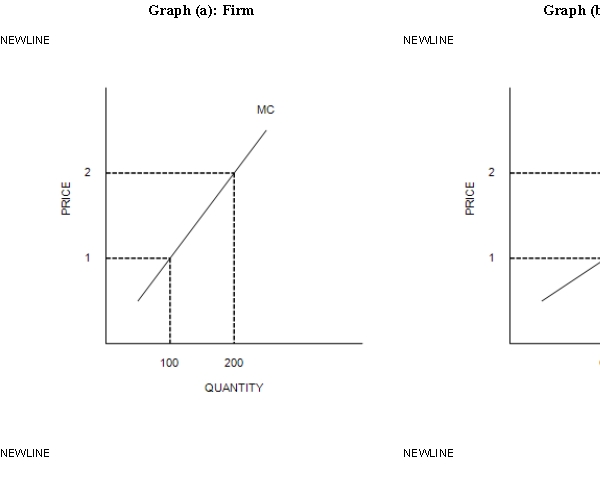 -Refer to Figure 14-4. If there are 300 identical firms in this market, what level of output will be supplied to the market when price is $1.00?
 (Multiple Choice)
4.8/5 (98)
(98) Winona's Fudge Shoppe is maximizing profits by producing 1,000 pounds of fudge per day. If Winona's fixed costs unexpectedly increase and the market price remains constant, then the short run profit-maximizing level of output
(Multiple Choice)
4.8/5 (72)
(72) A firm will shut down in the short run if revenue is not sufficient to cover its variable costs of production.
(True/False)
4.8/5 (74)
(74) A popular resort restaurant will maximize profits if it chooses to stay open during the less-crowded "off season" when its total revenues exceed its variable costs.
(True/False)
4.9/5 (95)
(95) Figure 14-1
Suppose that a firm in a competitive market has the following cost curves: 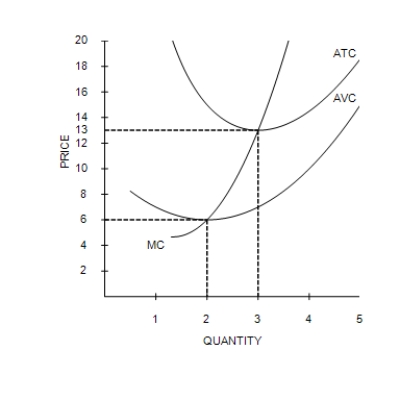
-Refer to Figure 14-1. If the market price rises above $13, the firm will earn
-Refer to Figure 14-1. If the market price rises above $13, the firm will earn (Multiple Choice)
4.8/5 (75)
(75) A firm operating in a competitive market will stay in business in the short run so long as the market price exceeds the firm's average total cost; otherwise, the firm will shut down.
(True/False)
4.7/5 (73)
(73) Scenario 14-4
A competitive firm sells its output for $20 per unit. When the firm produces 200 units of output, average variable cost is $16, marginal cost is $18, and average total cost is $23.
-Refer to Scenario 14-4. Calculate the firm's fixed cost at 200 units of output.
(Essay)
4.9/5 (80)
(80) A competitive firm currently produces and sells 800 units of output at a price of $10 per unit. The firm's fixed cost is $4,000 and its variable cost is $8,300. In the short run, should the firm continue to operate?
(Essay)
4.8/5 (75)
(75) 
Filters
- Essay(0)
- Multiple Choice(0)
- Short Answer(0)
- True False(0)
- Matching(0)