



 Chat with AI
Exam 14: Firms in Competitive Markets

Exam 1: Ten Principles of Economics220 Questions
Exam 2: Thinking Like an Economist284 Questions
Exam 3: Interdependence and the Gains From Trade192 Questions
Exam 4: The Market Forces of Supply and Demand277 Questions
Exam 5: Elasticity and Its Application222 Questions
Exam 6: Supply, Demand, and Government Policies321 Questions
Exam 7: Consumers, Producers, and the Efficiency of Markets218 Questions
Exam 8: Applications: The Costs of Taxation203 Questions
Exam 9: Application: International Trade214 Questions
Exam 10: Externalities204 Questions
Exam 11: Public Goods and Common Resources182 Questions
Exam 12: The Design of the Tax System225 Questions
Exam 13: The Costs of Production261 Questions
Exam 14: Firms in Competitive Markets243 Questions
Exam 15: Monopoly231 Questions
Exam 16: Monopolistic Competition246 Questions
Exam 17: Oligopoly204 Questions
Exam 18: The Markets for the Factors of Production232 Questions
Exam 19: Earnings and Discrimination230 Questions
Exam 20: Income Inequality and Poverty194 Questions
Exam 21: The Theory of Consumer Choice209 Questions
Exam 22: Frontiers in Microeconomics185 Questions
Exam 23: Measuring a Nations Income231 Questions
Exam 24: Measuring the Cost of Living214 Questions
Exam 25: Production and Growth187 Questions
Exam 26: Saving, Investment, and the Financial System225 Questions
Exam 27: Tools of Finance198 Questions
Exam 28: Unemployment and Its Natural Rate361 Questions
Exam 29: The Monetary System210 Questions
Exam 30: Money Growth and Inflation201 Questions
Exam 31: Open-Economy Macroeconomics: Basic Concepts194 Questions
Exam 32: A Macroeconomic Theory of the Open Economy188 Questions
Exam 33: Aggregate Demand and Aggregate Supply189 Questions
Exam 34: The Influence of Monetary and Fiscal Policy on Aggregate Demand207 Questions
Exam 35: The Short-Run Tradeoff Between Inflation and Unemployment223 Questions
Exam 36: Six Debates Over Macroeconomic Policy154 Questions
Select questions type


Figure 14-7
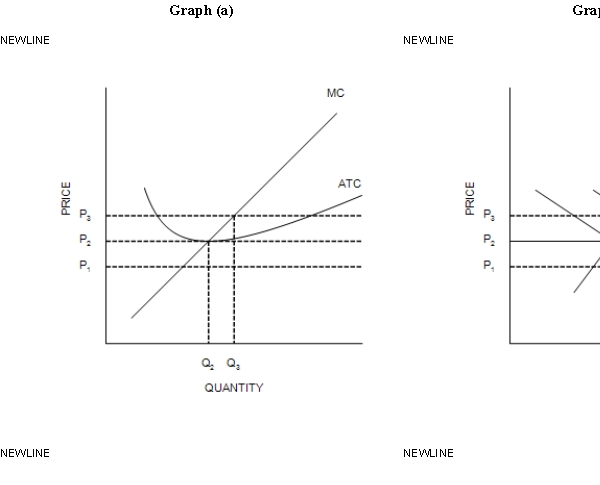 -Refer to Figure 14-7. Assume that the market starts in equilibrium at point W in graph (b) and that graph (a) illustrates the cost curves facing individual firms. Suppose that demand increases from D0 to D1. Which of the following statements is correct?
 (Multiple Choice)
5.0/5  (84)
(84) A firm maximizes its profit by selling 2,500 units of output with an average revenue of $6.99. The firm's marginal cost at 2,500 units of output is __________.
(Short Answer)
4.9/5 (72)
(72) What is the relationship between price and marginal revenue for a competitive firm?
(Essay)
4.8/5 (74)
(74) Figure 14-4
In the following figure, graph (a) depicts the linear marginal cost (MC) of a firm in a competitive market, and graph (b) depicts the linear market supply curve for a market with a fixed number of identical firms.
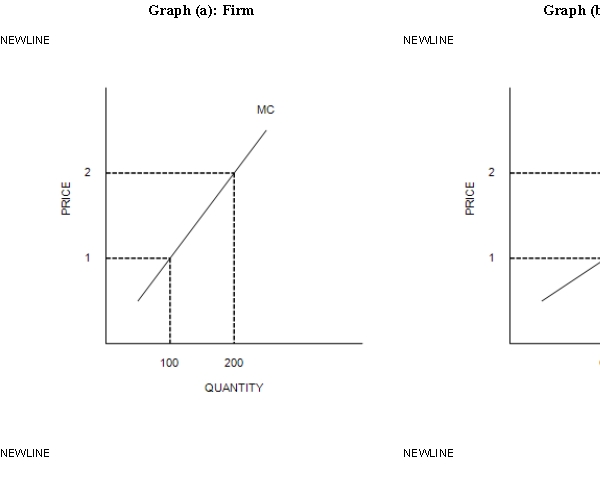 -Refer to Figure 14-4. If there are 100 identical firms in this market, what is the value of Q2?
 (Multiple Choice)
4.9/5 (76)
(76) Table 14-8
A firm in a competitive market has the following cost structure.
Quantity (Units) Average Total Cost (Dollars) 0 -- 1 10 2 8 3 7 4 8 5 10
-Refer to Table 14-8. If the firm's fixed cost of production is $3, and the market price is $10, how many units should the firm produce to maximize profit?
(Multiple Choice)
5.0/5 (79)
(79) Table 14-6
Suppose that a firm in a competitive market faces the following revenues and costs:
Quantity (Units) Total Revenue (Dollars) Total Cost (Dollars) 0 0 3 1 6 5 2 12 8 3 18 12 4 24 17 5 30 23 6 36 30 7 42 38
-Refer to Table 14-6. The firm will produce a quantity greater than three because at 3 units of output, marginal cost
(Multiple Choice)
4.8/5 (82)
(82) Figure 14-1
Suppose that a firm in a competitive market has the following cost curves: 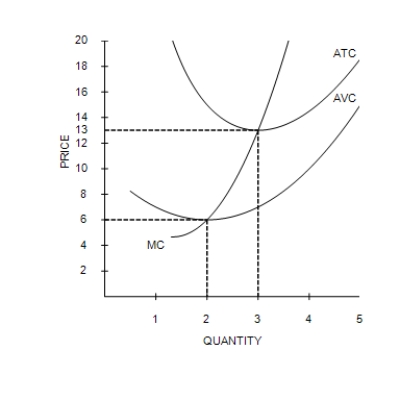
-Refer to Figure 14-1. If the market price falls below $6, the firm will earn
-Refer to Figure 14-1. If the market price falls below $6, the firm will earn (Multiple Choice)
4.7/5 (86)
(86) Suppose a firm is considering producing zero units of output. We call this shutting down in the short run and exiting an industry in the long run.
(True/False)
4.8/5 (93)
(93) Whenever a perfectly competitive firm chooses to change its level of output, its marginal revenue
(Multiple Choice)
4.8/5 (80)
(80) Table 14-1
Price (Dollars per unit) Quantity Demanded (Units) 5 0 5 2 5 4 5 6 5 8 5 10 5 12 5 14 5 16 5 18
-Refer to Table 14-1. The price and quantity relationship in the table is most likely a demand curve faced by a firm in a
(Multiple Choice)
4.9/5 (75)
(75) A competitive firm currently produces and sells 7,500 units of output at a price of $2.50 per unit. The firm's average fixed cost is $0.75 and its average total cost is $2.80. In the short run, should the firm continue to operate?
(Essay)
4.9/5 (87)
(87) Suppose a firm in a competitive market earned $2,000 in total revenue and had a marginal revenue of $20 for the last unit produced and sold. What is the average revenue per unit, and how many units were sold?
(Multiple Choice)
4.8/5 (87)
(87) If a firm observes that the price of its product is above average variable cost, it would choose to continue to produce the good in the short run, even if that firm experiences economic losses.
(True/False)
4.9/5 (79)
(79) In making a short-run profit-maximizing production decision, the firm must consider both fixed and variable cost.
(True/False)
4.8/5 (76)
(76) At its current level of production a profit-maximizing firm in a competitive market receives $12.50 for each unit it produces and faces an average total cost of $10. At the market price of $12.50 per unit, the firm's marginal cost curve crosses the marginal revenue curve at an output level of 1,000 units. What is the firm's current profit? What is likely to occur in this market and why?
(Essay)
4.8/5 (74)
(74) Table 14-5
Suppose that a firm in a competitive market faces the following revenues and costs:
Quantity (Units) Marginal Cost (Dollars) Marginal Revenue (Dollars) 12 5 7 13 6 7 14 7 7 15 8 7 16 9 7 17 10 7
-Refer to Table 14-5. If the firm is currently producing 14 units, what would you advise the owners?
(Multiple Choice)
4.8/5 (80)
(80) Tom produces commemorative t-shirts in a competitive market. If Tom decides to decrease his output, this will
(Multiple Choice)
4.9/5 (95)
(95) Table 14-4
The following table presents cost and revenue information for a firm operating in a competitive industry.
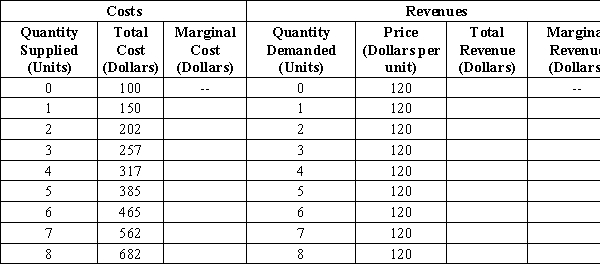 -Refer to Table 14-4. What is the average revenue when 3 units are sold?
 (Multiple Choice)
4.9/5 (74)
(74) Figure 14-3
Suppose a firm operating in a competitive market has the following cost curves: 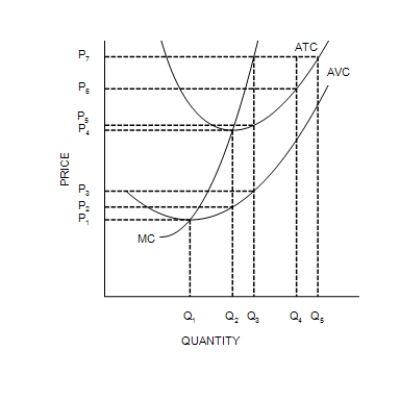 -Refer to Figure 14-3. In the short run, if the market price is higher than P4 but less than P6, individual firms in a competitive industry will earn
 (Multiple Choice)
4.8/5 (77)
(77) For a certain firm, the 100th unit of output that the firm produces has a marginal revenue of $11 and a marginal cost of $10. It follows that the
(Multiple Choice)
4.7/5 (74)
(74) 
Filters
- Essay(0)
- Multiple Choice(0)
- Short Answer(0)
- True False(0)
- Matching(0)