



 Chat with AI
Exam 14: Firms in Competitive Markets

Exam 1: Ten Principles of Economics220 Questions
Exam 2: Thinking Like an Economist284 Questions
Exam 3: Interdependence and the Gains From Trade192 Questions
Exam 4: The Market Forces of Supply and Demand277 Questions
Exam 5: Elasticity and Its Application222 Questions
Exam 6: Supply, Demand, and Government Policies321 Questions
Exam 7: Consumers, Producers, and the Efficiency of Markets218 Questions
Exam 8: Applications: The Costs of Taxation203 Questions
Exam 9: Application: International Trade214 Questions
Exam 10: Externalities204 Questions
Exam 11: Public Goods and Common Resources182 Questions
Exam 12: The Design of the Tax System225 Questions
Exam 13: The Costs of Production261 Questions
Exam 14: Firms in Competitive Markets243 Questions
Exam 15: Monopoly231 Questions
Exam 16: Monopolistic Competition246 Questions
Exam 17: Oligopoly204 Questions
Exam 18: The Markets for the Factors of Production232 Questions
Exam 19: Earnings and Discrimination230 Questions
Exam 20: Income Inequality and Poverty194 Questions
Exam 21: The Theory of Consumer Choice209 Questions
Exam 22: Frontiers in Microeconomics185 Questions
Exam 23: Measuring a Nations Income231 Questions
Exam 24: Measuring the Cost of Living214 Questions
Exam 25: Production and Growth187 Questions
Exam 26: Saving, Investment, and the Financial System225 Questions
Exam 27: Tools of Finance198 Questions
Exam 28: Unemployment and Its Natural Rate361 Questions
Exam 29: The Monetary System210 Questions
Exam 30: Money Growth and Inflation201 Questions
Exam 31: Open-Economy Macroeconomics: Basic Concepts194 Questions
Exam 32: A Macroeconomic Theory of the Open Economy188 Questions
Exam 33: Aggregate Demand and Aggregate Supply189 Questions
Exam 34: The Influence of Monetary and Fiscal Policy on Aggregate Demand207 Questions
Exam 35: The Short-Run Tradeoff Between Inflation and Unemployment223 Questions
Exam 36: Six Debates Over Macroeconomic Policy154 Questions
Select questions type


Figure 14-6
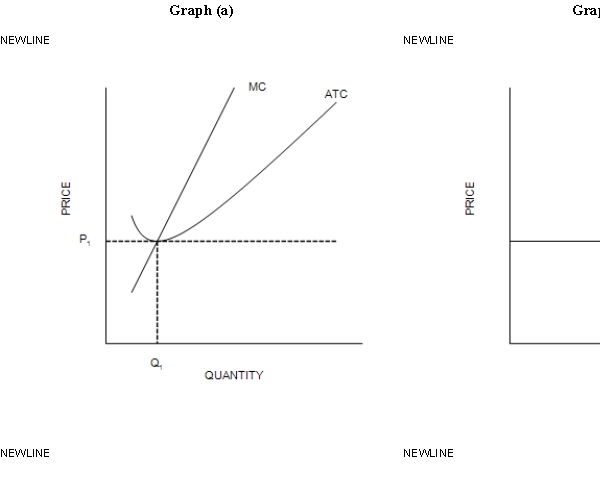 -Refer to Figure 14-6. If the figure in graph (a) reflects the long-run equilibrium of a profit-maximizing firm in a competitive market, the figure in graph (b) most likely reflects
 (Multiple Choice)
4.8/5  (68)
(68) If identical firms that remain in a competitive market over the long run make zero economic profit, why do these firms choose to remain in the market?
(Essay)
4.7/5 (84)
(84) You purchase a $30, nonrefundable ticket to a play at a local theater. Ten minutes into the show you realize that it is not a very good show and place only a $10 value on seeing the remainder of the show. Alternatively you could leave the theater and go home and watch TV or read a book. You place an $8 value on watching TV and a $12 value on reading a book.
(Multiple Choice)
4.8/5 (83)
(83) In a competitive market, firms are unable to differentiate their product from that of other producers.
(True/False)
4.9/5 (78)
(78) The long-run supply curve in a competitive market is more elastic than the short-run supply curve.
(True/False)
4.9/5 (85)
(85) In a certain large city there are two firms that supply concrete. The concrete sold by the first firm is indistinguishable from the concrete sold by the second firm. Is the market competitive?
(Essay)
4.8/5 (81)
(81) In a competitive market the price is $8. A typical firm in the market has ATC = $6, AVC = $5, and MC = $8. How much economic profit is the firm earning in the short run?
(Multiple Choice)
4.8/5 (62)
(62) Firms in a competitive market are said to be price takers because there are many sellers in the market, and the goods offered by the firms are very similar if not identical.
(True/False)
4.8/5 (81)
(81) Figure 14-2
Suppose a firm operating in a competitive market has the following cost curves:
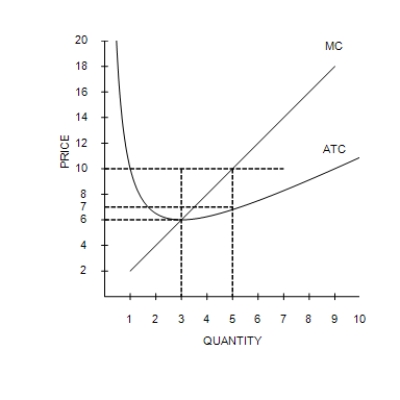 -Refer to Figure 14-2. The firm will earn zero economic profit if the market price is
 (Multiple Choice)
4.9/5 (82)
(82) Figure 14-7
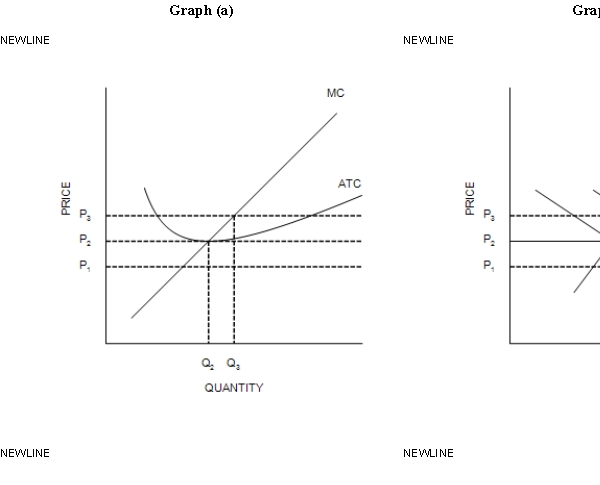 -Refer to Figure 14-7. Suppose a firm in a competitive market, like the one depicted in graph (a), observes market price rising from P1 to P2. Which of the following could explain this observation?
 (Multiple Choice)
4.9/5 (77)
(77) A competitive market has two basic characteristics. What are those two characteristics?
(Essay)
4.9/5 (89)
(89) In the long run with free entry and exit and identical firms, are competitive firms' profits positive, zero, or negative?
(Essay)
4.9/5 (91)
(91) Figure 14-4
In the following figure, graph (a) depicts the linear marginal cost (MC) of a firm in a competitive market, and graph (b) depicts the linear market supply curve for a market with a fixed number of identical firms.
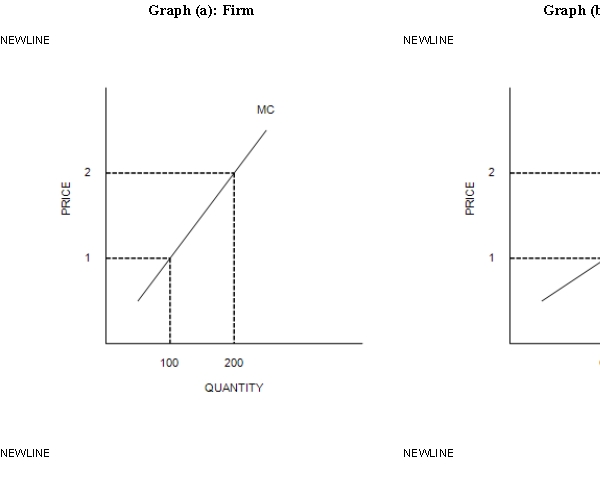 -Refer to Figure 14-4. When 100 identical firms participate in this market, at what price will 15,000 units be supplied to this market?
 (Multiple Choice)
4.8/5 (88)
(88) Figure 14-3
Suppose a firm operating in a competitive market has the following cost curves: 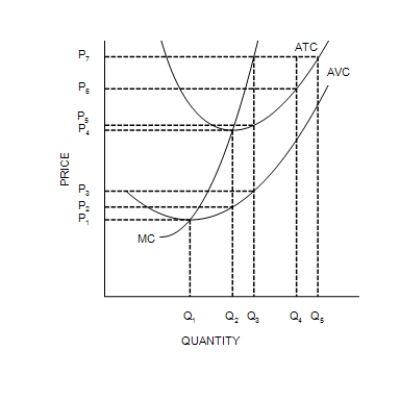 -Refer to Figure 14-3. When market price is P7, a profit-maximizing firm's short-run profits can be represented by the area
 (Multiple Choice)
4.8/5 (83)
(83) Table 14-2
The table represents a demand curve faced by a firm in a competitive market.
Price (Dollarsper unit) Quantity Demanded (Units) 5 0 5 1 5 2 5 3 5 4 5 5
-Refer to Table 14-2. For this firm, the average revenue from selling 4 units is
(Multiple Choice)
5.0/5 (85)
(85) Explain how a firm in a competitive market identifies the profit-maximizing level of production. When should the firm raise production, and when should the firm lower production?
(Essay)
4.9/5 (88)
(88) Consider a competitive market with a large number of identical firms. The firms in this market do not use any resources that are available only in limited quantities. In this market, an increase in demand will
(Multiple Choice)
4.7/5 (90)
(90) Which of the following represents the firm's short-run condition for shutting down?
(Multiple Choice)
4.7/5 (72)
(72) Figure 14-5 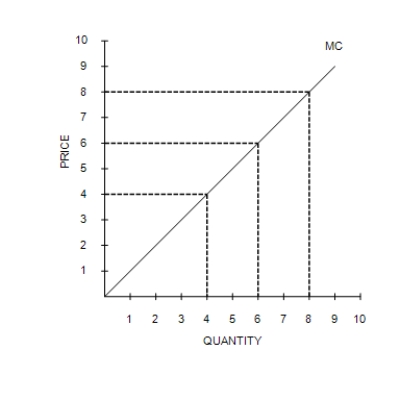 -Refer to Figure 14-5. The figure above is for a firm operating in a competitive industry. If there were four identical firms in the industry, which of the following price-quantity combinations would be on the market supply curve? ?
?
Point Price (Dollars) Quantity (Units) A 4 16 B 4 32 C 6 6 D 8 64
-Refer to Figure 14-5. The figure above is for a firm operating in a competitive industry. If there were four identical firms in the industry, which of the following price-quantity combinations would be on the market supply curve? ?
?
Point Price (Dollars) Quantity (Units) A 4 16 B 4 32 C 6 6 D 8 64 (Multiple Choice)
4.8/5 (74)
(74) 
Filters
- Essay(0)
- Multiple Choice(0)
- Short Answer(0)
- True False(0)
- Matching(0)