



 Chat with AI
Exam 22: Frontiers in Microeconomics

Exam 1: Ten Principles of Economics220 Questions
Exam 2: Thinking Like an Economist284 Questions
Exam 3: Interdependence and the Gains From Trade192 Questions
Exam 4: The Market Forces of Supply and Demand277 Questions
Exam 5: Elasticity and Its Application222 Questions
Exam 6: Supply, Demand, and Government Policies321 Questions
Exam 7: Consumers, Producers, and the Efficiency of Markets218 Questions
Exam 8: Applications: The Costs of Taxation203 Questions
Exam 9: Application: International Trade214 Questions
Exam 10: Externalities204 Questions
Exam 11: Public Goods and Common Resources182 Questions
Exam 12: The Design of the Tax System225 Questions
Exam 13: The Costs of Production261 Questions
Exam 14: Firms in Competitive Markets243 Questions
Exam 15: Monopoly231 Questions
Exam 16: Monopolistic Competition246 Questions
Exam 17: Oligopoly204 Questions
Exam 18: The Markets for the Factors of Production232 Questions
Exam 19: Earnings and Discrimination230 Questions
Exam 20: Income Inequality and Poverty194 Questions
Exam 21: The Theory of Consumer Choice209 Questions
Exam 22: Frontiers in Microeconomics185 Questions
Exam 23: Measuring a Nations Income231 Questions
Exam 24: Measuring the Cost of Living214 Questions
Exam 25: Production and Growth187 Questions
Exam 26: Saving, Investment, and the Financial System225 Questions
Exam 27: Tools of Finance198 Questions
Exam 28: Unemployment and Its Natural Rate361 Questions
Exam 29: The Monetary System210 Questions
Exam 30: Money Growth and Inflation201 Questions
Exam 31: Open-Economy Macroeconomics: Basic Concepts194 Questions
Exam 32: A Macroeconomic Theory of the Open Economy188 Questions
Exam 33: Aggregate Demand and Aggregate Supply189 Questions
Exam 34: The Influence of Monetary and Fiscal Policy on Aggregate Demand207 Questions
Exam 35: The Short-Run Tradeoff Between Inflation and Unemployment223 Questions
Exam 36: Six Debates Over Macroeconomic Policy154 Questions
Select questions type


Table 22-4
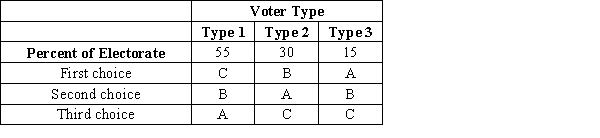 -Refer to Table 22-4. The table shows the preferences for three types of voters over three possible outcomes: A, B, and C. The table also shows the percentage of voters of each type. Based on this information, which of the following statements is true?
 (Multiple Choice)
4.9/5  (71)
(71) The criminal actions of the top managers of corporations such as Enron, Tyco, WorldCom, and Adelphia are an example of moral hazard.
(True/False)
4.9/5 (85)
(85) Which of the following events best exemplifies the concept of signaling?
(Multiple Choice)
4.7/5 (76)
(76) The proposal to place a tax on soda is intended to address what insight about human behavior?
(Short Answer)
4.8/5 (80)
(80) The unanimity property states that the ranking between any two outcomes should not depend on whether some third outcome is available.
(True/False)
4.8/5 (92)
(92) Political leaders are always aiming for an optimal combination of efficiency and equality.
(True/False)
4.9/5 (83)
(83) A safe driver would likely choose an auto insurance policy with a
(Multiple Choice)
4.8/5 (67)
(67) When some people are better informed than others and the imbalance affects the choices they make, economists say there is
(Short Answer)
4.9/5 (73)
(73) People with hidden health problems are more likely to buy health insurance than other people. As a result, people in average health may observe the high prices of insurance and decide not to buy it. This is an example of
(Short Answer)
4.9/5 (74)
(74) Studies of human decision-making have found that people do not give enough weight to a small number of vivid observations.
(True/False)
4.9/5 (74)
(74) The two major problems caused by asymmetric information are
(Multiple Choice)
4.8/5 (90)
(90) Adverse selection can only occur when there is asymmetric information.
(True/False)
4.9/5 (80)
(80) Which of the following is a plausible explanation for a firm paying above-equilibrium wages to its workers?
(Multiple Choice)
5.0/5 (83)
(83) Scenario 22-1
Shana owns a boutique that sells high-end women's clothing and accessories. Katie works part-time at the boutique and frequently is the only employee in this small store. Shana pays Katie a wage that is higher than the market wage for this type of job. When the store is not full of customers, Katie diligently works on displays and cleans to keep the store looking its best. Belinda is a customer in the store who asks Katie's opinion on the quality of some blouse she is considering purchasing. Even though she's had several other customers return this type of blouses due to flaws, Katie tells Belinda the quality is great. Magda is another customer who is returning a necklace without revealing that she lost a gem from it while wearing it.
-Refer to Scenario 22-1. Which of the ladies is a principal?
(Multiple Choice)
4.7/5 (77)
(77) Table 22-9
Sophie, Huan, and Santiago are lost with no map or GPS available. They come to an intersection at which they can turn left, turn right, or continue going straight. Their preferences are summarized in the table.
Sophie Huan Santiago First choice Left Right Straight Second choice Right Straight Left Third choice Straight Left Right
-Refer to Table 22-9. The travelers decide to conduct pairwise voting with the majority determining the outcome of each vote to decide their next move. Sophie is very confident that the travelers need to go left but she is having a difficult time convincing her friends. If she wants to ensure that the result of the voting is "left," how should she organize the voting?
(Essay)
4.8/5 (69)
(69) A Principles of Microeconomics professor wants to know how much prior knowledge her students have before beginning the class so she gives them a pre-test. This action is an example of
(Multiple Choice)
4.8/5 (88)
(88) In the field of study called political economy, economists make use of insights from the field of psychology.
(True/False)
5.0/5 (82)
(82) 
Filters
- Essay(0)
- Multiple Choice(0)
- Short Answer(0)
- True False(0)
- Matching(0)