



 Chat with AI
Exam 22: Frontiers in Microeconomics

Exam 1: Ten Principles of Economics220 Questions
Exam 2: Thinking Like an Economist284 Questions
Exam 3: Interdependence and the Gains From Trade192 Questions
Exam 4: The Market Forces of Supply and Demand277 Questions
Exam 5: Elasticity and Its Application222 Questions
Exam 6: Supply, Demand, and Government Policies321 Questions
Exam 7: Consumers, Producers, and the Efficiency of Markets218 Questions
Exam 8: Applications: The Costs of Taxation203 Questions
Exam 9: Application: International Trade214 Questions
Exam 10: Externalities204 Questions
Exam 11: Public Goods and Common Resources182 Questions
Exam 12: The Design of the Tax System225 Questions
Exam 13: The Costs of Production261 Questions
Exam 14: Firms in Competitive Markets243 Questions
Exam 15: Monopoly231 Questions
Exam 16: Monopolistic Competition246 Questions
Exam 17: Oligopoly204 Questions
Exam 18: The Markets for the Factors of Production232 Questions
Exam 19: Earnings and Discrimination230 Questions
Exam 20: Income Inequality and Poverty194 Questions
Exam 21: The Theory of Consumer Choice209 Questions
Exam 22: Frontiers in Microeconomics185 Questions
Exam 23: Measuring a Nations Income231 Questions
Exam 24: Measuring the Cost of Living214 Questions
Exam 25: Production and Growth187 Questions
Exam 26: Saving, Investment, and the Financial System225 Questions
Exam 27: Tools of Finance198 Questions
Exam 28: Unemployment and Its Natural Rate361 Questions
Exam 29: The Monetary System210 Questions
Exam 30: Money Growth and Inflation201 Questions
Exam 31: Open-Economy Macroeconomics: Basic Concepts194 Questions
Exam 32: A Macroeconomic Theory of the Open Economy188 Questions
Exam 33: Aggregate Demand and Aggregate Supply189 Questions
Exam 34: The Influence of Monetary and Fiscal Policy on Aggregate Demand207 Questions
Exam 35: The Short-Run Tradeoff Between Inflation and Unemployment223 Questions
Exam 36: Six Debates Over Macroeconomic Policy154 Questions
Select questions type


Majority rule will produce the outcome most preferred by the median voter.
(True/False)
4.8/5  (81)
(81) The problem that arises when one person performs a task on behalf of another person is called the lemons problem.
(True/False)
4.9/5 (71)
(71) Frequently it is the case that: (1) A worker knows more than his employer about how much effort he puts into his job, and (2) the seller of a used car knows more than the buyer about the car's condition.
(Multiple Choice)
4.8/5 (84)
(84) Table 22-1
Three friends-Stephanie, Stella, and Lydia-are deciding where to go together for vacation. They all agree that they should go to one of the three places: Italy, Spain, or Hawaii. They also agree that they will have two pairwise votes to determine where to go on vacation, with the majority determining the outcome on each vote. The first, second, and third choices for each person are as indicated in the following table.
Stephanie Stella Lydia First choice Italy Spain Hawaii Second choice Spain Hawaii Italy Third choice Hawaii Italy Spain
-Refer to Table 22-1. If the first vote pits Italy against Hawaii and the second vote pits Spain against the winner of the first vote, then the outcome is as follows:
(Multiple Choice)
4.7/5 (77)
(77) Frank is given the choice between pizza and hotdogs and chooses pizza. Then, before serving him, his host tells Franks he could have a hamburger. Frank says he wants a hot dog. Which of the properties of Arrow's impossibility theorem does Frank violate?
(Short Answer)
4.7/5 (83)
(83) The Condorcet paradox shows that there is no scheme for aggregating individual preferences into a valid set of social preferences.
(True/False)
4.9/5 (80)
(80) What is the name of the mathematical result showing that no voting system can simultaneously satisfy the properties of unanimity, transitivity, independence of irrelevant alternatives, and no dictators?
(Multiple Choice)
4.8/5 (81)
(81) Scenario 22-3
Shana owns a boutique that sells high-end women's clothing and accessories. Katie works part-time at the boutique and frequently is the only employee in this small store. Shana pays Katie a wage that is higher than the market wage for this type of job. When the store is not full of customers, Katie diligently works on displays and cleans to keep the store looking its best. Belinda is a customer in the store who asks Katie's opinion on the quality of some jeans she is considering purchasing. Katie tells her the quality is great even though she's had several other customers return them due to flaws. Magda is another customer who is returning a necklace without volunteering that a gem is missing.
-Refer to Scenario 22-3. What is the term for the type of wage Shana pays Katie?
(Short Answer)
4.8/5 (77)
(77) Table 22-4
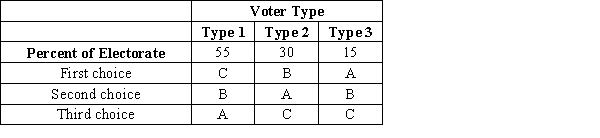 -Refer to Table 22-4. The table shows the preferences of three types of voters over three possible outcomes: A, B, and C. In addition, the table shows the percentage of voters of each type. Based on this information, which of the following statements is true?
 (Multiple Choice)
4.8/5 (66)
(66) Table 22-1
Three friends-Stephanie, Stella, and Lydia-are deciding where to go together for vacation. They all agree that they should go to one of the three places: Italy, Spain, or Hawaii. They also agree that they will have two pairwise votes to determine where to go on vacation, with the majority determining the outcome on each vote. The first, second, and third choices for each person are as indicated in the following table.
Stephanie Stella Lydia First choice Italy Spain Hawaii Second choice Spain Hawaii Italy Third choice Hawaii Italy Spain
-Refer to Table 22-1. If the friends change their minds and decide to choose a vacation destination using a Borda count, then
(Multiple Choice)
5.0/5 (73)
(73) Economists have found that asymmetric information is not very prevalent.
(True/False)
5.0/5 (84)
(84) Suppose a community is debating how much money to spend on improvements to the high school. The members of the community who have children advocate spending $20 million to make improvements. The remaining 60% of the community thinks the high school is just fine and does not want to spend anything. What will the outcome be?
(Essay)
4.9/5 (82)
(82) Studies show that during the March Madness college basketball tournament, the productivity of the average company in the United States falls considerably. This is an example of
(Multiple Choice)
5.0/5 (88)
(88) Table 22-8
The citizens of Mayville are having a severe budget shortage and are faced with eliminating athletics from the town high school. The town administrator has determined that the town can afford to maintain one sport. Exactly one of the three choices will prevail, and the choice will be made by way of pairwise voting, with the majority determining the outcome on each vote. The preferences of the voters are summarized in the table below.
 -Refer to Table 22-8. If the town decides to use a Borda count, which sport will win?
 (Short Answer)
4.8/5 (68)
(68) Smoking cessation tools (e.g., nicotine gum) provide evidence that people behave in a time inconsistent manner.
(True/False)
4.9/5 (77)
(77) Your friend tells you that her dad just suffered from a stroke because his blood pressure and cholesterol were too high. You know that your own father also has high blood pressure so you become worried that he will also have a stroke. This is an example of which systematic mistake that people make?
(Essay)
4.8/5 (84)
(84) The temptation of imperfectly monitored workers to shirk their responsibilities is an example of
(Multiple Choice)
4.9/5 (84)
(84) Researchers have found that the systematic mistakes that people make in their decision making include a lack of confidence in their own abilities.
(True/False)
4.8/5 (69)
(69) Table 22-7
The town of Franklin is facing a severe budget shortage. The town administrator has proposed four options to balance the budget: increase property taxes (taxes), cut the school arts budget (arts), turn off half of the streetlights in the town (streetlights), reduce police patrols (police). Exactly one of the four choices will prevail, and the choice will be made by way of pairwise voting, with the majority determining the outcome on each vote. The preferences of the voters are summarized in the table below.
Type A Type B Type C Type D \% of Electorate 14 40 28 18 First choice taxes streetlights arts police Second choice police arts taxes arts Third choice streetlights taxes police streetlights Fourth choice arts police streetlights taxes
-Refer to Table 22-7. If a Borda count is used, which option will win?
(Short Answer)
4.8/5 (99)
(99) 
Filters
- Essay(0)
- Multiple Choice(0)
- Short Answer(0)
- True False(0)
- Matching(0)