



 Chat with AI
Exam 22: Frontiers in Microeconomics

Exam 1: Ten Principles of Economics220 Questions
Exam 2: Thinking Like an Economist284 Questions
Exam 3: Interdependence and the Gains From Trade192 Questions
Exam 4: The Market Forces of Supply and Demand277 Questions
Exam 5: Elasticity and Its Application222 Questions
Exam 6: Supply, Demand, and Government Policies321 Questions
Exam 7: Consumers, Producers, and the Efficiency of Markets218 Questions
Exam 8: Applications: The Costs of Taxation203 Questions
Exam 9: Application: International Trade214 Questions
Exam 10: Externalities204 Questions
Exam 11: Public Goods and Common Resources182 Questions
Exam 12: The Design of the Tax System225 Questions
Exam 13: The Costs of Production261 Questions
Exam 14: Firms in Competitive Markets243 Questions
Exam 15: Monopoly231 Questions
Exam 16: Monopolistic Competition246 Questions
Exam 17: Oligopoly204 Questions
Exam 18: The Markets for the Factors of Production232 Questions
Exam 19: Earnings and Discrimination230 Questions
Exam 20: Income Inequality and Poverty194 Questions
Exam 21: The Theory of Consumer Choice209 Questions
Exam 22: Frontiers in Microeconomics185 Questions
Exam 23: Measuring a Nations Income231 Questions
Exam 24: Measuring the Cost of Living214 Questions
Exam 25: Production and Growth187 Questions
Exam 26: Saving, Investment, and the Financial System225 Questions
Exam 27: Tools of Finance198 Questions
Exam 28: Unemployment and Its Natural Rate361 Questions
Exam 29: The Monetary System210 Questions
Exam 30: Money Growth and Inflation201 Questions
Exam 31: Open-Economy Macroeconomics: Basic Concepts194 Questions
Exam 32: A Macroeconomic Theory of the Open Economy188 Questions
Exam 33: Aggregate Demand and Aggregate Supply189 Questions
Exam 34: The Influence of Monetary and Fiscal Policy on Aggregate Demand207 Questions
Exam 35: The Short-Run Tradeoff Between Inflation and Unemployment223 Questions
Exam 36: Six Debates Over Macroeconomic Policy154 Questions
Select questions type


Explain the Condorcet paradox. To which type of voting system does it apply?
(Essay)
4.9/5  (97)
(97) Employers who choose to pay their workers a wage that exceeds the equilibrium wage are acting in accordance with
(Multiple Choice)
4.9/5 (94)
(94) A "satisficer" is a person whose decision making is the same as that predicted by mainstream economic models.
(True/False)
4.8/5 (69)
(69) The problem that results from an agent, who is imperfectly monitored by the principal, engaging in dishonest or otherwise undesirable behavior is called
(Short Answer)
4.9/5 (94)
(94) The Condorcet paradox demonstrates that the order in which people vote on choices may influence the final outcome.
(True/False)
4.8/5 (76)
(76) If A is preferred to B and B is preferred to C, then we would expect A to be preferred to C. This property is called
(Short Answer)
4.9/5 (89)
(89) Scenario 22-3
Shana owns a boutique that sells high-end women's clothing and accessories. Katie works part-time at the boutique and frequently is the only employee in this small store. Shana pays Katie a wage that is higher than the market wage for this type of job. When the store is not full of customers, Katie diligently works on displays and cleans to keep the store looking its best. Belinda is a customer in the store who asks Katie's opinion on the quality of some jeans she is considering purchasing. Katie tells her the quality is great even though she's had several other customers return them due to flaws. Magda is another customer who is returning a necklace without volunteering that a gem is missing.
-Refer to Scenario 22-3. Suppose Shana is tired of all of the problems with the brand of jeans she carries and decides to carry a different, higher quality brand instead. She is concerned that her customers will not trust the quality of the new brand so she offers a 60 day money-back guarantee. The action taken by Shana is called
(Short Answer)
4.9/5 (73)
(73) Arrow's impossibility theorem illustrates the difficulties in creating the perfect voting system.
(True/False)
4.9/5 (81)
(81) If A is preferred to B and C is preferred to D, then B must be preferred to C to satisfy transitivity.
(True/False)
4.7/5 (79)
(79) A person's tendency to smoke a cigarette after promising himself that he will quit is an example of the behavioral economics insight that people are inconsistent over time
(True/False)
5.0/5 (79)
(79) Arrow's impossibility theorem shows that it is impossible to find a better voting system than pairwise majority voting.
(True/False)
4.7/5 (89)
(89) The mathematical result showing that, under certain assumptions, there is no scheme for aggregating individual preferences into a valid set of social preferences is called
(Short Answer)
4.7/5 (79)
(79) Table 22-3
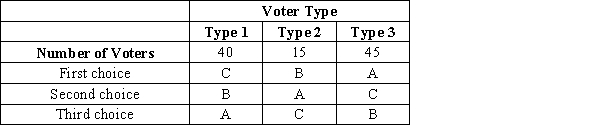 -Refer to Table 22-3. The table shows the preferences of 100 voters over three possible outcomes: A, B, and C. In pairwise majority voting in which voters choose first between A and B and then choose between the winner of the first vote and C,
 (Multiple Choice)
4.9/5 (91)
(91) The Condorcet paradox implies that the order in which items are voted on under majority rule is unimportant.
(True/False)
4.9/5 (75)
(75) Majority rule will produce the outcome most preferred by the median voter, as demonstrated by the
(Multiple Choice)
4.8/5 (78)
(78) Arrow's impossibility theorem demonstrates the impossibility of the median voter theorem.
(True/False)
4.7/5 (78)
(78) The Condorcet voting paradox demonstrates that democratic outcomes do not always obey the property of
(Multiple Choice)
4.8/5 (72)
(72) Assume there are nine voters in a certain small town and let x stand for the preferred number of dollars spent per person per month on garbage collection. For Voters 1, 2, and 3, x = $10; for Voter 4, x = $15; for Voter 5, x = $18; and for Voters 6, 7, 8 and 9, x = $20. Based on these preferences, which of these dollar amounts will win over any one of the others?
(Multiple Choice)
4.8/5 (76)
(76) An example of asymmetric information is when a seller of a house knows more than the buyer about the house's condition.
(True/False)
4.8/5 (75)
(75) Table 22-8
The citizens of Mayville are having a severe budget shortage and are faced with eliminating athletics from the town high school. The town administrator has determined that the town can afford to maintain one sport. Exactly one of the three choices will prevail, and the choice will be made by way of pairwise voting, with the majority determining the outcome on each vote. The preferences of the voters are summarized in the table below.
 -Refer to Table 22-8. Suppose the townspeople vote and choose hockey but the town administrator overrules the vote and chooses football because the town's football team has a chance of winning the state championship. Which of the properties of Arrow's impossibility theorem is violated?
 (Short Answer)
4.8/5 (74)
(74) 
Filters
- Essay(0)
- Multiple Choice(0)
- Short Answer(0)
- True False(0)
- Matching(0)