



 Chat with AI
Exam 22: Frontiers in Microeconomics

Exam 1: Ten Principles of Economics220 Questions
Exam 2: Thinking Like an Economist284 Questions
Exam 3: Interdependence and the Gains From Trade192 Questions
Exam 4: The Market Forces of Supply and Demand277 Questions
Exam 5: Elasticity and Its Application222 Questions
Exam 6: Supply, Demand, and Government Policies321 Questions
Exam 7: Consumers, Producers, and the Efficiency of Markets218 Questions
Exam 8: Applications: The Costs of Taxation203 Questions
Exam 9: Application: International Trade214 Questions
Exam 10: Externalities204 Questions
Exam 11: Public Goods and Common Resources182 Questions
Exam 12: The Design of the Tax System225 Questions
Exam 13: The Costs of Production261 Questions
Exam 14: Firms in Competitive Markets243 Questions
Exam 15: Monopoly231 Questions
Exam 16: Monopolistic Competition246 Questions
Exam 17: Oligopoly204 Questions
Exam 18: The Markets for the Factors of Production232 Questions
Exam 19: Earnings and Discrimination230 Questions
Exam 20: Income Inequality and Poverty194 Questions
Exam 21: The Theory of Consumer Choice209 Questions
Exam 22: Frontiers in Microeconomics185 Questions
Exam 23: Measuring a Nations Income231 Questions
Exam 24: Measuring the Cost of Living214 Questions
Exam 25: Production and Growth187 Questions
Exam 26: Saving, Investment, and the Financial System225 Questions
Exam 27: Tools of Finance198 Questions
Exam 28: Unemployment and Its Natural Rate361 Questions
Exam 29: The Monetary System210 Questions
Exam 30: Money Growth and Inflation201 Questions
Exam 31: Open-Economy Macroeconomics: Basic Concepts194 Questions
Exam 32: A Macroeconomic Theory of the Open Economy188 Questions
Exam 33: Aggregate Demand and Aggregate Supply189 Questions
Exam 34: The Influence of Monetary and Fiscal Policy on Aggregate Demand207 Questions
Exam 35: The Short-Run Tradeoff Between Inflation and Unemployment223 Questions
Exam 36: Six Debates Over Macroeconomic Policy154 Questions
Select questions type


Screening is an action taken by an uninformed party to induce an informed party to reveal information.
(True/False)
4.9/5  (74)
(74) Maria and Jose installed a "nanny-camera" in their home so that they can view how the nanny is interacting with their children while they are at work. What type of problem are they trying to combat?
(Short Answer)
4.9/5 (87)
(87) The tendency of many people to procrastinate supports the view that people are consistent over time.
(True/False)
4.8/5 (83)
(83) If the seller of a used car offers a limited warranty, the warranty is an example of
(Multiple Choice)
4.9/5 (76)
(76) Scenario 22-1
Shana owns a boutique that sells high-end women's clothing and accessories. Katie works part-time at the boutique and frequently is the only employee in this small store. Shana pays Katie a wage that is higher than the market wage for this type of job. When the store is not full of customers, Katie diligently works on displays and cleans to keep the store looking its best. Belinda is a customer in the store who asks Katie's opinion on the quality of some blouse she is considering purchasing. Even though she's had several other customers return this type of blouses due to flaws, Katie tells Belinda the quality is great. Magda is another customer who is returning a necklace without revealing that she lost a gem from it while wearing it.
-Refer to Scenario 22-1. Which of the ladies is causing a moral hazard problem?
(Multiple Choice)
4.9/5 (84)
(84) The two major problems caused by asymmetric information are the moral-hazard problem and the principal-agent problem.
(True/False)
4.8/5 (77)
(77) Table 22-2
Three longtime friends-Stephanie, Stella, and Lydia-are deciding how they will spend their Sunday afternoon. They all agree that they should do one of the three things: go to a play, play baseball, or go to a soccer game. They also agree that they will have two pairwise votes to determine how to spend their afternoon, with the majority determining the outcome on each vote. The first, second, and third choices for each person are as indicated in the following table.
Stephanie Stella Lydia First choice soccer game baseball play Second choice baseball play soccer game Third choice play soccer game baseball
-Refer to Table 22-2. Which of the following statements is correct regarding the Condorcet paradox and the results of pairwise voting by Stephanie, Stella, and Lydia?
(Multiple Choice)
4.8/5 (79)
(79) An implication of the median voter theorem is that Republicans and Democrats will try to align their views with those of the median voter.
(True/False)
4.7/5 (81)
(81) Mary decides to save $50 from each paycheck for a trip to Europe. But she spends her entire paycheck on new clothes. Which of the following systematic mistakes does this illustrate?
(Multiple Choice)
5.0/5 (84)
(84) The Condorcet voting paradox shows that outcomes based on dictatorial preferences do not always obey the property of transitivity.
(True/False)
4.7/5 (94)
(94) Table 22-3
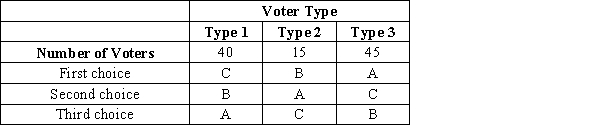 -Refer to Table 22-3. The table shows the preferences of 100 voters over three possible outcomes: A, B, and C. If a Borda count election were held among these voters, giving three points to each voter's first choice, two points to the second choice, and one point to the last choice, which outcome would win the election?
 (Multiple Choice)
4.8/5 (85)
(85) Employers can try to overcome the moral-hazard problem involving their employees by
(Multiple Choice)
4.9/5 (84)
(84) In corporations, which of the following are the principals in the principal-agent relationship?
(Multiple Choice)
4.9/5 (86)
(86) Which of the following is an example of satisficing behavior?
(Multiple Choice)
4.8/5 (70)
(70) Table 22-9
Sophie, Huan, and Santiago are lost with no map or GPS available. They come to an intersection at which they can turn left, turn right, or continue going straight. Their preferences are summarized in the table.
Sophie Huan Santiago First choice Left Right Straight Second choice Right Straight Left Third choice Straight Left Right
-Refer to Table 22-9. The travelers decide to conduct pairwise voting with the majority determining the outcome of each vote to decide their next move. If they first choose between going left and going straight, and then choose between the winner of the first vote and going right, which direction will they go?
(Short Answer)
5.0/5 (77)
(77) Explain how the presence of asymmetric information in car insurance markets may lead people who are good drivers or even average drivers to choose not to buy car insurance unless the law requires it.
(Essay)
4.9/5 (80)
(80) Ed promises his wife that he will mow the lawn on Saturday morning, but when Saturday morning arrives he changes his mind and says he will do it on Sunday. What insight about human behavior can be deduced from Ed's decision?
(Short Answer)
4.9/5 (78)
(78) Rather than always choosing the best course of action, humans make decisions that are merely good enough. In other words, they are
(Short Answer)
4.9/5 (75)
(75) Which of the following offers an explanation as to why the principal-agent problem exists for a firm?
(Multiple Choice)
4.8/5 (74)
(74) 
Filters
- Essay(0)
- Multiple Choice(0)
- Short Answer(0)
- True False(0)
- Matching(0)